
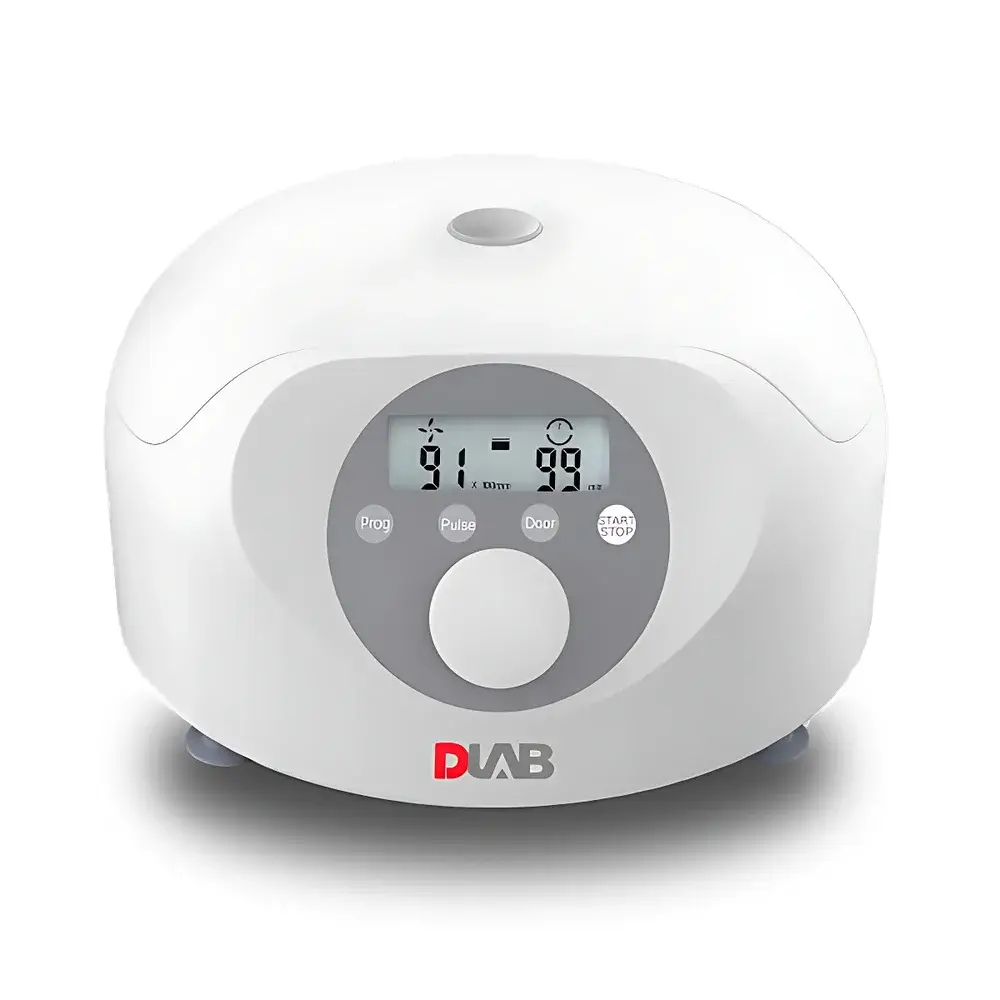
DLAB D2012S Microcentrifuge
| Brand | DLAB |
|---|---|
| Origin | Beijing, China |
| Manufacturer Type | Direct Manufacturer |
| Instrument Type | Benchtop Centrifuge |
| Speed Range | 300–15,000 rpm (100 rpm increments) |
| Max RCF | 15,100 × g |
| Rotor Type | Fixed-angle rotor |
| Capacity | 12 × 0.2 / 0.5 / 1.5 / 2.0 mL tubes |
| Timer Range | 30 s – 99 min or continuous mode |
| Acceleration Time | 11 s (0 → max speed) |
| Deceleration Time | 15 s (max → stop) |
| Speed Accuracy | ±20 rpm |
| Display | LCD |
| Noise Level | ≤55 dB(A) |
| Motor | Brushless DC motor |
| Power Supply | 100–240 V AC, 50/60 Hz |
| Dimensions (L×W×H) | 272 × 260 × 154 mm |
| Weight | 6.2 kg |
| Safety Features | Lid interlock, overspeed protection, overtemperature monitoring, real-time status diagnostics |
| Functions | RCF/rpm conversion, “pulse” (short-run) mode, audible operation feedback |
Overview
The DLAB D2012S Microcentrifuge is a compact, high-performance benchtop centrifuge engineered for precision and reliability in molecular biology and clinical laboratory workflows. Utilizing brushless DC motor technology, it delivers rapid acceleration (0–15,000 rpm in 11 seconds), stable rotational dynamics, and consistent torque output across variable input voltages (100–240 V AC). Its fixed-angle rotor design enables efficient sedimentation of nucleic acids, proteins, cellular debris, and other macromolecular components under controlled g-force conditions—up to 15,100 × g. The instrument operates with low acoustic emission (≤55 dB[A]), minimizing ambient disturbance in shared lab environments, and integrates real-time electronic diagnostics to monitor operational integrity during runs.
Key Features
- Brushless DC motor: Ensures extended service life, minimal maintenance, and precise speed control without carbon brush wear or commutation noise.
- Wide voltage compatibility: Maintains accurate rotational speed regardless of line voltage fluctuations—critical for labs operating in regions with unstable power infrastructure.
- Pulse centrifugation mode: Enables rapid, single-action separation for quick pellet formation without timer setup—ideal for brief wash steps or interim sample conditioning.
- Lid interlock and overspeed protection: Complies with IEC 61010-1 safety standards; automatically halts operation if lid is opened mid-run or if rotational speed exceeds programmed limits.
- Intelligent diagnostics: Continuously monitors motor temperature, rotor imbalance, and drive performance—displaying fault codes on the LCD interface for traceable troubleshooting.
- RCF/rpm dual-display conversion: Facilitates method transfer between instruments and simplifies protocol documentation by allowing direct switching between relative centrifugal force and rotational speed units.
Sample Compatibility & Compliance
The D2012S accommodates standard microcentrifuge tubes (0.2 mL, 0.5 mL, 1.5 mL, and 2.0 mL) in a 12-position fixed-angle rotor. Tube compatibility extends to most commercially available polypropylene and PCR-grade tubes rated for ≥15,000 rpm. The system supports routine applications aligned with ISO 15189 and CLIA requirements for pre-analytical sample processing—including DNA/RNA extraction, plasmid purification, enzymatic reaction termination, and small-volume cell pelleting. While the unit itself does not generate refrigeration, its thermal management system prevents excessive rotor heating during repeated short-duration runs, preserving sample integrity in ambient-temperature workflows.
Software & Data Management
The D2012S operates via an embedded microcontroller with non-volatile memory for storing up to 10 user-defined protocols. All run parameters—including speed, time, acceleration/deceleration profiles, and pulse duration—are retained after power cycling. Though the device lacks network connectivity or PC-based software, its LCD interface provides timestamped run history (last 20 cycles), including actual RCF achieved, elapsed time, and any triggered safety events. This audit-ready log structure supports GLP-compliant documentation practices when paired with manual lab notebook entries or LIMS-integrated workflow logs.
Applications
- Nucleic acid isolation (e.g., spin-column–based DNA/RNA purification)
- Plasmid miniprep and maxiprep workflows
- PCR product cleanup and enzyme removal
- Microbial cell pelleting (e.g., E. coli, yeast) prior to lysis
- Protein precipitation and desalting steps in small-scale assays
- Centrifugal filtration support for membrane-based concentration devices
- Routine microvolume sample clarification in histology and immunoassay prep
FAQ
Does the D2012S support refrigerated operation?
No—the D2012S is a non-refrigerated microcentrifuge optimized for ambient-temperature applications. For temperature-sensitive samples requiring thermal control, users should pre-chill tubes and maintain samples on ice before and after centrifugation.
Is rotor balancing required before each run?
Yes. Although the rotor is factory-balanced, proper tube loading symmetry (e.g., opposing positions filled with equal volumes) is essential to prevent vibration, premature bearing wear, and automatic shutdown due to imbalance detection.
Can the D2012S be used with 0.2 mL PCR strips?
Yes—when using compatible PCR strip carriers or adapters designed for 0.2 mL tube geometry, the rotor accepts standard 8-well strips. Verify mechanical fit and balance distribution prior to operation.
What safety certifications does the D2012S meet?
The instrument conforms to IEC 61010-1:2010 for electrical safety in laboratory equipment and includes CE marking for the European Economic Area. It also complies with RoHS 2011/65/EU restrictions on hazardous substances.
How is calibration verified for speed accuracy?
DLAB recommends annual verification using a certified handheld tachometer. The specified speed tolerance of ±20 rpm applies at all setpoints within the 300–15,000 rpm range and is validated during factory calibration per ISO/IEC 17025–accredited procedures.



