
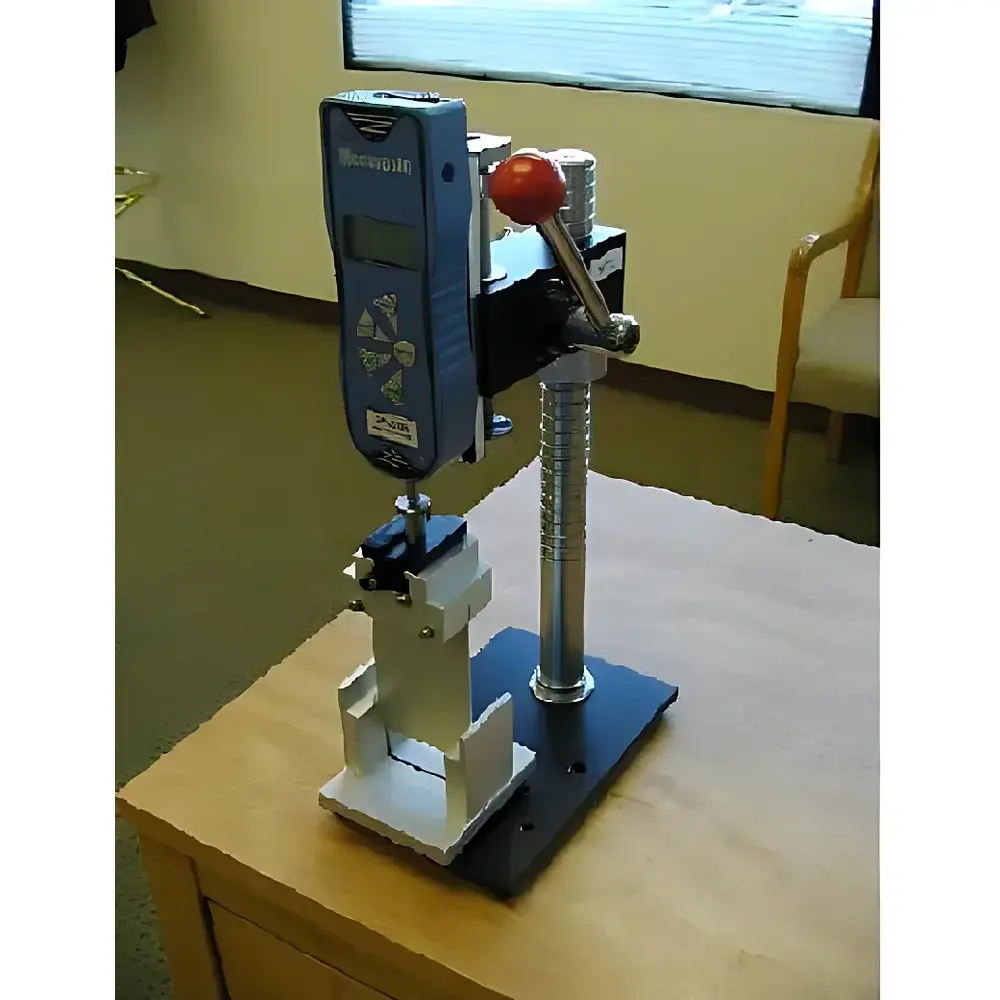
FTC TMS-BFG Manual Texture Analyzer
| Brand | FTC |
|---|---|
| Origin | USA |
| Model | TMS-BFG |
| Power Source | Manual (hand-cranked) |
| Construction | Full stainless-steel frame with corrosion-resistant and wear-resistant finish |
| Display | Backlit LCD showing real-time force values |
| Force Units | N, lbf, kgf |
| Operating Modes | Compression and Tension |
| Data Interface | RS232 serial port |
| Data Storage | Onboard memory with export capability |
| Software | Included proprietary texture analysis software (Windows-compatible) |
| Overload Protection | Audible and visual alert at ≥110% of full-scale capacity |
| Portability | Integrated carry handle |
| Compliance | Designed to support ASTM F2574 (Standard Test Method for Measuring Tenderness of Peas), ISO 11350 (Food — Determination of textural properties — General principles), and USDA/FSIS meat tenderness validation protocols |
Overview
The FTC TMS-BFG Manual Texture Analyzer is a precision-engineered, hand-operated mechanical instrument designed for standardized texture profiling of food materials in laboratory, quality control, and R&D environments. Rooted in over five decades of FTC’s legacy in physical property measurement—dating back to the pioneering TU and TM series used as industrial benchmarks for pea tenderness evaluation in the 1960s and 1970s—the TMS-BFG retains core metrological rigor while integrating modern usability features. It operates on a proven mechanical lever-arm principle: manual rotation of the crank drives a calibrated lead screw, translating human input into controlled, linear displacement of the probe or fixture. Force is measured via high-stability load cell technology, with analog-to-digital conversion enabling accurate real-time quantification of resistance during compression (e.g., fruit firmness, cookie fracture) or tension (e.g., meat strip tensile strength, noodle pull resistance). Unlike motorized systems, its manual actuation eliminates variability from motor speed inconsistencies and provides direct operator control over strain rate—a critical parameter in texture method standardization per ASTM F2574 and ISO 11350.
Key Features
- Manual operation ensures precise, repeatable strain-rate control without motor-induced inertia or acceleration artifacts—essential for comparative tenderness studies across batches or cultivars.
- Full stainless-steel structural frame engineered for long-term dimensional stability, corrosion resistance in humid or saline test environments (e.g., brined meats, pickled vegetables), and abrasion resistance during repeated fixture changes.
- Backlit LCD display delivers immediate readout of peak force, deformation distance, and slope-derived parameters (e.g., toughness index) in user-selectable units: newtons (N), pound-force (lbf), or kilogram-force (kgf).
- Dual-mode mechanical architecture supports both compression (e.g., puncture, extrusion, hardness) and tension (e.g., tensile strength, adhesion, chewiness) testing using interchangeable fixtures—including Warner-Bratzler blade, spherical probe, Kramer shear cell, and tensile grips.
- Onboard data logging stores up to 1,000 test records with timestamp, mode, unit, and peak value; exported via RS232 to Windows-based FTC TexturePro CT software for curve visualization, statistical analysis (mean, SD, CV%), and report generation compliant with GLP documentation requirements.
- Integrated overload protection triggers audible beep and display warning when applied force exceeds 110% of selected range—preventing sensor drift and preserving calibration integrity over extended service life.
Sample Compatibility & Compliance
The TMS-BFG accommodates a broad spectrum of food matrices without thermal or electrical interference: raw and cooked muscle foods (beef, poultry, fish fillets), horticultural produce (tomatoes, apples, carrots), cereal-based products (noodles, rice cakes, tortillas), confectionery (gummies, caramels), and legumes (fresh/frozen peas, cooked lentils). Its mechanical design avoids electromagnetic noise that could affect sensitive electronic sensors—making it suitable for use near ovens, refrigerated chambers, or wet processing lines. The system aligns with methodological frameworks referenced in USDA Agricultural Handbook No. 8, AOAC Official Method 985.21 (cereal hardness), and FDA Food Code Annex 3 guidelines for objective texture verification in HACCP plans. All firmware and software comply with 21 CFR Part 11 requirements for electronic records and signatures when configured with audit-trail-enabled TexturePro CT.
Software & Data Management
TexturePro CT software (v4.2+) provides validated, traceable data handling: automatic calibration certificate import, configurable pass/fail thresholds per test protocol, batch-level summary statistics, and PDF report generation with embedded force–distance curves. Raw data exports to CSV or Excel preserve full resolution for secondary analysis in MATLAB or JMP. Audit trails record user ID, timestamp, parameter changes, and data export events—supporting FDA, EFSA, and BRCGS audit readiness. Software updates are delivered via secure FTP with version-controlled release notes and IQ/OQ documentation packages available upon request.
Applications
- Quantifying pea tenderness per ASTM F2574 using the standard 3.2-mm diameter probe at 2 mm/s equivalent manual speed.
- Evaluating shear force of cooked meat strips (Warner-Bratzler configuration) for grading consistency in abattoir QC labs.
- Measuring dough extensibility and resistance-to-extension in flour quality assessment per AACC Method 54-10.
- Assessing crispness loss kinetics in fried snacks during accelerated shelf-life studies.
- Validating texture modifications in plant-based meat analogues under varying hydration and thermal processing conditions.
FAQ
Is the TMS-BFG suitable for regulated GMP/GLP environments?
Yes—when used with TexturePro CT software configured for audit trail and electronic signature, it meets 21 CFR Part 11 and ISO/IEC 17025 documentation requirements.
Can test methods be customized for non-standard samples?
Absolutely—the mechanical platform accepts user-defined fixtures and the software allows custom test sequences, trigger thresholds, and calculation formulas.
What maintenance is required to ensure long-term accuracy?
Annual recalibration by an ISO/IEC 17025-accredited lab is recommended; routine verification using NIST-traceable deadweight standards is performed daily or per shift.
Does the system support multi-language UI?
TexturePro CT supports English, Spanish, French, German, and Simplified Chinese interfaces—configured at installation.
How is strain rate controlled manually?
Operators maintain consistent crank rotation speed using the integrated tachometer guide; method SOPs specify revolutions-per-minute (RPM) targets correlated to mm/s displacement via gear ratio documentation.




