
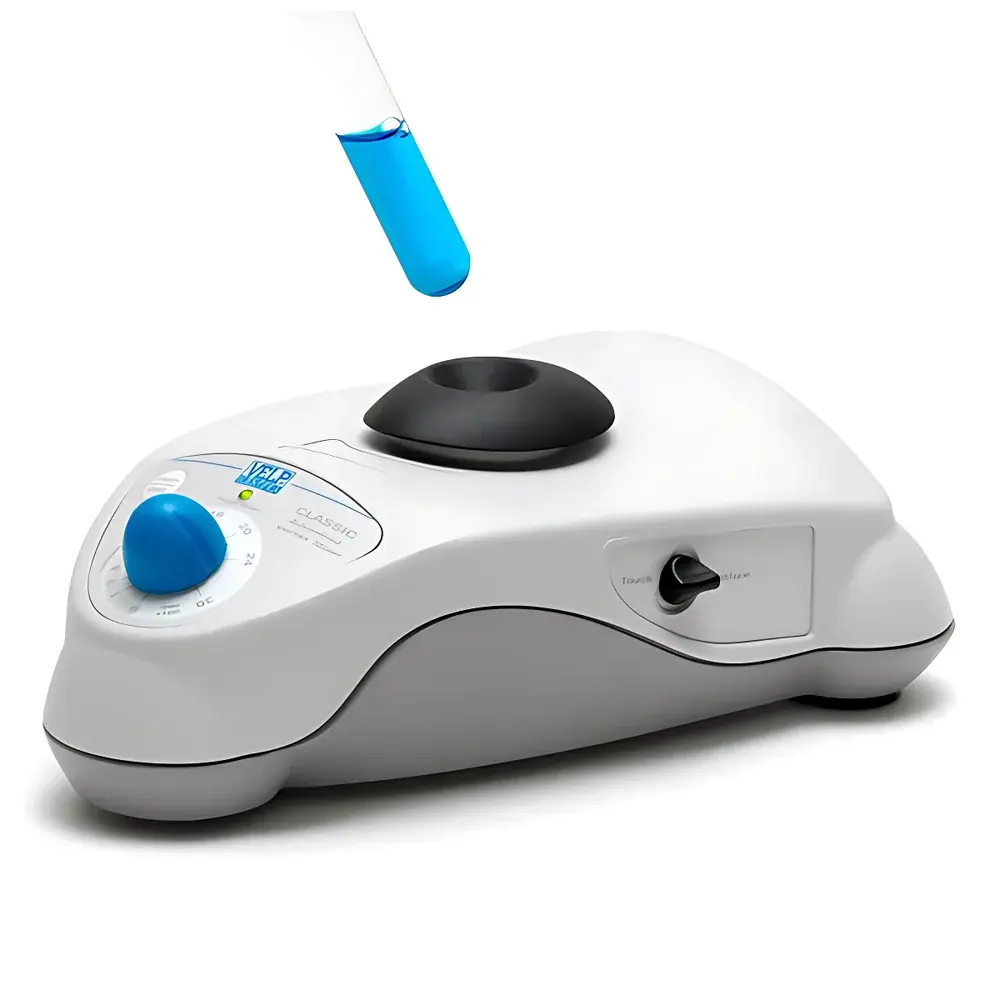
VELP CLASSIC Vortex Mixer
| Brand | VELP |
|---|---|
| Origin | Italy |
| Manufacturer Type | Authorized Distributor |
| Origin Category | Imported |
| Model | CLASSIC |
| Price | Upon Request |
| Speed Range | 0–3000 rpm |
| Operation Modes | Continuous & Touch-Activated |
| Motion Type | Circular Orbital |
| Body Material | Zinc Alloy with High-Performance Polymer Housing |
| Amplitude | 4.5 mm |
| Speed Indication | Analog Dial |
| IP Rating | IP42 |
| Foot Design | Three Non-Slip Rubber Feet |
| Voltage/Frequency | Universal Input (100–240 V, 50/60 Hz) |
| Adapter Compatibility | Wide Range for Tubes (0.2–50 mL), Microplates (96-/384-well), and Beakers |
Overview
The VELP CLASSIC Vortex Mixer is an engineered solution for rapid, reproducible sample homogenization in life science, clinical diagnostics, pharmaceutical quality control, and academic research laboratories. Operating on the principle of orbital shaking—where a motor-driven platform induces circular motion at a fixed amplitude—the instrument achieves efficient mixing through controlled kinetic energy transfer to liquid samples contained in vessels placed directly on the cup or adapter. Its core design prioritizes mechanical stability, chemical resistance, and operational flexibility across diverse vessel formats. The device delivers consistent orbital displacement (4.5 mm amplitude) over its full speed range (0–3000 rpm), enabling both gentle resuspension of pellets and vigorous emulsification of viscous or heterogeneous suspensions. Unlike centrifugal or magnetic stirrers, vortex mixers generate shear forces localized near the vessel walls, making them especially effective for small-volume mixing where convection-based methods are inefficient.
Key Features
- Robust mechanical architecture built around a precision-machined zinc alloy base, providing high mass inertia and minimizing vibration transmission during operation.
- High-stability platform with three integrated non-slip rubber feet ensures secure placement on benchtops—even under continuous high-speed operation or in shared lab environments subject to incidental contact.
- Analog speed dial offers intuitive, tactile control without digital latency; calibrated linear response enables repeatable setting recall across users and shifts.
- Touch-activated mode allows momentary mixing via light pressure—ideal for intermittent agitation during enzymatic reactions, staining protocols, or serial dilutions—while continuous mode supports unattended incubation-integrated workflows.
- IP42-rated enclosure protects internal electronics from accidental splashes and ambient dust ingress, supporting compliance with basic laboratory environmental safety requirements.
- Chemically resistant polymer housing withstands routine exposure to alcohols, dilute acids/bases, and common organic solvents encountered in sample prep workflows.
Sample Compatibility & Compliance
The CLASSIC Vortex Mixer accommodates a broad spectrum of standard labware through interchangeable adapters—including conical tubes (0.2 mL PCR strips to 50 mL centrifuge tubes), 96-well and 384-well microplates, and cylindrical glass or polypropylene beakers up to 100 mL. Adapter mounting requires no tools: simple press-fit engagement ensures rapid reconfiguration between assay types. All adapters are manufactured to dimensional tolerances compliant with ANSI/SLAS standards for microplate handling. While the mixer itself does not carry CE marking for IVD use, its construction adheres to EN 61010-1:2010 safety requirements for electrical equipment used in laboratory settings. It is routinely deployed in GLP-aligned environments where traceable, documented mixing parameters support audit readiness—particularly when paired with procedural SOPs defining speed/duration per application.
Software & Data Management
As a standalone analog instrument, the CLASSIC Vortex Mixer does not incorporate embedded firmware, network connectivity, or data logging capabilities. This design choice enhances long-term reliability, eliminates calibration drift associated with digital sensors, and avoids cybersecurity concerns inherent in connected lab devices. For laboratories requiring electronic recordkeeping, integration is achieved externally: mixing duration can be tracked via external timers synchronized to touch-activation events, and speed settings are manually logged in electronic lab notebooks (ELNs) alongside protocol steps. The absence of software dependencies ensures uninterrupted operation during power fluctuations or IT infrastructure maintenance—critical in core facilities supporting high-throughput workflows.
Applications
- Resuspension of lyophilized reagents, cell pellets, and precipitated nucleic acids prior to downstream analysis.
- Homogenization of immunoassay reagents, ELISA coating solutions, and antibody conjugates to prevent aggregation.
- Preparation of calibration standards and QC samples in clinical chemistry and toxicology labs.
- Emulsification of lipid nanoparticles (LNPs) and polymer-based drug delivery systems during formulation screening.
- Mixing of viscous buffers containing glycerol, sucrose, or Ficoll for density gradient applications.
- Routine agitation of bacterial cultures in screening plates during growth-phase monitoring.
FAQ
What is the maximum recommended load capacity for the platform?
The platform is rated for stable operation with single-vessel loads up to 500 g or multi-vessel configurations totaling ≤1.2 kg—provided weight distribution remains centered and adapters are correctly seated.
Can the CLASSIC be used with sealed tubes containing volatile solvents?
Yes—however, ensure tube caps are fully tightened and verify compatibility of cap materials (e.g., PTFE-lined closures) with solvent exposure prior to vortexing.
Is speed calibration traceable to national standards?
VELP provides factory calibration documentation upon request; end-user verification may be performed using a certified handheld tachometer aligned to ISO 16063-21 for rotational speed measurement.
Does the analog dial require periodic recalibration?
No—mechanical potentiometer-based speed control exhibits negligible drift over time; routine functional verification at 0, 1500, and 3000 rpm is sufficient for QA/QC compliance.
Are replacement adapters available for non-standard vessel geometries?
VELP offers custom adapter design services for OEM integration; standard catalog includes options for cryovials, PCR plates with skirted wells, and low-profile microcentrifuge tubes.



