
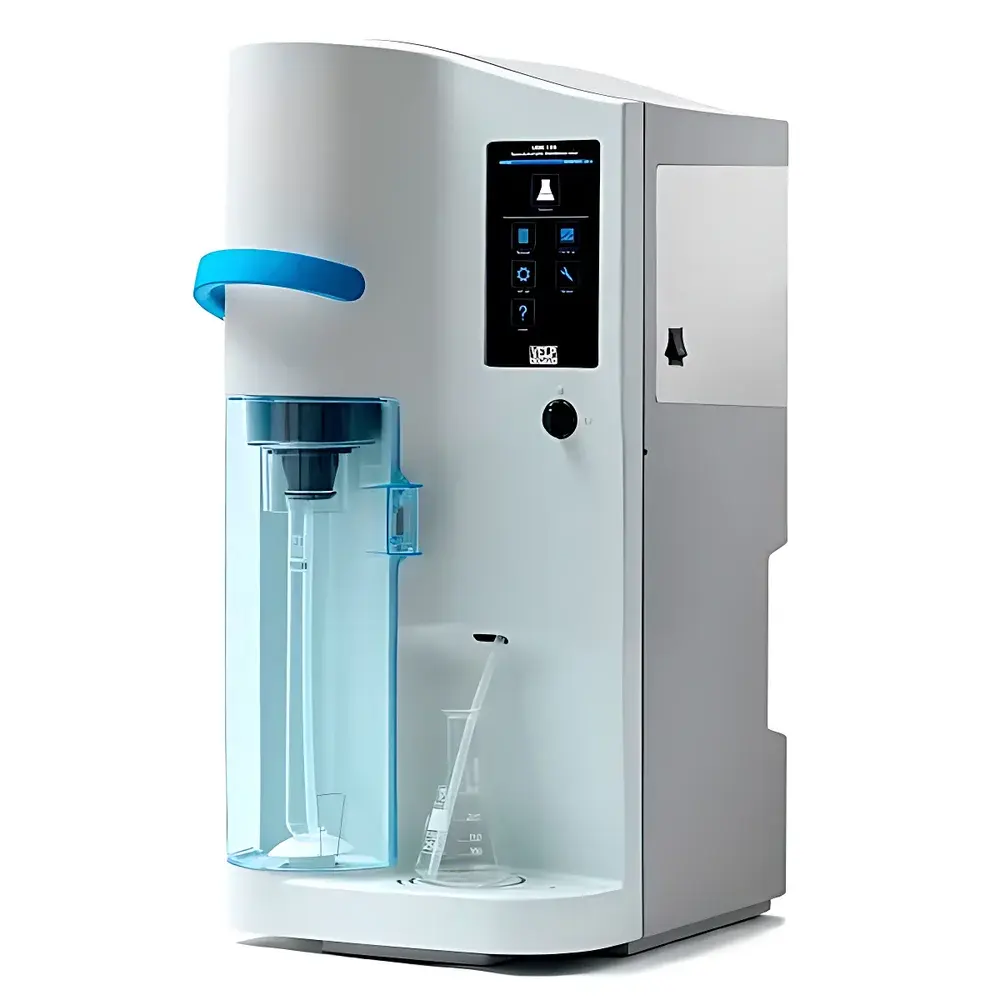
VELP UDK139 Automated Kjeldahl Nitrogen Determinator
| Brand | VELP |
|---|---|
| Origin | Italy |
| Model | UDK139 |
| Instrument Type | Automated Kjeldahl Nitrogen Determinator |
| Nitrogen Determination Range | 0.1–200 mg N |
| Sample Weight Capacity | ≤5 g |
| Distillation Time | 1–99 min (typical 3.5 min per sample) |
| Repeatability | ≤1% RSD |
| Nitrogen Recovery Rate | ≥99.5% |
| Power Consumption | 2100 W |
| Dimensions (L×W×H) | 780 mm × 385 mm × 416 mm |
| Safety Features | Steam Generator Overtemperature Protection, Cooling Water Flow Monitoring, Digestion Tube Position Sensor, Safety Door Interlock |
| Interface Ports | RS232, 2×USB, TTL, Ethernet |
| Programmable Methods | Up to 20 user-defined distillation protocols |
| Automatic Functions | Alkali dosing, steam generation, dilution, waste ejection (digestion tube & titration cup), cup rinsing, endpoint detection |
| Display | 3.5-inch capacitive touchscreen with multilingual UI (including English and Chinese) |
Overview
The VELP UDK139 Automated Kjeldahl Nitrogen Determinator is a fully integrated, benchtop system engineered for precise, reproducible, and compliant total nitrogen quantification in accordance with standardized wet-chemistry methodology. Based on the classical Kjeldahl principle—comprising digestion, distillation, and titration—the UDK139 automates the critical distillation and post-distillation handling stages following sample mineralization. It operates by converting ammonium ions (NH₄⁺), liberated during acid digestion of organic material, into ammonia gas under alkaline conditions; the ammonia is then carried by controlled steam into a boric acid receiving solution, where it is quantified via acid–base titration. Designed as the successor to the UDK132, the UDK139 incorporates VELP’s proprietary Thermal Efficiency Management System (TEMS), which optimizes thermal energy distribution across the steam generator and condenser assembly—reducing power demand without compromising distillation kinetics or analytical robustness.
Key Features
- Integrated steam generator with real-time pressure and temperature regulation ensures consistent vapor delivery across all sample types and matrix complexities.
- Titanium-coated high-efficiency condenser minimizes cooling water consumption by up to 40% versus conventional copper-based systems, supporting ISO 14001-aligned lab sustainability goals.
- 3.5-inch capacitive touchscreen interface supports both touch and remote operation (via optional IR remote); firmware includes native English and Chinese language options for global deployment.
- Automated reagent handling: programmable alkali dosing (NaOH/KOH), post-distillation dilution, and sequential waste evacuation from both digestion tubes and titration cups—eliminating manual transfer steps.
- Comprehensive safety architecture: interlocked safety door, digestion tube presence verification, steam generator overtemperature cutoff, and continuous cooling water flow monitoring with audible/visual alarm escalation.
- Onboard method storage for up to 20 customizable distillation protocols—including variable alkali volume, steam ramp rate, condensation delay, and titration endpoint criteria—enabling full traceability per ASTM D1142 and ISO 8968-1.
Sample Compatibility & Compliance
The UDK139 accommodates solid, liquid, and semi-solid samples up to 5 g mass, including foodstuffs (dairy, cereals, meat), agricultural feed, environmental sludges, and pharmaceutical excipients. Its validated recovery rate of ≥99.5% and repeatability of ≤1% RSD meet the performance thresholds required by AOAC Official Method 981.10, ISO 5983-1:2009, and USP <467> residual solvent testing workflows where nitrogen content correlates with protein load. The system’s hardware and firmware support GLP/GMP documentation requirements: audit trails for method edits, user logins, calibration events, and result exports are retained locally and exportable via USB or network. Optional integration with LIMS via RS232 or Ethernet enables automated data handoff compliant with FDA 21 CFR Part 11 when paired with validated electronic signature modules.
Software & Data Management
Embedded firmware provides full control over distillation parameters—including steam initiation delay, alkali injection timing, condensate collection duration, and automatic titration start trigger—and allows configuration of report templates with customizable fields (sample ID, operator, date/time stamp, method name, raw titrant volume, %N, %protein). Data export formats include CSV and PDF; reports may be printed directly via USB-connected thermal printers or transmitted to networked PCs. Firmware updates are performed via USB stick with SHA-256 integrity verification. All operational logs—including error codes, safety event timestamps, and reagent usage counters—are time-stamped and stored for ≥12 months onboard.
Applications
- Protein quantification in dairy products (e.g., milk powder, whey, casein) per ISO 8968-1 and IDF 20B:2013.
- Nitrogen balance studies in animal nutrition research, adhering to AOAC 984.13 and AACC 46-13A.
- Quality control of fertilizers and soil amendments under ISO 13878:2018.
- Regulatory compliance testing for nitrogen content in dietary supplements and botanical extracts per USP <281>.
- Environmental analysis of wastewater sludge and compost leachates per EPA Method 350.1.
FAQ
What digestion systems is the UDK139 compatible with?
It interfaces seamlessly with VELP’s DK series digesters (e.g., DK20, DK6) and third-party digestion blocks meeting ISO 5983-2 mechanical and dimensional specifications for tube alignment and exhaust coupling.
Does the UDK139 support automated titration?
No—the UDK139 performs automated distillation and sample conditioning only. Titration must be conducted externally using a compatible autotitrator (e.g., Metrohm 809, Hanna HI84532) or manually with standardized HCl/BTB reagents.
Can distillation methods be password-protected?
Yes—administrator-level access controls restrict editing of stored methods, calibration settings, and system configurations; user roles (operator, supervisor, administrator) are enforced at firmware level.
Is cooling water temperature monitored in real time?
The system verifies coolant flow continuity and minimum flow rate but does not measure inlet water temperature; ambient cooling water supply must be maintained between 10–25°C per installation guidelines.
What is the expected service interval for the titanium condenser?
Under normal use (≤200 samples/week) and adherence to weekly descaling protocol with 5% citric acid, the condenser requires no replacement for ≥5 years; VELP provides lifetime corrosion warranty on titanium components.




