
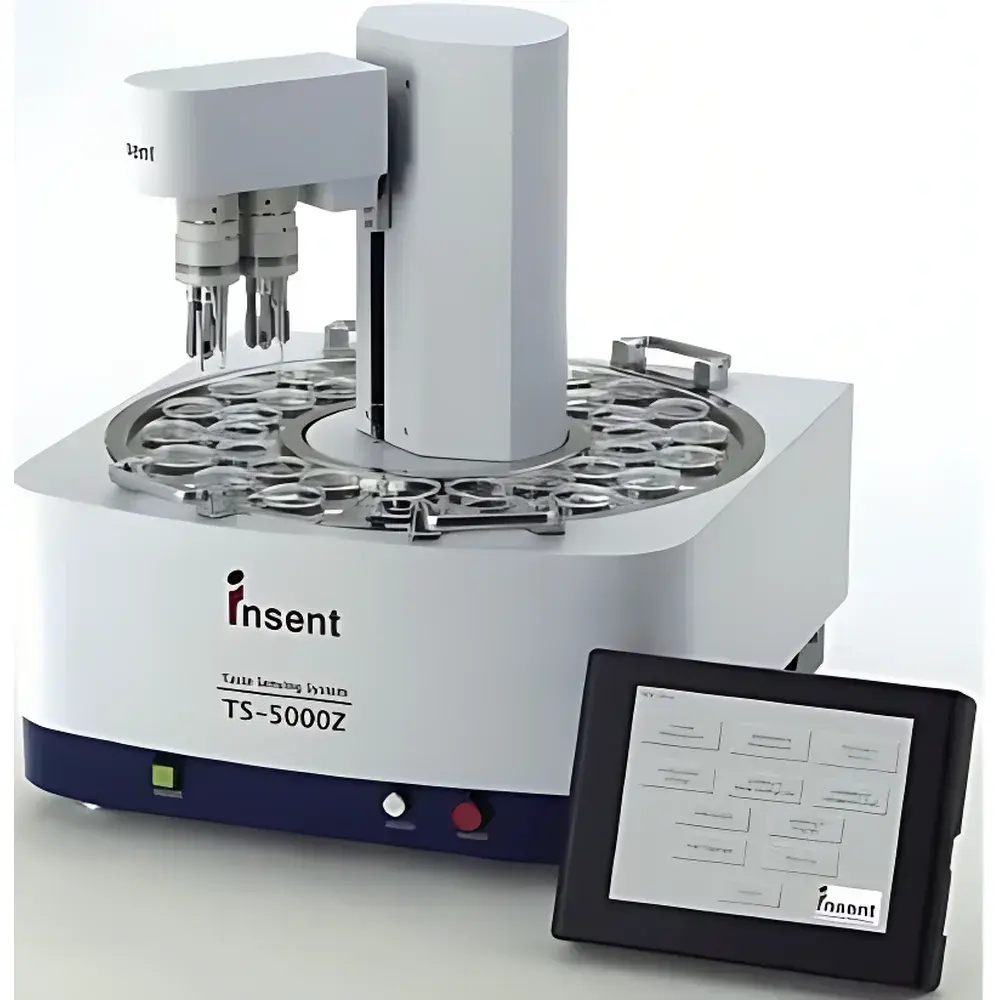
Insent TS-5000Z Electronic Tongue System
| Brand | Insent |
|---|---|
| Origin | Japan |
| Model | TS-5000Z |
| Type | Taste Sensing System |
| Sensor Principle | Artificial Lipid Membrane Array |
| Output Metrics | Relative Taste Intensity (Bitterness, Sourness, Saltiness, Sweetness, Umami, Astringency), Aftertaste Duration (Bitter/Umami/Astringent), Richness Index |
| Data Output | Multidimensional Taste Profile Vectors, PCA Loadings, Radar Charts, 3D Spherical Plots, Contour Maps, Time-Resolved Taste Kinetics |
| Compliance | Designed for GLP-compliant sensory QA/QC workflows |
| Software | TS-5000Z Analysis Suite v4.2 with Audit Trail & User Access Control (21 CFR Part 11 Ready) |
Overview
The Insent TS-5000Z Electronic Tongue System is a validated, membrane-based taste sensing platform engineered for objective, quantitative characterization of gustatory properties in liquid and semi-solid samples. Unlike conventional chemical assays that target individual compounds, the TS-5000Z operates on the principle of cross-reactive lipid-polymer membrane sensors—each sensor exhibits differential, reversible potential shifts in response to multiple taste substances via ion–lipid interactions. These responses are captured as multivariate electrochemical signals (mV vs. Ag/AgCl reference), then transformed into standardized taste intensity vectors using proprietary calibration algorithms anchored to human sensory panel data. The system delivers reproducible, instrument-independent taste profiles aligned with ISO 11133 and ASTM E2807-22 guidelines for instrumental sensory evaluation. It is not a predictive model or AI classifier; rather, it functions as a physicochemical transduction interface between sample chemistry and perceptual taste space—making it suitable for routine QC, formulation benchmarking, stability monitoring, and regulatory documentation where human panel variability must be minimized.
Key Features
- Eight-channel artificial lipid membrane sensor array with independent temperature-controlled measurement cells (±0.1 °C stability)
- Real-time kinetic acquisition mode for aftertaste profiling (up to 300 s post-immersion), enabling quantification of bitterness persistence, umami richness decay, and astringency build-up
- Integrated sample auto-dilution module supporting 1:2 to 1:100 serial dilutions without manual intervention
- Touchscreen-guided workflow with context-sensitive prompts and step-by-step validation checks at rinse, calibration, and measurement stages
- Electromagnetic noise suppression architecture compliant with IEC 61326-1:2013 for stable operation in shared laboratory environments
- Onboard macro scripting engine (TCL-based) allowing automation of multi-step protocols—including cleaning cycles, standard series runs, and comparative batch analysis
- Preloaded reference libraries for green tea aging, instant soup differentiation, pharmaceutical bitter masking efficacy, and bread matrix classification
Sample Compatibility & Compliance
The TS-5000Z accepts aqueous extracts, beverages, oral suspensions, homogenized food slurries (≤500 µm particle size), and pharmaceutical solutions without filtration when turbidity remains below 20 NTU. Solid samples require standardized extraction per AOAC 994.02 or USP method transfer protocols. All sensor surfaces are chemically resistant to ethanol, citric acid (pH 2.0–7.0), and sodium chloride (up to 1.5 mol/L). The system supports full traceability under Good Laboratory Practice (GLP) and current Good Manufacturing Practice (cGMP) frameworks: electronic signatures, operator-level permission tiers, immutable audit logs, and 21 CFR Part 11–ready data export (CSV, PDF, XML) with SHA-256 hash verification. Calibration verification is performed daily using certified reference standards traceable to NIST SRM 1846 (bitterness), SRM 1847 (umami), and SRM 1848 (sourness).
Software & Data Management
The TS-5000Z Analysis Suite provides dual-mode operation: guided wizard mode for routine testing and expert mode for advanced multivariate modeling. Core analytical outputs include principal component analysis (PCA) score plots, hierarchical cluster dendrograms, radar charts normalized to reference standards, spherical projection maps for multidimensional similarity assessment, and contour heatmaps visualizing time-resolved taste evolution. All datasets are stored in an encrypted SQLite database with automatic versioning and rollback capability. Remote access is supported via HTTPS-secured web interface (optional Data Management Server add-on), enabling cross-site collaboration while maintaining local data sovereignty. Raw signal files (.tsd) retain full temporal resolution (10 Hz sampling) and are exportable for third-party statistical validation (e.g., R, Python scikit-learn, SIMCA-P).
Applications
- Quantitative bitterness duration profiling of API formulations to support QbD-driven excipient selection
- Detection of oxidative degradation markers in green tea infusions via sourness–astringency ratio drift over accelerated shelf-life studies
- Differentiation of wheat cultivars in baked goods through umami–saltiness interaction patterns in crumb extracts
- Verification of counterfeit herbal preparations by comparing taste fingerprint divergence against authenticated reference materials
- Consumer complaint triage: correlating off-taste reports (e.g., metallic aftertaste) with specific sensor channel anomalies across production batches
- Supporting FDA IND submissions with instrumentally derived taste equivalence data for generic drug product development
FAQ
How does the TS-5000Z correlate with human sensory panel data?
Correlation is established through concurrent testing of ≥30 reference samples spanning the full taste intensity range, followed by partial least squares regression (PLSR) mapping of sensor output vectors to median panel scores (n≥12 assessors, ISO 8586). Typical R² values exceed 0.92 for primary tastes and 0.85 for aftertaste metrics.
Can the system analyze viscous or particulate samples?
Yes—samples up to 10,000 cP may be measured after dilution or centrifugation; particulates >500 µm must be removed to prevent sensor fouling. Optional ultrasonic dispersion module available for uniform suspension preparation.
Is sensor replacement required after each sample?
No. Sensors are reusable for ≥500 measurements per set when maintained per Insent’s Cleaning Protocol C-7 (ethanol/water rinse + KCl regeneration). Lifespan is verified via daily sensitivity check using standard solution Z-1.
Does the software support automated report generation for regulatory submissions?
Yes. Template-driven PDF reports include raw signal traces, PCA biplots, statistical summaries, instrument calibration history, and digital signature fields—all compliant with ALCOA+ data integrity principles.
What training and documentation are provided?
Includes on-site installation qualification (IQ), operational qualification (OQ), user manual (EN/JP/CN), SOP templates for GxP environments, and annual proficiency testing kits with certified reference materials.






