
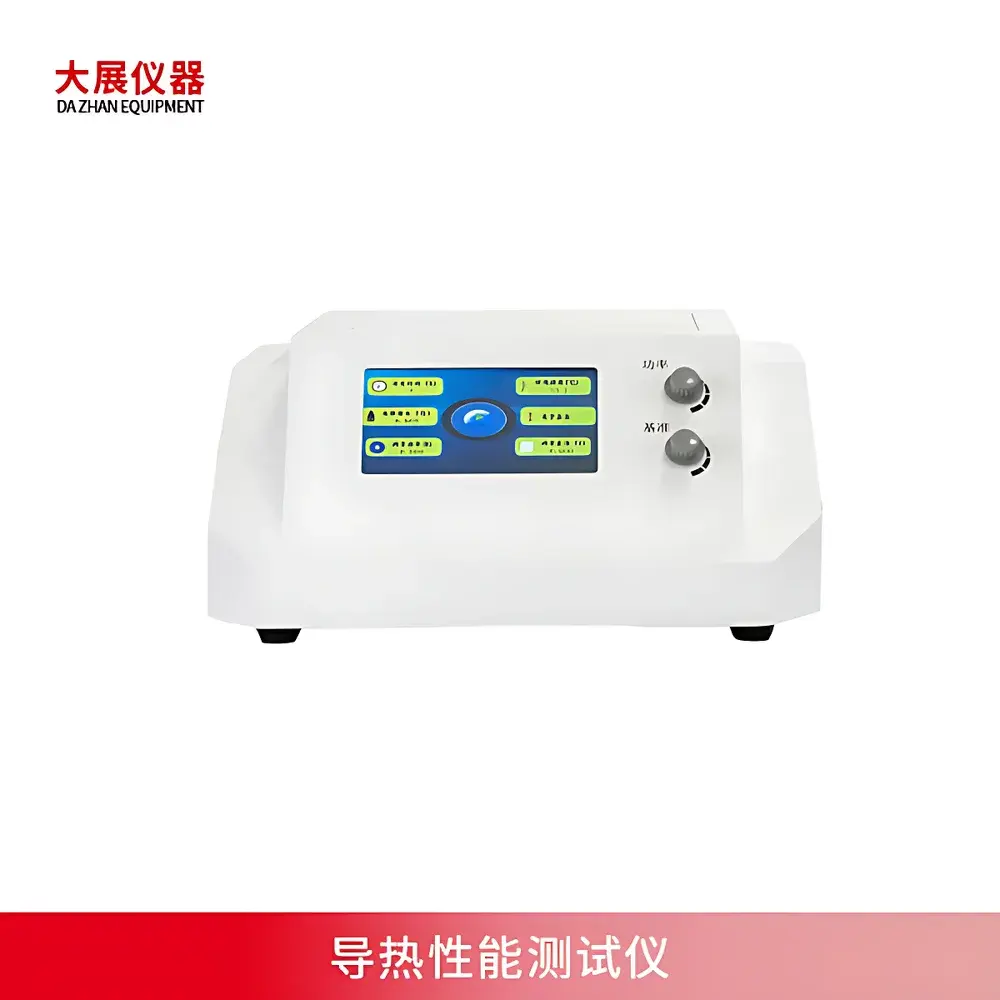
DZDR-S Thermal Conductivity Analyzer by DAZHAN
| Brand | DAZHAN |
|---|---|
| Origin | Jiangsu, China |
| Model | DZDR-S |
| Measurement Principle | Transient Plane Source (TPS) Method |
| Thermal Conductivity Range | 0.0001–300 W/(m·K) |
| Accuracy | ±3% |
| Temperature Range | Ambient to 130 °C (optional extension: −40 °C to 300 °C) |
| Sample Forms | Solid, Liquid, Powder, Paste, Gel, Coating, Thin Film |
| Probe Diameters | 7.5 mm, 15 mm, 50 mm (interchangeable) |
| Measurement Time | 5–160 s (user-configurable) |
| Repeatability | ≤3% |
| Power Supply | AC 220 V, <500 W |
| Sample Dimensions (min.) | 15×15×3.75 mm (for 7.5 mm probe) |
| Compliance | ASTM D5334, ISO 22007-2, GB/T 32064–2015 |
Overview
The DZDR-S Thermal Conductivity Analyzer is a benchtop instrument engineered for high-reproducibility measurement of thermal conductivity and thermal diffusivity across diverse material classes. It operates on the Transient Plane Source (TPS) method—a well-established non-steady-state technique defined in ASTM D5334 and ISO 22007-2. In this method, a thin, double-sided nickel spiral sensor—acting simultaneously as both heater and resistance thermometer—is sandwiched between two identical sample halves (or placed on a single bulk sample with appropriate thermal boundary conditions). A controlled current pulse generates transient heating, and the resulting time-dependent voltage response is recorded with microsecond resolution. The thermal conductivity is derived from the slope of the log(ΔT) vs. log(t) curve during the early-time regime, where ΔT is the temperature rise and t is time. This physics-based approach eliminates reliance on steady-state equilibration, enabling rapid, absolute measurements without calibration standards—critical for R&D labs requiring throughput without compromising metrological traceability.
Key Features
- Three interchangeable TPS probes (7.5 mm, 15 mm, and 50 mm diameter) optimized for different sample geometries and thermal effusivity ranges—ensuring optimal signal-to-noise ratio across low-conductivity insulators (e.g., aerogels, foams) and high-conductivity metals or ceramics.
- Measurement duration fully configurable from 5 s to 160 s, balancing speed and precision; typical tests complete within 30–90 s for routine QC applications.
- No specialized sample preparation required: solids need only one flat surface ≥2× probe diameter; powders are tested in standardized stainless-steel containment cells; liquids and pastes are measured in sealed, thermally stable cuvettes.
- Non-destructive testing protocol preserves sample integrity—enabling repeated measurements under varying temperature or humidity conditions, essential for aging studies or thermal cycling validation.
- Integrated 7-inch capacitive touchscreen with intuitive GUI supports multi-language operation (English default), real-time curve visualization, and on-device data review—including raw voltage vs. time traces and fitted thermal conductivity values.
- Robust hardware architecture includes PID-controlled ambient temperature stabilization (±0.1 °C), electromagnetic shielding for low-noise signal acquisition, and galvanically isolated analog front-end circuitry compliant with IEC 61000-4 immunity standards.
Sample Compatibility & Compliance
The DZDR-S accommodates heterogeneous physical forms without modification: rigid solids (metals, polymers, composites), flexible sheets (foams, textiles), granular media (ceramic powders, battery electrode materials), dispersions (nanofluids, slurries), viscoelastic gels (thermal interface materials), and thin films (≤100 µm) using optional substrate compensation algorithms. All measurements adhere to internationally recognized protocols: ASTM D5334 (standard test method for thermal conductivity of soil and soft rock), ISO 22007-2 (plastics—determination of thermal conductivity), and Chinese national standard GB/T 32064–2015 (instrumental determination of thermal transport properties). Data logs include full metadata (probe ID, ambient T, sample geometry, excitation power, fit residuals), supporting GLP/GMP audit readiness and 21 CFR Part 11-compliant electronic records when paired with validated laboratory information management systems (LIMS).
Software & Data Management
Bundled DZDR-Control v4.x software provides full instrument control, automated curve fitting using Levenberg–Marquardt nonlinear regression, and uncertainty propagation based on ISO/IEC Guide 98-3 (GUM). Raw data export is supported in CSV, TXT, and HDF5 formats; batch processing enables statistical analysis across sample sets (mean, SD, CV%, confidence intervals at 95%). Reporting templates comply with ISO/IEC 17025 requirements—each report embeds digital signatures, instrument calibration certificates (traceable to NIM, China), and environmental monitoring logs. Optional API integration allows direct data ingestion into MATLAB, Python (NumPy/Pandas), or enterprise MES platforms via RESTful HTTP endpoints with TLS 1.2 encryption.
Applications
- Materials Science: Screening of polymer nanocomposites, phase-change materials (PCMs), and thermal barrier coatings—quantifying filler dispersion effects on through-plane conductivity.
- Energy Systems: Characterization of battery electrode slurries, solid-state electrolytes, and heat sink alloys to inform thermal management design in EVs and grid-scale storage.
- Building Physics: Validation of insulation performance (rock wool, vacuum panels, aerogel blankets) per EN ISO 10456 and ASHRAE 90.1 compliance workflows.
- Food & Pharma: Monitoring thermal stability of frozen foods, lyophilized biologics, and edible films—correlating conductivity changes with moisture migration or crystallinity shifts.
- Geotechnical Engineering: In-situ soil thermal resistivity mapping for underground cable rating and geothermal loop design per IEEE 835 and IEC 60287.
FAQ
What standards does the DZDR-S comply with for thermal conductivity measurement?
ASTM D5334, ISO 22007-2, and GB/T 32064–2015. Full compliance documentation—including uncertainty budgets and inter-laboratory comparison reports—is provided with each system.
Can the instrument measure anisotropic materials?
Yes—by rotating the probe orientation relative to sample crystallographic or fiber axes and performing orthogonal measurements. Anisotropy ratio (k∥/k⊥) is computed automatically in the software.
Is cryogenic or high-temperature operation supported?
The base configuration covers ambient to 130 °C. Optional environmental chambers extend the range to −40 °C or up to 300 °C, with probe-specific calibration files supplied.
How is probe calibration maintained over time?
Each probe carries a unique NIST-traceable calibration certificate. Drift is monitored via daily reference checks using certified SRM 1470a (fused quartz) and SRM 1450c (fiberglass board); software alerts trigger recalibration if deviation exceeds ±1.5%.
Does the system support automated sample changers?
Not natively—but the RS-485 and Ethernet interfaces enable third-party robotic integration (e.g., Hamilton STAR, Tecan Fluent) via custom SCPI command scripting.



