
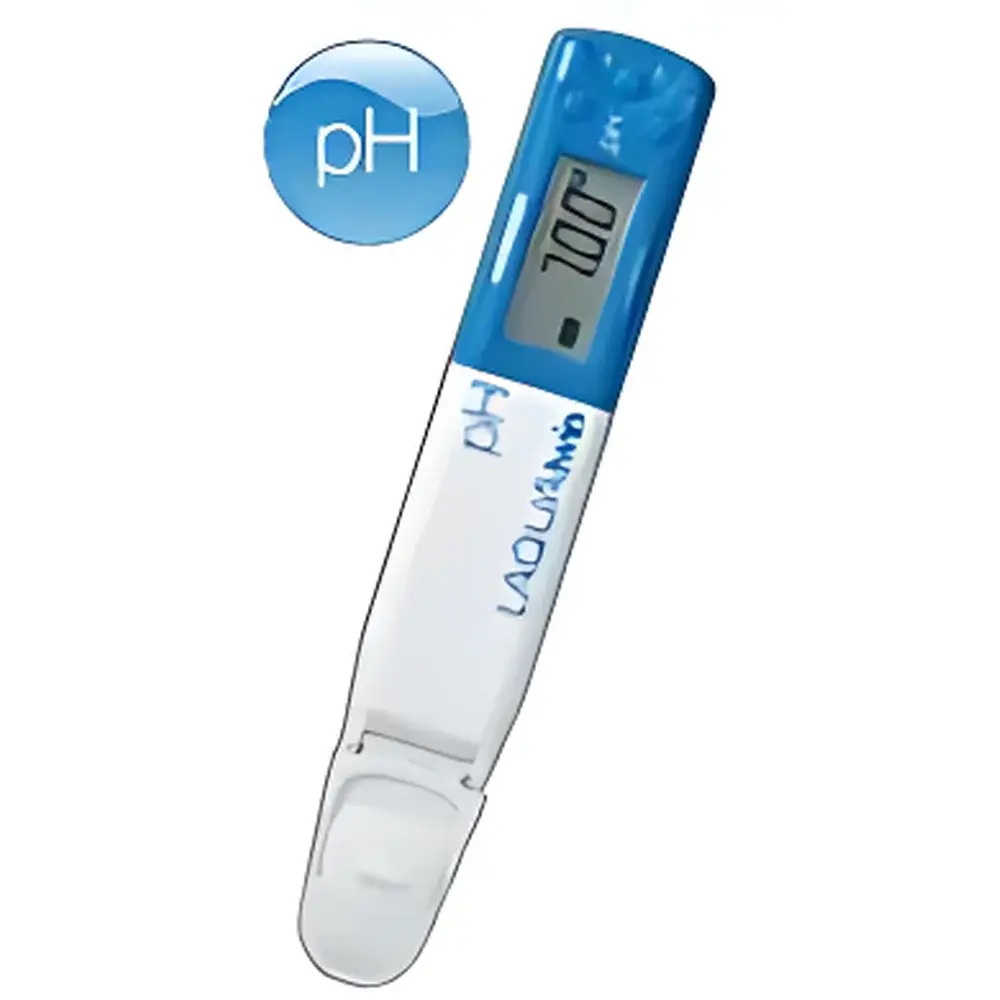
HORIBA LAQUAtwin pH B-711 / B-712 Portable Pen-Type pH Meter
| Brand | HORIBA |
|---|---|
| Origin | Japan |
| Model | LAQUAtwin pH B-711 (single-point calibration) / B-712 (dual-point calibration) |
| Instrument Type | Pen-type pH meter |
| Parameter Type | Single-parameter (pH) |
| Measurement Range | 2.0–12.0 pH |
| Resolution & Accuracy | ±0.1 pH |
| Minimum Sample Volume | 0.05 mL (with sampling film) or ≥0.1 mL |
| Calibration Solutions | pH 4.01, 7.00, and 9.18 standard buffers |
| Temperature Compensation | Automatic (ATC), 5–40 °C operating range |
| Ingress Protection | IP67 (submersible to 1 m for 30 min) |
| Power | Two CR2032 lithium coin cells |
| Dimensions | 164 × 29 × 20 mm (excl. protrusions) |
| Weight | ~50 g (instrument only, batteries excluded) |
Overview
The HORIBA LAQUAtwin pH B-711 and B-712 are compact, handheld pen-type pH meters engineered for rapid, reliable field and spot-check measurements in environmental monitoring, aquaculture, food processing, hydroponics, and educational laboratories. These instruments employ a robust flat-surface glass pH electrode — a design refined through decades of HORIBA electrochemical sensor development — enabling stable potential response with minimal sample volume. Unlike conventional combination electrodes requiring immersion, the LAQUAtwin’s planar sensing surface permits measurement from as little as 0.05 mL of liquid when used with the optional sampling film accessory, significantly reducing waste and contamination risk. The measurement principle follows the Nernst equation, where the electrode potential difference between the pH-sensitive glass membrane and a built-in Ag/AgCl reference system is converted into a digital pH reading with automatic temperature compensation (ATC). Designed as direct successors to the B-211/B-212 series, the B-711 and B-712 integrate enhanced electronics, improved drift stability, and intuitive one-button operation — delivering laboratory-grade repeatability (±0.1 pH) in a rugged, pocket-sized form factor.
Key Features
- Flat-surface glass pH electrode optimized for micro-volume analysis (0.05–0.1 mL), minimizing sample consumption and cross-contamination
- One-touch measurement and calibration interface: press once to initiate auto-ranging, ATC, and stabilized reading; visual confirmation via smiley-face icon on LCD
- IP67-rated enclosure: fully dust-tight and submersible to 1 m for 30 minutes — suitable for humid, outdoor, or splash-prone environments (not intended for underwater operation)
- Dual calibration options: B-711 supports single-point (e.g., pH 7.00) calibration; B-712 supports two-point calibration (e.g., pH 4.01 and 7.00 or 7.00 and 9.18) for extended accuracy across the full 2.0–12.0 pH range
- Automatic endpoint hold function freezes the stable reading on-screen, eliminating subjective judgment of stabilization
- Integrated temperature sensor enables real-time ATC (0–50 °C range, compensated per NIST pH-temperature coefficients), ensuring traceable accuracy under variable ambient conditions
- Low-power architecture: powered by two standard CR2032 batteries with typical operational life exceeding 5,000 measurements
Sample Compatibility & Compliance
The LAQUAtwin pH meters accommodate aqueous solutions with low to moderate turbidity and suspended solids. For samples containing particulates, HORIBA recommends filtration using the optional polypropylene filter membrane prior to measurement. The flat electrode design resists clogging and facilitates easy cleaning with deionized water or mild detergent. These instruments comply with IEC 60529 (IP67), JIS Z 8401 (pH measurement standards), and ISO 7888 (water quality — pH determination). While not certified for GLP/GMP-regulated production environments, their documented repeatability (±0.1 pH), traceable calibration protocol, and audit-ready calibration log (via optional PC interface cable and software) support data integrity requirements in QA/QC workflows aligned with ISO/IEC 17025 principles. They are routinely deployed in EPA Method 150.1–compliant field screening and ASTM D1293 (Standard Test Method for pH of Water) applications.
Software & Data Management
The B-711 and B-712 operate autonomously without external software but support optional connectivity via HORIBA’s LAQUA Connect PC application (Windows/macOS) using a USB-to-serial adapter cable. This interface enables time-stamped data export (CSV), calibration history review, firmware updates, and customizable report generation. All calibration events — including date, buffer values used, slope (%), and offset (mV) — are stored internally with timestamping. The firmware adheres to ALCOA+ principles for raw data integrity: each measurement retains its native analog-to-digital conversion value, ATC parameters, and battery status. While not 21 CFR Part 11 compliant out-of-the-box, the device can be integrated into validated workflows where electronic records are generated and archived externally with appropriate procedural controls.
Applications
- Environmental field testing: river, lake, and wastewater pH profiling during regulatory compliance surveys
- Aquaculture and aquarium management: daily pH monitoring of recirculating systems and hatchery tanks
- Food & beverage QA: spot-checking brine solutions, marinades, dairy products, and brewing wort
- Horticulture and hydroponics: nutrient solution pH verification before irrigation cycles
- Education: undergraduate chemistry and environmental science labs emphasizing micro-volume electrochemical techniques
- Swimming pool and spa maintenance: rapid verification of disinfection efficacy via pH control
FAQ
What is the minimum sample volume required for accurate measurement?
0.05 mL when used with the optional sampling film; otherwise, ≥0.1 mL is recommended. Ensure the electrode surface is fully covered and free of air bubbles.
Can the B-711 perform two-point calibration?
No — the B-711 is hardware-limited to single-point calibration. For two-point calibration across the full pH range, select the B-712 model.
Is the instrument suitable for measuring viscous or high-salinity samples?
It is validated for aqueous solutions up to 1 M NaCl. For highly viscous, protein-rich, or sulfide-containing media, frequent electrode cleaning and periodic recalibration are advised.
How often should calibration be performed?
Daily calibration is recommended for routine use; before each measurement session if traceability is required; and immediately after exposure to extreme pH or contaminated samples.
Does the IP67 rating permit underwater operation?
No — IP67 certifies resistance to temporary submersion (1 m depth, 30 min), but the device must not be operated while submerged. Measurements require atmospheric contact at the electrode surface.






