
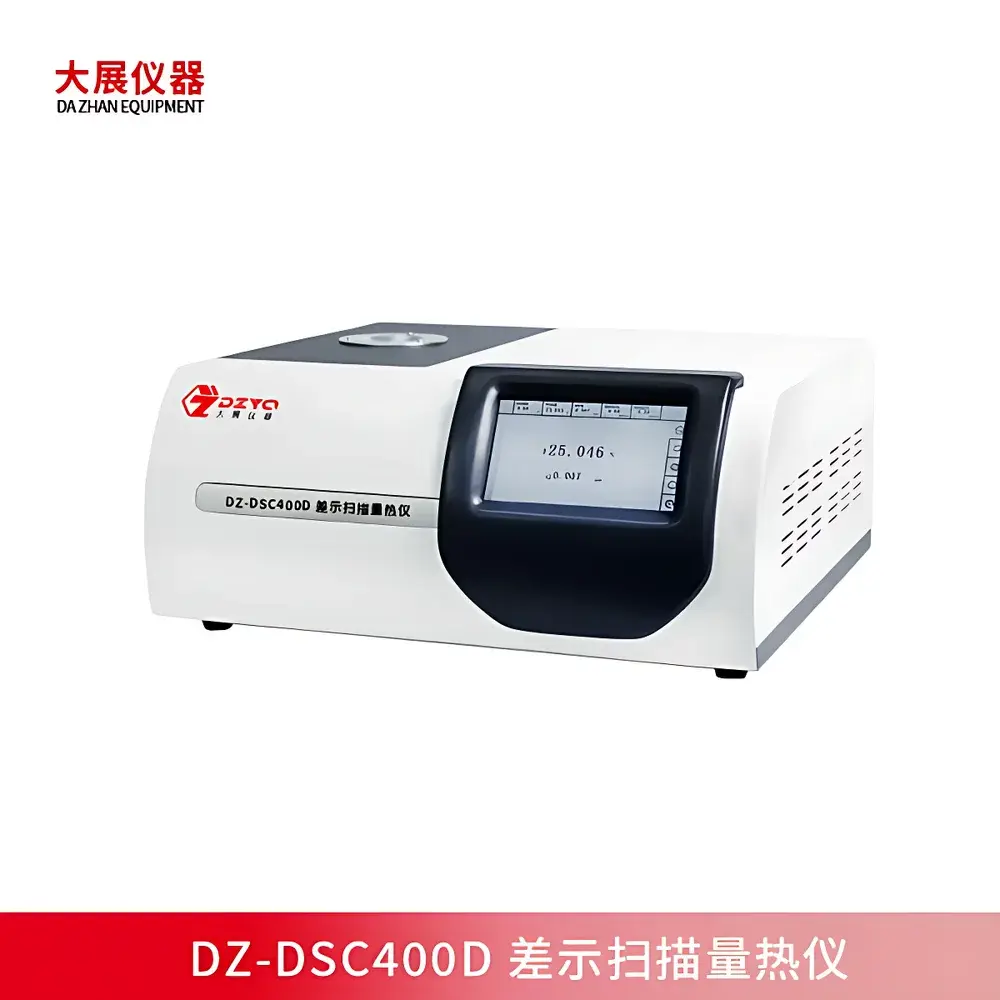
DAZHAN DZ-DSC400D Mechanical Refrigeration Differential Scanning Calorimeter
| Brand | DAZHAN |
|---|---|
| Origin | Jiangsu, China |
| Manufacturer Type | Authorized Distributor |
| Country of Origin | China |
| Model | DZ-DSC400D |
| Price Range | USD 19,500–27,800 (FOB China) |
| Sample Capacity | Single-sample configuration |
| Instrument Type | Heat-Flux DSC |
| Temperature Range | −70 °C to 600 °C |
| Temperature Control | Intelligent PID algorithm |
| Temperature Accuracy | ±0.001 °C |
| Heating/Cooling Rate | 0.1–100 °C/min (heating), −0.1 to −60 °C/min (cooling) |
| Temperature Precision | ±0.001 °C |
| DSC Signal Range | ±1000 mW |
| DSC Sensitivity | 0.0001 mW |
| Temperature Resolution | 0.001 °C |
| Gas Flow Range | 0–200 mL/min (expandable) |
| Cooling Method | Integrated mechanical refrigeration system (supplemented by optional air-cooling, Peltier, and liquid nitrogen interfaces) |
Overview
The DAZHAN DZ-DSC400D is a high-performance, mechanically refrigerated heat-flux differential scanning calorimeter engineered for precision thermal characterization across academic, industrial, and regulatory laboratory environments. Based on the fundamental principle of measuring differential heat flow between a sample and an inert reference as both are subjected to identical, programmable temperature profiles, the DZ-DSC400D delivers quantitative thermodynamic data—including enthalpy changes (ΔH), phase transition temperatures (e.g., Tg, Tm, Tc), oxidative induction time (OIT), and crystallization kinetics—under controlled atmospheric conditions. Its extended operational range (−70 °C to 600 °C), combined with rapid cooling capability (up to −60 °C/min), enables rigorous evaluation of polymers, pharmaceuticals, composites, food matrices, and specialty chemicals where low-temperature transitions or high-temperature stability assessments are critical.
Key Features
- Optimized furnace architecture with indirect conductive heating—minimizing thermal gradients and electromagnetic pulse interference for superior baseline flatness and long-term signal stability.
- Dual-stage mechanical refrigeration system integrated into the core instrument design, eliminating dependency on external cryogens while achieving sub-ambient operation down to −70 °C without performance compromise.
- Upgraded high-sensitivity thermopile sensor array with active electromagnetic shielding and low-noise analog signal conditioning circuitry, delivering DSC sensitivity of 0.0001 mW and temperature resolution of 0.001 °C.
- Intelligent PID-based temperature control algorithm ensures precise ramp rate adherence (0.1–100 °C/min) and exceptional reproducibility across repeated thermal cycles.
- Triple-gas manifold system supporting automated switching between two reactive gas streams (e.g., N2/O2) and one inert purge line, with fast stabilization (<15 s) and digitally regulated flow (0–200 mL/min, field-expandable).
- Ruggedized aluminum alloy furnace housing with thermal mass optimization, enabling consistent thermal inertia and minimal drift over multi-day experiments.
Sample Compatibility & Compliance
The DZ-DSC400D accommodates standard hermetic and vented aluminum crucibles (e.g., 40 µL, 100 µL), as well as specialized high-pressure stainless-steel cells for volatile or reactive samples. It supports ASTM E793 (enthalpy of fusion), ASTM E1356 (glass transition), ISO 11357 series (polymer thermal behavior), and USP (thermal analysis of pharmaceutical excipients). Data acquisition and reporting comply with GLP and GMP documentation requirements; audit trails, user access controls, and electronic signature support can be enabled via optional software modules aligned with FDA 21 CFR Part 11 principles.
Software & Data Management
Controlled via DAZHAN’s proprietary ThermalPro™ v4.2 software suite (Windows 10/11 compatible), the DZ-DSC400D provides real-time visualization, multi-step program definition, automatic peak integration, baseline correction algorithms (tangent, step, spline), and comparative overlay of up to 32 thermograms. Raw data is exported in ASCII (.txt) or universal .csv format; metadata—including instrument ID, operator, calibration history, and environmental logs—is embedded in each dataset. The software supports IQ/OQ documentation templates and integrates with LIMS systems via OPC UA or direct database export (ODBC-compliant).
Applications
- Characterization of polymer crystallinity, degradation onset, and crosslinking kinetics in R&D and QC labs.
- Determination of glass transition (Tg) and cold crystallization (Tcc) in amorphous pharmaceuticals per ICH Q5C guidelines.
- Oxidative stability assessment of lubricants, biofuels, and edible oils using OIT and OOT protocols (ASTM D3893, ISO 11357-6).
- Thermal safety screening of battery electrolytes and cathode materials under inert and oxidizing atmospheres.
- Quality control of food-grade packaging films, starch gelatinization profiles, and protein denaturation enthalpies.
- Validation of thermal curing cycles for composites and adhesives in aerospace and automotive manufacturing.
FAQ
Does the DZ-DSC400D meet international calibration traceability standards?
Yes—the instrument is supplied with NIST-traceable calibration certificates for temperature (indium, zinc, tin) and enthalpy (indium), performed at accredited third-party laboratories prior to shipment.
Can the mechanical refrigeration system operate continuously at −70 °C?
Yes—continuous sub-ambient operation is supported within the specified temperature range; ambient lab temperature must remain ≤25 °C and relative humidity <60% for optimal refrigeration efficiency.
Is remote monitoring or networked operation supported?
The ThermalPro™ software supports Ethernet-based instrument control and real-time data streaming to local network drives; remote desktop access is permitted subject to institutional IT security policies.
What maintenance intervals are recommended for routine operation?
Furnace cleaning and sensor inspection every 6 months; refrigeration oil and filter replacement every 24 months; annual full-system performance verification including temperature accuracy, baseline stability, and gas flow calibration.
Are application-specific method templates available?
DAZHAN provides validated SOP templates for polymer Tg, pharmaceutical OIT, and food starch gelatinization, fully editable within ThermalPro™ and compliant with ISO/IEC 17025 method validation frameworks.



