
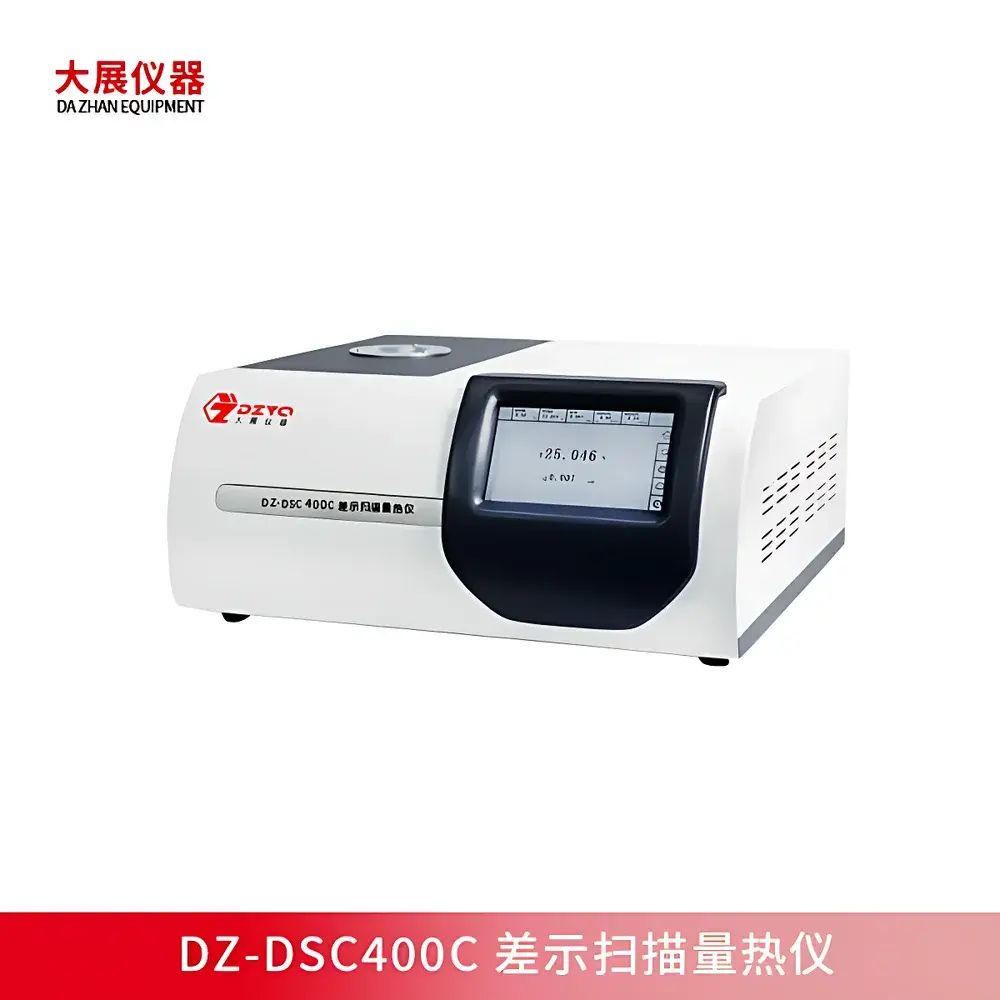
DAZHAN DZ-DSC400C Differential Scanning Calorimeter
| Brand | DAZHAN |
|---|---|
| Origin | Jiangsu, China |
| Manufacturer Type | Domestic Instrument Manufacturer |
| Model | DZ-DSC400C |
| Sample Capacity | Single-sample configuration |
| Instrument Type | Heat-Flux DSC |
| Temperature Range | −50 °C to 600 °C |
| Temperature Accuracy | ±0.001 °C |
| Temperature Precision (Resolution) | 0.001 °C |
| Heating/Cooling Rate | 0.1–100 K/min (heating), −0.1 to −40 K/min (cooling) |
| Scan Modes | Isothermal, dynamic heating, dynamic cooling |
| DSC Signal Range | ±1000 mW |
| Temperature Stability (Drift) | ≤0.1 °C/h |
| Cooling Method | Peltier-based active refrigeration (standard) |
| Gas Control | Triple-gas manifold with automatic dual-atmosphere switching (e.g., N₂ ↔ O₂), plus dedicated inert purge line |
| Temperature Control Algorithm | Adaptive PID with self-tuning and dynamic/static hybrid compensation |
Overview
The DAZHAN DZ-DSC400C is a high-stability, heat-flux differential scanning calorimeter engineered for precise thermal characterization of solid and semi-crystalline materials across an extended operational temperature range (−50 °C to 600 °C). It operates on the fundamental principle of measuring differential heat flow between a sample and an inert reference as both are subjected to identical, programmable thermal profiles. This enables quantitative determination of endothermic and exothermic transitions—including glass transition (Tg), melting point (Tm), crystallization onset (Tc), enthalpy changes (ΔH), oxidative induction time (OIT), and cure kinetics—under controlled atmospheric conditions. Designed for reproducibility in regulated environments, the DZ-DSC400C integrates a thermally optimized furnace architecture with low-drift sensor arrays and real-time thermal inertia compensation, delivering baseline stability suitable for ISO 11357-1 compliant measurements.
Key Features
- Advanced Peltier-based cooling system enabling rapid, repeatable sub-ambient operation down to −50 °C without cryogenic consumables—ideal for polymer low-Tg analysis and pharmaceutical amorphous stability assessment.
- Multi-mode thermal control architecture combining adaptive PID algorithms with dynamic/static thermal modeling, including auto-tuning and memory-assisted profile optimization for consistent ramp fidelity across repeated runs.
- Triple-gas delivery system with electromechanically actuated dual-atmosphere switching (e.g., inert N₂ ↔ reactive O₂), achieving <3 s stabilization time post-switch; integrated purge channel supports ASTM D3895-compliant OIT testing.
- Enhanced furnace design featuring symmetric thermal mass distribution and low-thermal-capacitance sensor mounts, resulting in improved baseline flatness (<0.05 mW drift over 30 min at 50 °C) and reduced thermal lag during high-rate scans.
- High-resolution signal acquisition (0.001 °C temperature resolution, ±0.001 °C accuracy) coupled with ±1000 mW DSC range and 24-bit analog-to-digital conversion for robust detection of weak thermal events in nanocomposites or low-mass biological samples.
Sample Compatibility & Compliance
The DZ-DSC400C accommodates standard aluminum, gold, or hermetic stainless-steel crucibles (60–100 µL volume), supporting solids, powders, thin films, and small-volume liquids (≤20 mg typical). Its temperature calibration traceability aligns with NIST SRM 720e (indium), SRM 761 (zinc), and SRM 1986 (sapphire), satisfying ISO/IEC 17025 preconditions for accredited labs. The instrument’s firmware and data handling protocols support audit-ready operation per FDA 21 CFR Part 11 requirements—including electronic signatures, user access levels, and immutable audit trails—when deployed with validated software configurations. It meets essential safety and EMC criteria per IEC 61010-1 and CE marking directives.
Software & Data Management
The bundled DSC Analysis Suite v4.x provides full GLP-compliant workflow management: method templates with parameter locking, automated peak integration using tangent-onset and extrapolated-onset algorithms, multi-step baseline correction, and comparative overlay of up to 32 curves. Raw data is stored in vendor-neutral ASCII format (.txt) with embedded metadata (operator ID, timestamp, calibration status, gas history). Export modules support ASTM E1981, ISO 11357-7, and USP reporting structures. Optional network licensing enables centralized instrument monitoring and remote method deployment across lab networks.
Applications
- Materials Science: Quantification of Tg, cold crystallization, and melt enthalpy in polyolefins, polyesters, and biodegradable polymers per ASTM D3418 and ISO 11357-3.
- Pharmaceutical Development: Solid-state stability screening of amorphous dispersions, polymorph identification, and excipient compatibility studies under ICH Q5E guidelines.
- Food Science: Measurement of fat crystallization kinetics, starch gelatinization enthalpy, and moisture-induced phase transitions in low-water activity systems.
- Quality Control: Routine verification of resin cure degree in composites (ASTM D7028), oxidation resistance of lubricants (ASTM D3895), and thermal degradation onset in flame-retardant cables.
- Academic Research: Teaching thermodynamics principles via hands-on demonstration of first- and second-order transitions, kinetic modeling (Ozawa-Flynn-Wall), and modulated DSC extensions.
FAQ
What cooling methods does the DZ-DSC400C support beyond the standard Peltier system?
The base configuration uses solid-state Peltier cooling. Optional accessories include a forced-air module for moderate cooling enhancement, a mechanical chiller for extended sub-zero capability, and a liquid nitrogen adapter for ultra-low-temperature operation down to −100 °C.
Is the instrument compatible with GLP/GMP-regulated environments?
Yes—when operated with validated software settings and documented calibration procedures, the DZ-DSC400C supports full audit trail generation, role-based access control, and electronic signature compliance required by 21 CFR Part 11 and EU Annex 11.
Can the DSC Analysis Suite import third-party thermal data formats?
It accepts generic ASCII and CSV files with defined column headers (time, temperature, heat flow), enabling cross-platform comparison with TA Instruments, Mettler Toledo, or Netzsch datasets.
What is the recommended maintenance schedule for optimal baseline stability?
Quarterly sensor recalibration using certified standards (NIST SRMs), biannual furnace cleaning with non-abrasive solvents, and annual verification of gas flow accuracy using a calibrated mass flow meter are advised per ISO/IEC 17025 maintenance protocols.



