
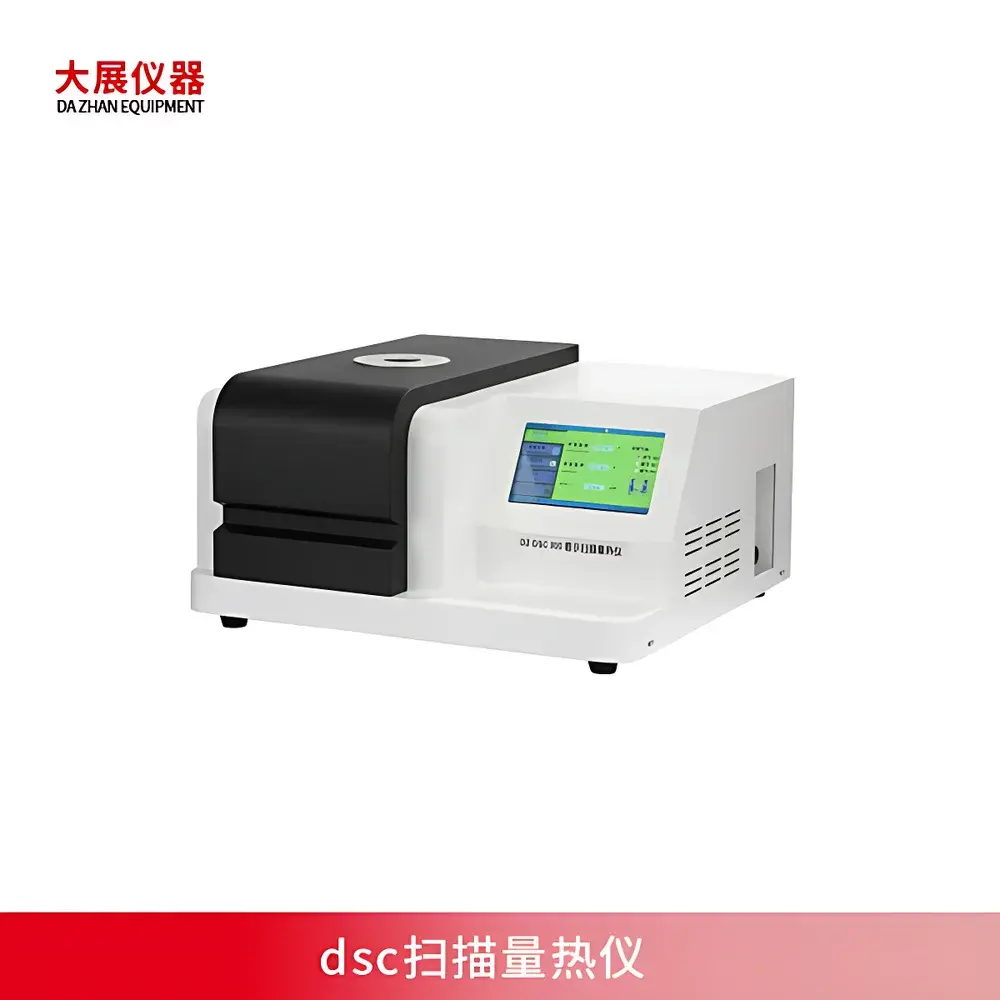
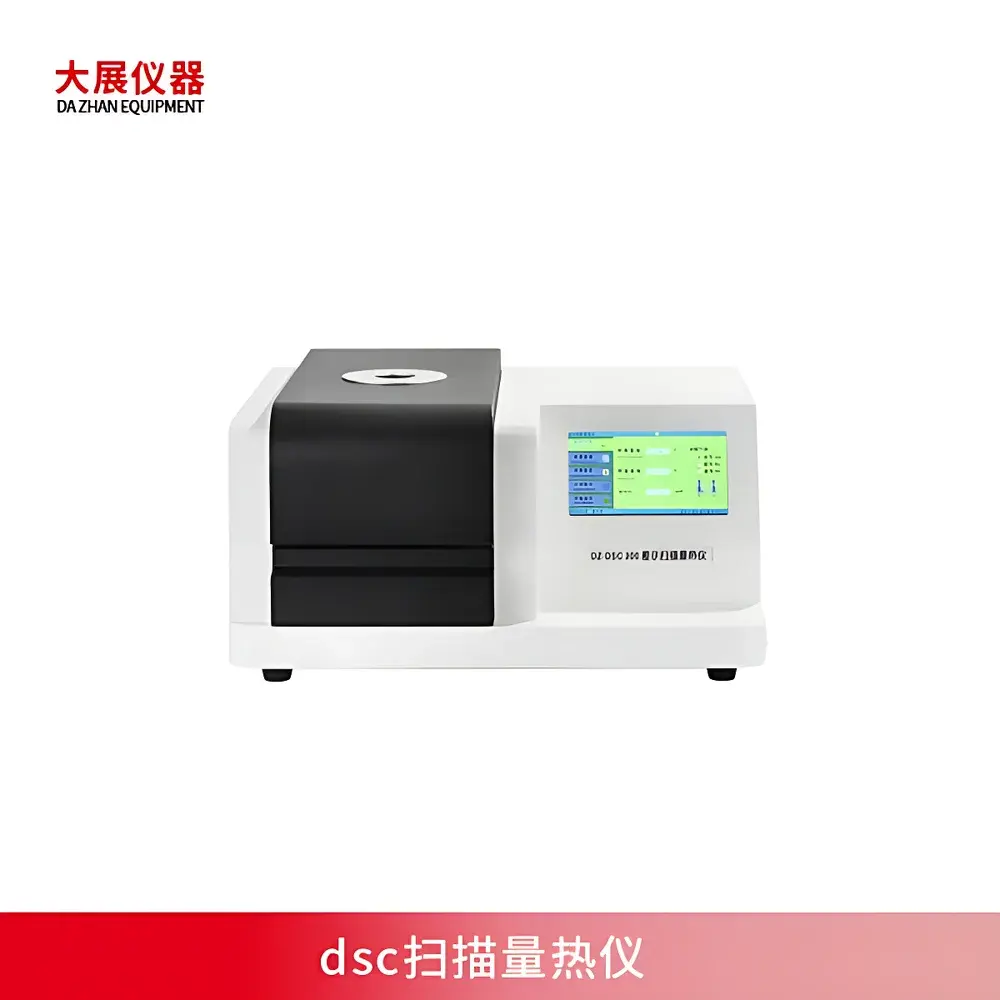
Nanjing Dazhan DZ-DSC300 Differential Scanning Calorimeter
| Brand | Nanjing Dazhan |
|---|---|
| Origin | Jiangsu, China |
| Manufacturer Type | Direct Manufacturer |
| Instrument Type | DSC |
| Model | DZ-DSC300 |
| Sample Capacity | Single |
| Temperature Range | Ambient to 600 °C |
| Temperature Accuracy | ±0.001 °C |
| Heating/Cooling Rate | 0.1–100 °C/min |
| Temperature Precision | ±0.001 °C |
| DSC Signal Range | 0 to ±600 mW |
| Temperature Stability | ±0.01 °C |
| DSC Resolution | 0.01 µW |
| DSC Sensitivity | 0.001 mW |
| Atmosphere Control | Dual-gas automatic switching (N₂, air, or custom gas) |
| Gas Flow Rate | 0–300 mL/min (customizable) |
| Gas Pressure Rating | ≤5 MPa |
| Calibration Standards Included | Indium, Tin, Lead |
| Display | 7-inch 24-bit color capacitive touchscreen |
| Data Interface | Standard USB |
| Power Supply | AC 220 V / 50 Hz (optional customization) |
Overview
The Nanjing Dazhan DZ-DSC300 Differential Scanning Calorimeter is a high-precision thermal analysis instrument engineered for quantitative measurement of heat flow differences between a sample and an inert reference as a function of temperature or time. Operating on the principle of heat-flux DSC, the system employs a symmetric furnace design with integrated thermal shielding and triple-layer lid insulation to minimize thermal lag and enhance baseline stability. It delivers calibrated thermal data under controlled atmospheric conditions—supporting dual-gas automatic switching (e.g., N₂ and synthetic air) with programmable flow regulation up to 300 mL/min. Designed for routine and research-grade applications in polymer science, pharmaceutical development, and materials characterization, the DZ-DSC300 meets essential metrological requirements for GLP-compliant laboratories and aligns with foundational test protocols referenced in ASTM E794, ISO 11357, and USP <1163>.
Key Features
- Thermally optimized furnace architecture with triple-layer insulated lid, reducing thermal drift and improving signal-to-noise ratio during extended isothermal holds.
- High-resolution thermocouple-based sensor array fabricated using thermal fusion bonding—eliminating micro-weld inconsistencies and enabling sub-milliwatt sensitivity (0.001 mW) and 0.01 µW resolution.
- Programmable multi-segment thermal control: supports up to six independent heating, cooling, and isothermal steps per run—including ramp rate modulation from 0.1 to 100 °C/min with real-time feedback stabilization.
- Dual-mode operation interface: fully functional 7-inch capacitive touchscreen (24-bit color, responsive UI) paired with PC-based software control via standard USB 2.0—enabling remote parameter adjustment, live curve overlay, and synchronized data logging.
- Robust electromagnetic shielding of analog signal acquisition circuitry, minimizing environmental noise interference across low-signal regimes typical in glass transition or oxidative induction time measurements.
- Built-in calibration traceability: shipped with certified reference materials (Indium, Tin, Lead) and software-supported multi-point temperature calibration routines compliant with ISO/IEC 17025 documentation practices.
Sample Compatibility & Compliance
The DZ-DSC300 accommodates standard aluminum, gold-plated aluminum, and high-pressure stainless-steel crucibles (50–100 µL capacity), supporting solid, semi-crystalline, and powdered samples up to 30 mg. Its ambient-to-600 °C operational envelope enables characterization of thermoplastics, thermosets, pharmaceutical actives, metal alloys, and energetic materials. The instrument satisfies key regulatory expectations for thermal method validation: temperature accuracy (±0.001 °C) and stability (±0.01 °C) are verified per ASTM E967 and ISO 11357-1. Optional audit-trail-enabled software modules support 21 CFR Part 11 compliance when deployed in GxP environments. All hardware and firmware conform to IEC 61000-4 electromagnetic compatibility standards and CE marking requirements for laboratory instrumentation.
Software & Data Management
The proprietary DZ-TA Suite provides intuitive workflow management—from method creation and real-time visualization to post-run baseline correction, peak integration, and kinetic modeling (e.g., Ozawa-Flynn-Wall, Kissinger). Raw data are stored in vendor-neutral ASCII format (.csv) with embedded metadata (timestamp, operator ID, calibration status, gas flow log). Version-controlled method templates ensure inter-laboratory reproducibility. Software supports automated report generation with customizable headers, statistical summaries (n≥3 replicates), and export to LIMS-compatible formats. Optional cloud-sync extension enables secure offsite backup and cross-site comparative analysis—without compromising local data sovereignty.
Applications
- Determination of glass transition temperature (Tg) in amorphous polymers and copolymers with enhanced resolution at low enthalpy transitions.
- Quantification of melting enthalpy (ΔHf), crystallinity index, and cold crystallization kinetics in polyolefins and biodegradable polyesters.
- Assessment of curing exotherms, degree of crosslinking, and gel point identification in epoxy and phenolic resin systems.
- Oxidative induction time (OIT) and oxidative onset temperature (OOT) evaluation under dynamic air/N₂ switching protocols per ASTM D3895 and ISO 11357-6.
- Thermal stability profiling of APIs and excipients, including dehydration, polymorphic transitions, and decomposition onset detection.
- Quality control screening of batch-to-batch consistency in industrial composites and recycled polymer feedstocks.
FAQ
What reference materials are included for calibration?
Indium (Tm = 156.60 °C), Tin (Tm = 231.93 °C), and Lead (Tm = 327.50 °C) are supplied with certified purity ≥99.99% and traceable NIST-equivalent uncertainty statements.
Can the DZ-DSC300 operate under inert and oxidative atmospheres within a single run?
Yes—the dual-gas manifold enables automatic, software-triggered switching between two pre-configured gases (e.g., N₂ → air) at user-defined temperatures or times, critical for OIT and oxidation kinetics studies.
Is the instrument compatible with third-party thermal analysis software?
Raw .csv output includes all primary channels (temperature, heat flow, time, gas flow, ramp rate), allowing import into OriginLab, MATLAB, or Thermo Scientific™ OMNIC™ for advanced modeling.
What maintenance is required for long-term baseline stability?
Annual verification using supplied standards and optional factory recalibration service; crucible cleaning with acetone/isopropanol; periodic inspection of furnace seal integrity and gas line fittings.
Does the system support GLP audit trails?
With optional DZ-TA Secure Edition software, full electronic signatures, change logs, and 21 CFR Part 11–compliant user access controls are available upon configuration.
Related Products



