
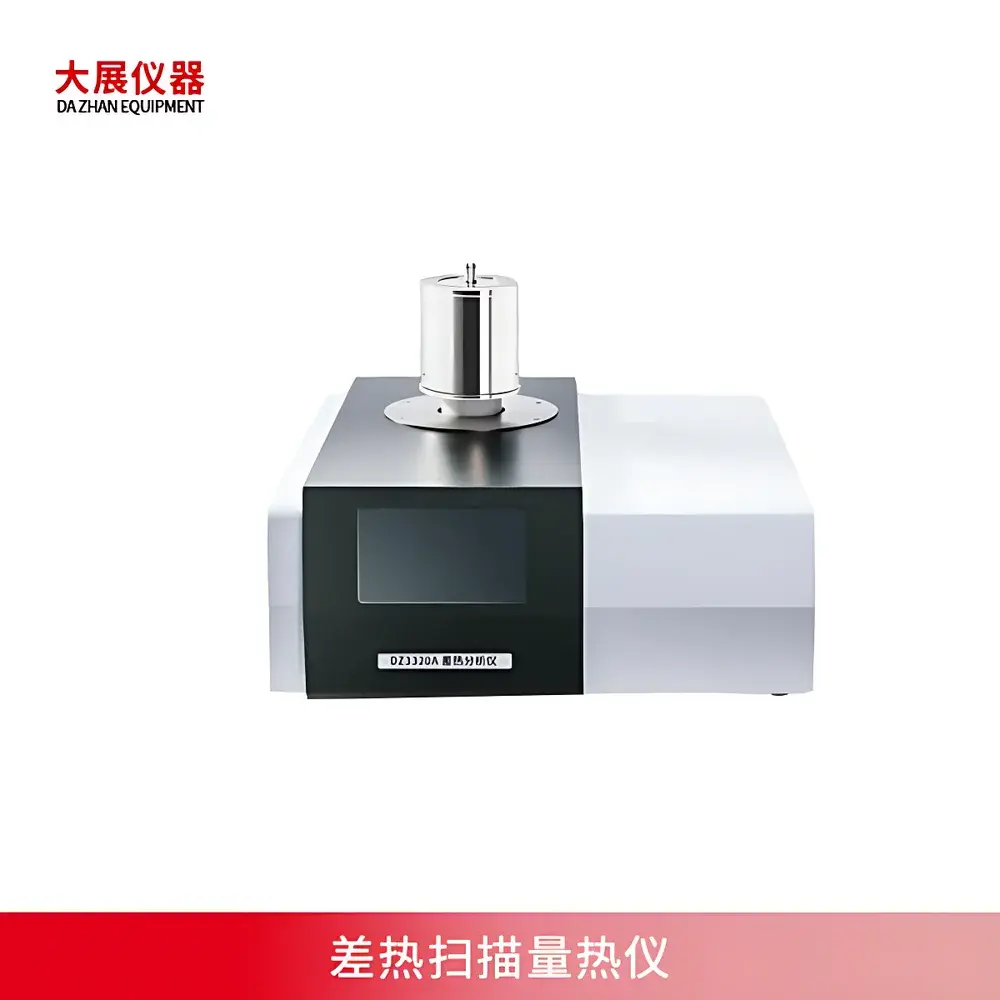
DAZHAN DZ3320A Differential Thermal Analyzer (DTA)
| Brand | DAZHAN |
|---|---|
| Origin | Jiangsu, China |
| Model | DZ3320A |
| Sample Capacity | Single |
| Instrument Type | Differential Thermal Analyzer (DTA) |
| Temperature Range | Ambient to 1150 °C |
| Temperature Accuracy | ±0.1 °C |
| Heating/Cooling Rate | 0.1–100 °C/min |
| DTA Signal Range | 0 to ±2000 µV (expandable) |
| DTA Sensitivity | 0.01 µV |
| Temperature Resolution | 0.01 °C |
| Temperature Repeatability | ±0.1 °C |
| Control Interface | USB bidirectional communication |
| Display | 7-inch 24-bit color LCD touchscreen |
| Sensor Material | Ni-Cr alloy thermocouple |
| Furnace Design | Top-opening vertical furnace |
| Atmosphere Control | Programmable internal gas switching |
| Power Supply | AC 220 V, 50 Hz |
Overview
The DAZHAN DZ3320A Differential Thermal Analyzer (DTA) is a high-precision, benchtop thermal analysis instrument engineered for quantitative detection of endothermic and exothermic transitions in solid and powdered materials. Unlike differential scanning calorimetry (DSC), which measures heat flow differences under controlled heating/cooling, the DZ3320A operates on the classical DTA principle: it records temperature differentials (ΔT) between a sample and an inert reference material as both are subjected to identical thermal programs. This enables direct identification of transition onset temperatures—including melting, crystallization, glass transition (Tg), solid-state phase transformations, decomposition, oxidation, and dehydration—without requiring calibration against heat capacity standards. Designed for routine laboratory use in academic research, quality control, and materials development labs, the DZ3320A delivers reproducible thermal event detection across a wide operational range from ambient to 1150 °C, with programmable heating/cooling rates spanning 0.1 to 100 °C/min.
Key Features
- ARM-based embedded controller ensures stable temperature ramping, real-time signal acquisition, and low-latency response during dynamic thermal events.
- Top-opening vertical furnace architecture eliminates mechanical lift mechanisms, improving thermal homogeneity, reducing thermal lag, and enhancing long-term calibration stability.
- Ni-Cr alloy thermocouples provide extended service life at elevated temperatures (up to 1150 °C), resistance to oxidation and chemical corrosion in air or inert atmospheres, and consistent signal linearity over repeated cycles.
- 7-inch full-color capacitive touchscreen interface supports intuitive navigation, real-time curve visualization, parameter entry, and on-device baseline adjustment via slope and intercept controls.
- USB 2.0 bidirectional communication enables synchronized operation: instrument control and data streaming occur simultaneously with PC-based software, supporting concurrent manual intervention and automated sequence execution.
- Integrated atmosphere management allows programmable gas switching (e.g., N2, Ar, O2, synthetic air) via internal solenoid valves—critical for studying oxidative stability, combustion behavior, or inert-phase transitions.
- Factory-supplied calibration standards (e.g., high-purity In, Sn, Zn, Al) enable user-performed temperature verification and one-click baseline correction, ensuring traceability to NIST-traceable reference points.
Sample Compatibility & Compliance
The DZ3320A accommodates standard ceramic or alumina crucibles (typically 50–100 µL volume), supporting solids, powders, thin films, and granular composites. Sample mass range is optimized between 1–20 mg for optimal signal-to-noise ratio and thermal equilibration. The system complies with fundamental requirements of ASTM E794 (Standard Test Method for Melting and Crystallization Temperatures by Thermal Analysis), ISO 11357-1 (Plastics — Differential Scanning Calorimetry — Part 1: General Principles), and supports GLP-aligned workflows through audit-trail-capable software logging. While not certified to FDA 21 CFR Part 11 out-of-the-box, raw data files (ASCII .txt or binary .dtf) retain full timestamped metadata, enabling integration into validated LIMS or electronic lab notebook (ELN) systems where required.
Software & Data Management
Bundled Windows-compatible software provides real-time thermal curve plotting, multi-segment heating program definition (including hold steps, cooling ramps, and cyclic protocols), automatic peak detection, and baseline subtraction using polynomial or linear interpolation. Data export formats include CSV, Excel (.xlsx), and image (PNG, SVG) for reporting. All acquisitions store instrument configuration, environmental logs (ambient temperature, power status), and operator ID fields—facilitating retrospective review and method validation. Raw signal files preserve 24-bit resolution and millisecond-level time stamps, permitting post-acquisition reprocessing without loss of fidelity.
Applications
- Determination of melting point, eutectic temperature, and solidus/liquidus boundaries in metallurgical alloys and solder pastes.
- Characterization of polymer crystallinity, Tg shifts induced by plasticizers or fillers, and thermal degradation onset in composites.
- Analysis of phase transitions in battery cathode materials (e.g., LiCoO2, NMC) under controlled atmospheres.
- Studying dehydration kinetics of pharmaceutical hydrates and excipient compatibility in pre-formulation studies.
- Quantifying enthalpy changes associated with solid-state reactions, such as perovskite formation or zeolite framework collapse.
- Evaluation of thermal stability of catalysts, ceramics, and refractory oxides under oxidizing or reducing conditions.
FAQ
What distinguishes DTA from DSC in practical application?
DTA detects temperature differentials (ΔT) between sample and reference, making it highly sensitive to transition onset but not directly quantifying enthalpy. DSC measures heat flow difference (dQ/dt) and requires calibration for absolute enthalpy values. DZ3320A is optimized for qualitative/semi-quantitative transition mapping—not absolute heat capacity measurement.
Can the DZ3320A operate under vacuum or reducing atmospheres?
The standard configuration supports inert and oxidizing gases via built-in solenoid valves. Vacuum or H2-containing atmospheres require optional quartz tube extension and external gas handling modules—not included in base configuration.
Is temperature calibration traceable to international standards?
Yes. The instrument ships with certified reference materials (In, Sn, Zn, Al) and supports user-executed calibration routines aligned with ASTM E794 and ISO 11357-1; calibration reports can be generated with uncertainty estimates based on certified melting point tolerances.
What is the minimum detectable thermal event size?
With a DTA sensitivity of 0.01 µV and noise floor <0.005 µV RMS, the system reliably resolves transitions involving ≥0.5 mg of material exhibiting ≥1 J/g enthalpy change under standard 10 °C/min ramp conditions.
Does the software support automated report generation compliant with ISO/IEC 17025?
The software generates customizable PDF reports containing raw curves, annotated peaks, method parameters, and operator metadata. Full ISO/IEC 17025 compliance requires additional laboratory-specific validation of software configuration, change control, and electronic signature implementation—outside the scope of the base package.



