
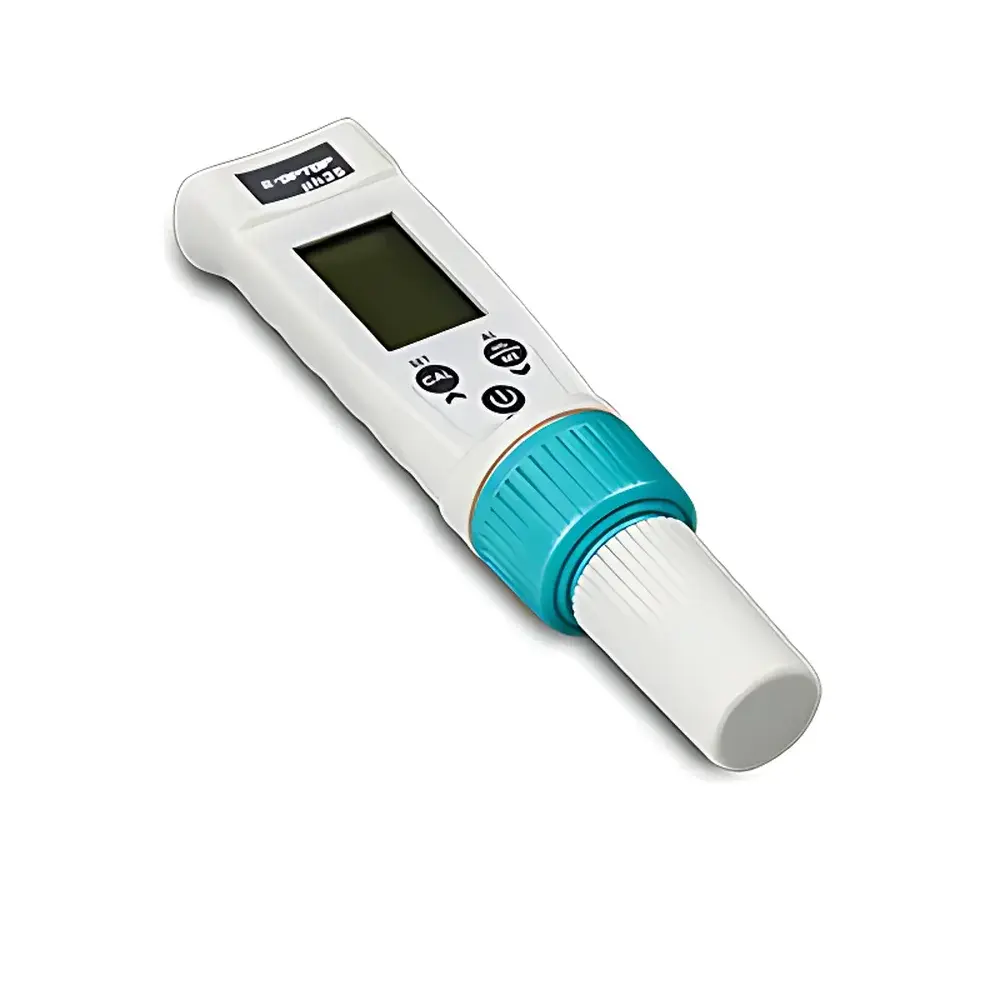
SOP TOP DO35 Portable Dissolved Oxygen Meter
| Brand | SOP TOP |
|---|---|
| Model | DO35 |
| Type | Portable Electrochemical Dissolved Oxygen Meter |
| Measurement Principle | Clark-type Polarographic Membrane Electrode |
| Display | Multi-line LED with backlight (22 × 32 mm) |
| Protection Rating | IP67 |
| Power Supply | 1 × AA alkaline battery (1.5 V) |
| Auto-off | 6 min inactivity with data retention |
| Data Storage | 10 measurement records |
| Operating Temperature | 0–60.0 °C (32–140.0 °F) |
| DO Range | 0.00–20.00 mg/L and 0.0–200.0 % saturation |
| Resolution | 0.01 mg/L, 0.1 %, 0.1 °C, 1 °F |
| Accuracy | ±1.5 % of full scale |
| Temperature Compensation | Automatic or manual |
| Atmospheric Pressure Compensation | 600–1100 mbar |
| Salinity Compensation | 0.0–140.0 ppt |
| Calibration | 1-point or 2-point (air-saturated water or zero-oxygen solution) |
| Hold Function | Yes |
| Low-Battery Indicator | Yes |
Overview
The SOP TOP DO35 Portable Dissolved Oxygen Meter is an industrial-grade handheld electrochemical analyzer engineered for reliable, on-site measurement of dissolved oxygen (DO) concentration in aqueous environments. It employs a Clark-type polarographic membrane electrode — a proven, stable sensing architecture widely adopted in environmental monitoring, wastewater treatment, aquaculture, and laboratory fieldwork. The instrument operates on the principle of oxygen diffusion through a gas-permeable membrane to a cathode, where reduction current is linearly proportional to partial pressure of O₂. This current is converted to concentration units (mg/L) and percent saturation (%), both referenced to temperature, atmospheric pressure, and salinity. Designed for rugged daily use, the DO35 meets IP67 ingress protection standards, ensuring dust-tight operation and submersion resistance up to 1 meter for 30 minutes — critical for field technicians working in rain, humid labs, or near open water bodies.
Key Features
- True dual-range DO display: 0.00–20.00 mg/L and 0.0–200.0 % saturation — optimized for both low-oxygen anaerobic zones and hyper-saturated surface waters.
- Integrated temperature sensor with automatic or user-selectable compensation — eliminates manual correction errors across 0–60.0 °C operating range.
- Real-time atmospheric pressure compensation (600–1100 mbar) and salinity adjustment (0.0–140.0 ppt), enabling accurate DO reporting at elevation or in brackish/estuarine systems.
- High-contrast multi-line LED display (22 × 32 mm) with energy-efficient backlight — legible under low-light conditions without draining battery life.
- Intelligent power management: auto-shutdown after 6 minutes of inactivity, with all active readings preserved in non-volatile memory.
- Onboard data storage for 10 measurement sets — includes timestamped DO value, temperature, % saturation, and calibration status — exportable via manual transcription for QA/QC logs.
- Robust mechanical design with sealed keypad and reinforced housing — compliant with IEC 60529 IP67 specifications for field durability.
Sample Compatibility & Compliance
The DO35 is validated for use with freshwater, seawater, wastewater effluent, aquarium systems, bioreactor influents, and process streams in food & beverage production. Its Clark electrode configuration requires routine membrane replacement and electrolyte refilling per manufacturer guidelines to maintain metrological integrity. While not certified to ISO/IEC 17025 as a standalone calibrated system, the DO35 supports traceable calibration using NIST-traceable saturated air (100 %) and sodium sulfite (0 %) standards. It complies with general requirements of ASTM D888 (Standard Test Methods for Dissolved Oxygen in Water) for field-deployable instrumentation and aligns with EPA Method 360.1 for basic DO screening in ambient water quality assessment. No regulatory certification (e.g., FDA 21 CFR Part 11) applies, as the device lacks network connectivity or electronic audit trail functionality.
Software & Data Management
The DO35 operates as a self-contained, embedded-system instrument with no PC interface, driver software, or cloud synchronization capability. All data handling occurs locally: measurements are displayed in real time, held via “Read Hold” function, and stored in internal memory for immediate review. The 10-record capacity supports short-term trend logging — e.g., diurnal DO profiling in ponds or pre/post-aeration checks in activated sludge tanks. Users may manually transcribe values into LIMS-compatible spreadsheets or paper-based GLP-compliant field notebooks. For laboratories requiring digital traceability, SOP TOP recommends pairing the DO35 with external data loggers or third-party Bluetooth adapters (not supplied) — though such integration falls outside factory validation scope.
Applications
- Environmental field surveys: Stream health assessment, lake stratification studies, wetland restoration monitoring.
- Wastewater operations: Aeration basin optimization, return activated sludge (RAS) control, effluent compliance verification per local discharge permits.
- Aquaculture management: Real-time DO tracking in hatcheries, raceways, and recirculating aquaculture systems (RAS) to prevent hypoxia-induced mortality.
- Educational laboratories: Undergraduate chemistry and environmental science courses emphasizing electrochemical sensor fundamentals and water quality parameter interdependence.
- Food processing: Monitoring DO levels in rinse water, CIP solutions, and packaging headspace validation (indirect application via liquid-phase proxy).
FAQ
What type of electrode does the DO35 use?
It uses a replaceable Clark-type polarographic dissolved oxygen sensor with Teflon membrane and KCl-based electrolyte.
Is calibration required before each use?
For quantitative accuracy, single-point calibration against air-saturated water is recommended before critical measurements; two-point (zero and span) calibration is advised when measuring across wide DO ranges or after membrane replacement.
Can the DO35 measure in seawater?
Yes — with salinity compensation enabled (0.0–140.0 ppt), it corrects for ionic strength effects on oxygen solubility, supporting marine and estuarine applications.
Does the instrument meet GLP or GMP documentation requirements?
No — it lacks electronic audit trail, user authentication, or secure data export. It is suitable for field screening but not for regulated cGMP environments requiring ALCOA+ data integrity.
How often should the membrane and electrolyte be replaced?
Typically every 2–4 weeks under continuous use; more frequently in turbid, high-suspended-solid, or high-H₂S environments — refer to SOP TOP’s Maintenance Schedule PN-DO35-MNT-Rev2.





