
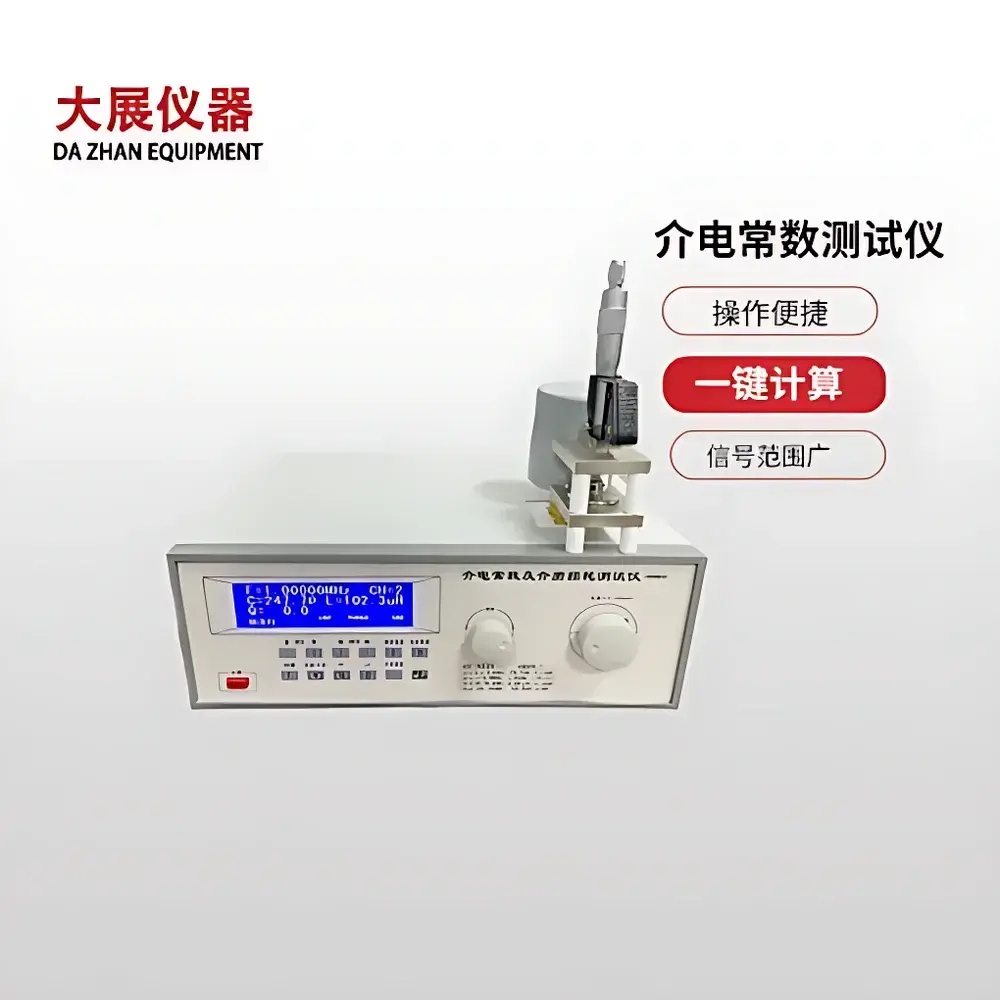
Nanjing Dazhan DZ5001 Dielectric Constant and Loss Tangent Analyzer
| Brand | Nanjing Dazhan |
|---|---|
| Origin | Jiangsu, China |
| Manufacturer Type | Direct Manufacturer |
| Model | DZ5001 |
| Frequency Range | 10 kHz – 100 MHz |
| Frequency Accuracy | ±3×10⁻⁵ (6-digit resolution) |
| Capacitance Measurement Range | 1 pF – 25 nF |
| Capacitance Resolution | 0.1 pF |
| Capacitance Accuracy | ±1 pF or <1% |
| Inductance Measurement Range | 1 nH – 140 mH |
| Inductance Resolution | 0.1 nH |
| Inductance Accuracy | <3% |
| Q Factor Range | 1–1000 |
| Q Resolution | 0.1 (4-digit display) |
| Q Measurement Error | <5% |
| Dielectric Constant (εᵣ) Display Accuracy | ±0.001 |
| Dissipation Factor (tan δ) Display Accuracy | ±0.0001 |
| Sample Thickness Range | 0.1 mm – 10 mm |
| Compliance | GB/T 1693–2007 |
| Auto-Null Function | Residual inductance & lead inductance compensation |
| Tuning Capacitor | 17–240 pF (silver-plated monolithic) |
| Resonance Search | Motorized auto-scan |
| Display | LCD showing F, L, C, Q, Lₜ, Cₜ, εᵣ, Tₙ, etc. |
Overview
The Nanjing Dazhan DZ5001 Dielectric Constant and Loss Tangent Analyzer is a precision impedance-resonance instrument engineered for the quantitative characterization of dielectric properties in solid insulating materials. It operates on the principle of series resonance in a high-Q LC circuit, where the sample—configured as a parallel-plate capacitor—is integrated into a tunable resonant cavity. By precisely measuring the resonant frequency (f), dynamic capacitance (C), and quality factor (Q) under controlled sinusoidal excitation across a wide frequency band (10 kHz to 100 MHz), the system calculates relative permittivity (εr) and dissipation factor (tan δ) using standardized physical models defined in GB/T 1693–2007. Unlike broadband impedance analyzers or network analyzers, the DZ5001 employs direct resonance null detection with motorized capacitance tuning, delivering superior signal-to-noise ratio and measurement stability—particularly critical for low-loss ceramics, polymer films, and high-purity oxides where tan δ values fall below 10−4.
Key Features
- Automated residual inductance compensation: Real-time subtraction of fixture inductance and parasitic lead inductance, eliminating systematic offset errors inherent in high-frequency LCR measurements.
- Motor-driven precision tuning capacitor (17–240 pF): Silver-plated monolithic construction ensures thermal stability and repeatability; step-motor control enables reproducible resonance point localization within ±0.1 pF.
- Direct digital synthesis (DDS) signal source: 6-digit frequency resolution (±3×10⁻⁵), enabling traceable calibration against national frequency standards and compliance with metrological requirements for R&D labs.
- High-fidelity 12-bit ADC acquisition: Ensures stable Q-factor readings even for ultra-low-loss materials (e.g., fused quartz, sapphire substrates), minimizing drift during extended measurement cycles.
- Integrated thickness-aware εr computation: Accepts user-input sample thickness (0.1–10 mm) and automatically applies geometric correction per ASTM D150 and IEC 60250, reducing operator-induced calculation error.
- Multi-parameter real-time LCD display: Simultaneous readout of resonant frequency (F), calibrated inductance (L), tuning capacitance (C), Q-value, total inductance (Lt), total capacitance (Ct), εr, and normalized thickness (Tn).
Sample Compatibility & Compliance
The DZ5001 is optimized for rigid, planar dielectrics with uniform cross-sections, including but not limited to alumina and zirconia ceramics, borosilicate glass wafers, polyimide and PTFE films, mica sheets, and fired porcelain substrates. Electrode configuration follows standard parallel-plate geometry with gold-sputtered or vacuum-deposited electrodes (user-supplied). The system conforms to GB/T 1693–2007 “Determination of Dielectric Constant and Dielectric Loss Tangent of Solid Electrical Insulating Materials at Power, Audio and Radio Frequencies”, and its measurement methodology aligns with foundational principles referenced in ASTM D150, IEC 60250, and ISO 18166. While not certified for GLP/GMP environments out-of-the-box, its deterministic resonance algorithm, audit-ready parameter logging, and traceable frequency source support validation protocols required under FDA 21 CFR Part 11 when integrated into validated laboratory information management systems (LIMS).
Software & Data Management
The DZ5001 operates as a standalone benchtop instrument with embedded firmware—no external PC dependency required for basic operation. All measured parameters are stored in non-volatile memory with timestamping. Optional RS-232 or USB-to-serial interface enables ASCII data streaming to third-party software (e.g., LabVIEW, MATLAB, Python-based analysis suites) for batch reporting, statistical process control (SPC), or integration into automated material qualification workflows. Exported datasets include raw resonance coordinates, calculated εr and tan δ, measurement date/time, operator ID field, and environmental metadata (if external temperature/humidity sensors are connected). Firmware supports user-defined pass/fail thresholds for Q-value screening, with audible/visual alerts triggered upon deviation from preset limits (e.g., Q ≥ 500 for aerospace-grade composites).
Applications
- Quality assurance of ceramic capacitor dielectrics (BaTiO3, CaZrO3) during sintering process development.
- Low-loss characterization of microwave substrate materials (RT/duroid®, Rogers RO4000®) for RF PCB design validation.
- Research into ferroelectric phase transitions via temperature-dependent εr profiling (when paired with environmental chamber).
- Evaluation of moisture absorption effects in polymer encapsulants by tracking tan δ shift at 1 MHz.
- Teaching laboratories: Demonstrating Debye relaxation, interfacial polarization, and Cole-Cole plot generation.
- Standards laboratories: Cross-validation against primary reference materials (e.g., NIST SRM 1827 fused silica).
FAQ
What sample preparation is required?
Flat, parallel surfaces with electrode coverage ≥90% of area; thickness must be uniform within ±2% across measurement zone.
Can the DZ5001 measure liquids or powders?
No—it is designed exclusively for solid, self-supporting dielectrics compatible with parallel-plate electrode geometry.
Is calibration traceable to national standards?
Yes: internal DDS frequency source is calibrated against a TCXO referenced to UTC via GPS-disciplined oscillator; capacitance calibration uses NIST-traceable air-dielectric standards.
How does automatic residual inductance compensation work?
The instrument performs a two-point open-circuit calibration sequence, modeling fixture inductance as a series impedance and digitally subtracting its contribution from all subsequent measurements.
Does it support temperature-controlled measurements?
Not natively—but the compact form factor (280 × 220 × 120 mm) allows integration into custom thermal chambers with feedthrough electrodes and external temperature monitoring.



