
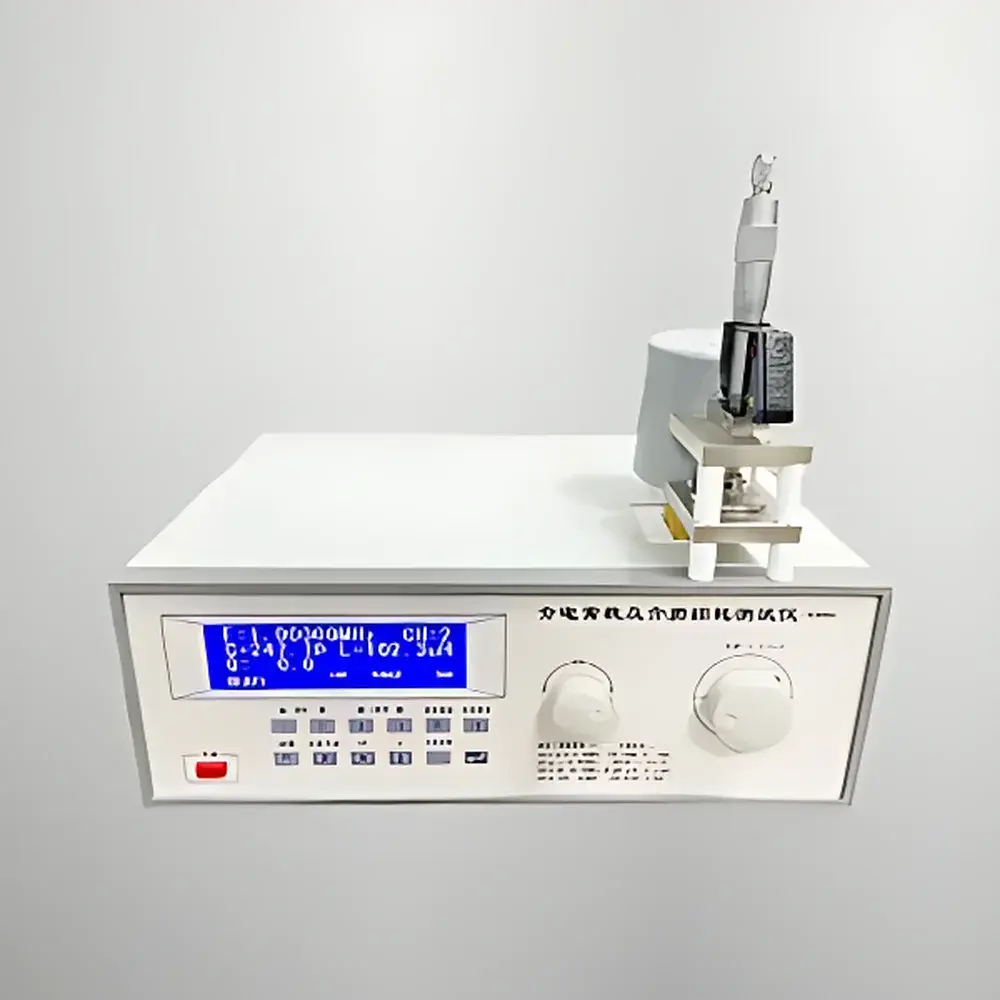
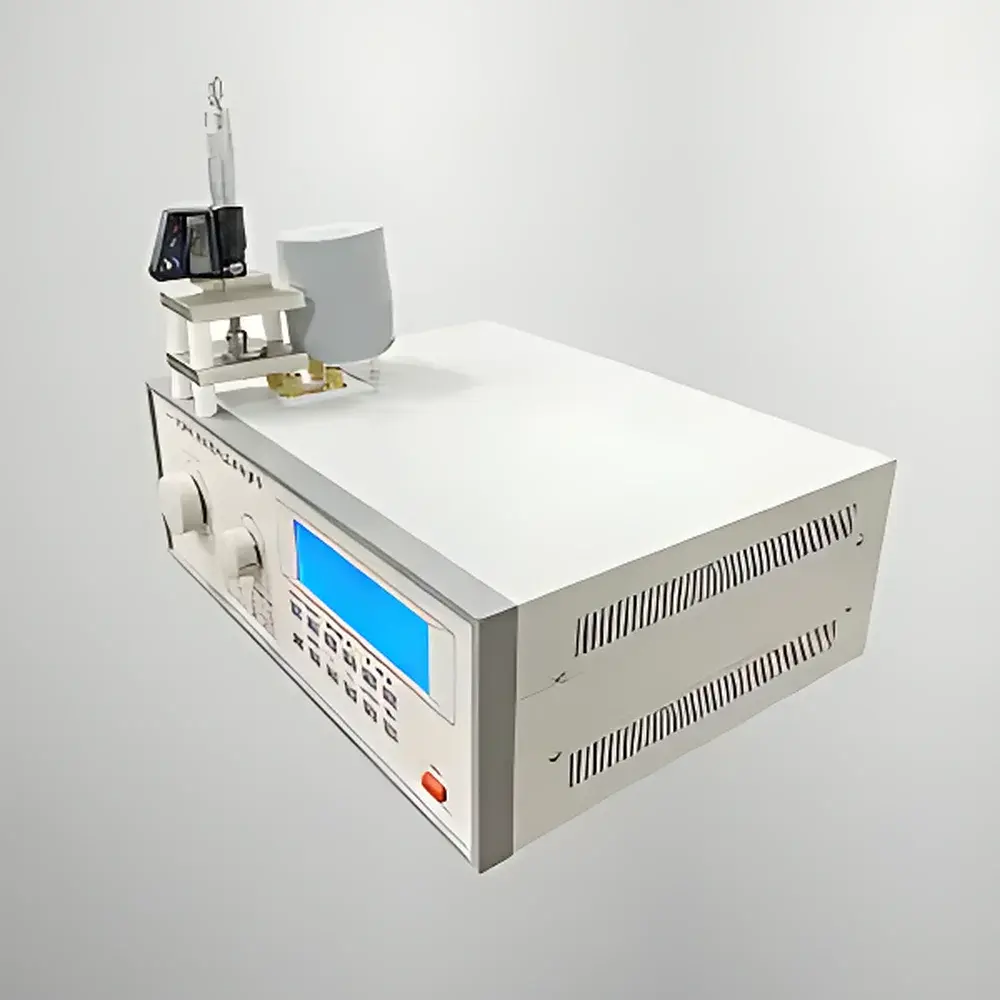
Nanjing Dazhan DZ5001 Dielectric Constant Analyzer
| Brand | Nanjing Dazhan |
|---|---|
| Origin | Jiangsu, China |
| Manufacturer Type | Manufacturer |
| Country of Origin | China |
| Model | DZ5001 |
| Price Range | USD 2,800 – 7,000 |
| Measurement Principle | Resonant Cavity / Series/Parallel Resonance Method (Q-factor based) |
| Frequency Range | 10 kHz – 100 MHz (DDS Synthesized, 7000:1 Sweep Ratio) |
| Frequency Accuracy | ±3×10⁻⁵ (6-digit resolution) |
| Capacitance Measurement Range | 1 pF – 25 nF |
| Capacitance Resolution | 0.1 pF |
| Capacitance Accuracy | ±1 pF or <1% |
| Inductance Measurement Range | 1 nH – 140 mH |
| Inductance Resolution | 0.1 nH |
| Inductance Accuracy | <3% |
| Q Factor Range | 1–1000 |
| Q Resolution | 0.1 (4-digit effective) |
| Q Measurement Error | <5% |
| Dielectric Constant (εᵣ) Display Accuracy | ±0.001 (3-digit decimal) |
| Loss Tangent (tan δ) / Dissipation Factor Accuracy | ±0.0001 (4-digit decimal) |
| Sample Thickness Range | 0.1 mm – 10 mm |
| Residual Inductance Compensation | Automatic (integrated lead & fixture inductance nulling) |
| Compliance Standard | GB/T 1693–2007 |
Overview
The Nanjing Dazhan DZ5001 Dielectric Constant Analyzer is a precision impedance-based measurement system engineered for the quantitative characterization of dielectric properties in solid insulating materials. It operates on the principle of series/parallel resonance in a high-Q LC circuit, where the sample—acting as a dielectric spacer between parallel-plate electrodes—alters the resonant frequency and bandwidth of the tuned circuit. By precisely tracking shifts in resonant frequency (fr), quality factor (Q), and effective capacitance (Ct), the instrument calculates relative permittivity (εr) and dissipation factor (tan δ) using standardized formulations derived from ASTM D150 and IEC 60250. Designed for laboratory-grade reproducibility, the DZ5001 integrates digital signal synthesis (DDS), 12-bit high-stability analog-to-digital conversion, and real-time automatic compensation for residual inductance—enabling accurate measurements across low-loss ceramics, polymer films, glass substrates, and oxide-based composites without manual calibration drift.
Key Features
- Wide-frequency DDS signal source (10 kHz to 100 MHz) with 6-digit frequency resolution and ±3×10⁻⁵ absolute accuracy
- Automatic resonant point search via stepper-motor-driven variable capacitor (17–240 pF main tuning range)
- Direct capacitance measurement capability from 1 pF to 25 nF with 0.1 pF resolution and <1% full-scale error
- Integrated residual inductance nulling algorithm that compensates for fixture and lead parasitics in real time
- LCD display of primary parameters: resonant frequency (fr), measured inductance (Lt), total capacitance (Ct), Q, εr, tan δ, and sample thickness (Tn)
- Dual-mode Q-range operation (auto/manual) with visual/audible pass/fail alert for preset Q thresholds (5–1000)
- Micrometer-integrated sample holder enabling precise, repeatable thickness control from 0.1 mm to 10 mm
Sample Compatibility & Compliance
The DZ5001 supports flat, homogeneous, non-conductive solid specimens including alumina, zirconia, cordierite, fused silica, borosilicate glass, polyimide, PTFE, epoxy laminates, and mica sheets. Samples must exhibit uniform thickness and surface parallelism within ±1 µm to ensure field homogeneity. Electrode contact is established via gold-plated parallel plates with adjustable pressure; no conductive coating is required for low-conductivity ceramics or polymers. The analyzer conforms to GB/T 1693–2007 (“Determination of Dielectric Constant and Dissipation Factor of Solid Electrical Insulating Materials at Power, Audio and Radio Frequencies”) and aligns with metrological traceability requirements under ISO/IEC 17025. While not FDA 21 CFR Part 11–certified out-of-the-box, its data logging architecture supports audit-trail-ready implementation when integrated with validated LIMS environments.
Software & Data Management
The DZ5001 operates as a standalone instrument with embedded firmware—no external PC dependency required for basic operation. All measurements are stored internally with timestamped parameter sets (fr, Ct, Q, εr, tan δ, Tn). Optional RS-232 or USB-C interface enables export of ASCII-formatted datasets for post-processing in MATLAB, Python (NumPy/Pandas), or Excel. Raw data includes full resonance sweep traces (frequency vs. amplitude/Q), facilitating advanced modeling of dispersion behavior (e.g., Debye relaxation analysis). Calibration constants—including electrode area, gap distance, and fixture capacitance—are user-configurable and retained in non-volatile memory. Firmware updates are performed via SD card, ensuring long-term maintainability without hardware modification.
Applications
- Quality control of high-purity ceramic substrates used in multilayer capacitors and LTCC modules
- Development of low-loss dielectrics for 5G millimeter-wave PCBs and antenna-in-package (AiP) assemblies
- Research into polarization mechanisms in ferroelectric thin films and relaxor perovskites
- Evaluation of moisture absorption effects on epoxy molding compounds (EMCs) and underfill materials
- Validation of thermal aging performance in high-voltage insulation systems (e.g., transformer bushings, cable terminations)
- Teaching laboratories for undergraduate solid-state physics and materials science curricula
FAQ
What sample preparation is required prior to measurement?
Flat, polished surfaces with parallelism ≤1 µm and thickness uniformity ±0.5% across the electrode area are mandatory. Surface contamination must be removed via isopropanol wipe and nitrogen drying.
Can the DZ5001 measure liquids or powders?
No—it is configured exclusively for solid, self-supporting dielectrics. Liquid or powder characterization requires a dedicated coaxial probe or cavity perturbation system.
Is temperature-controlled testing supported?
The base unit does not include environmental chamber integration; however, the sample stage is compatible with third-party heated/cooled platens (−40°C to +200°C) when equipped with feedthrough connectors.
How is traceability maintained for regulatory submissions?
Calibration certificates (traceable to NIM China) are provided with each unit. Users may perform periodic verification using certified reference standards (e.g., quartz crystal, sapphire wafer) per GB/T 1693–2007 Annex B.
Does the instrument support automated batch testing?
Yes—via optional serial command protocol (SCPI-like), enabling integration into automated test sequences controlled by LabVIEW or Python scripts.



