
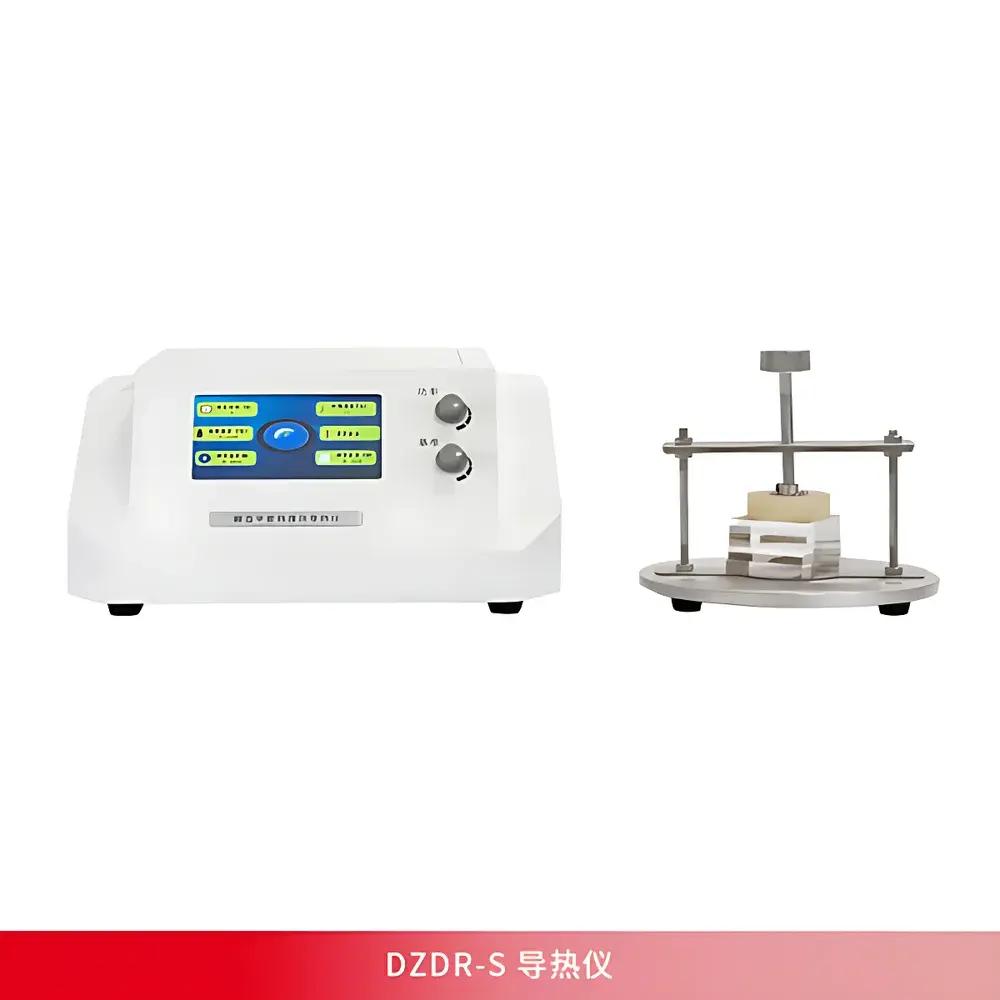
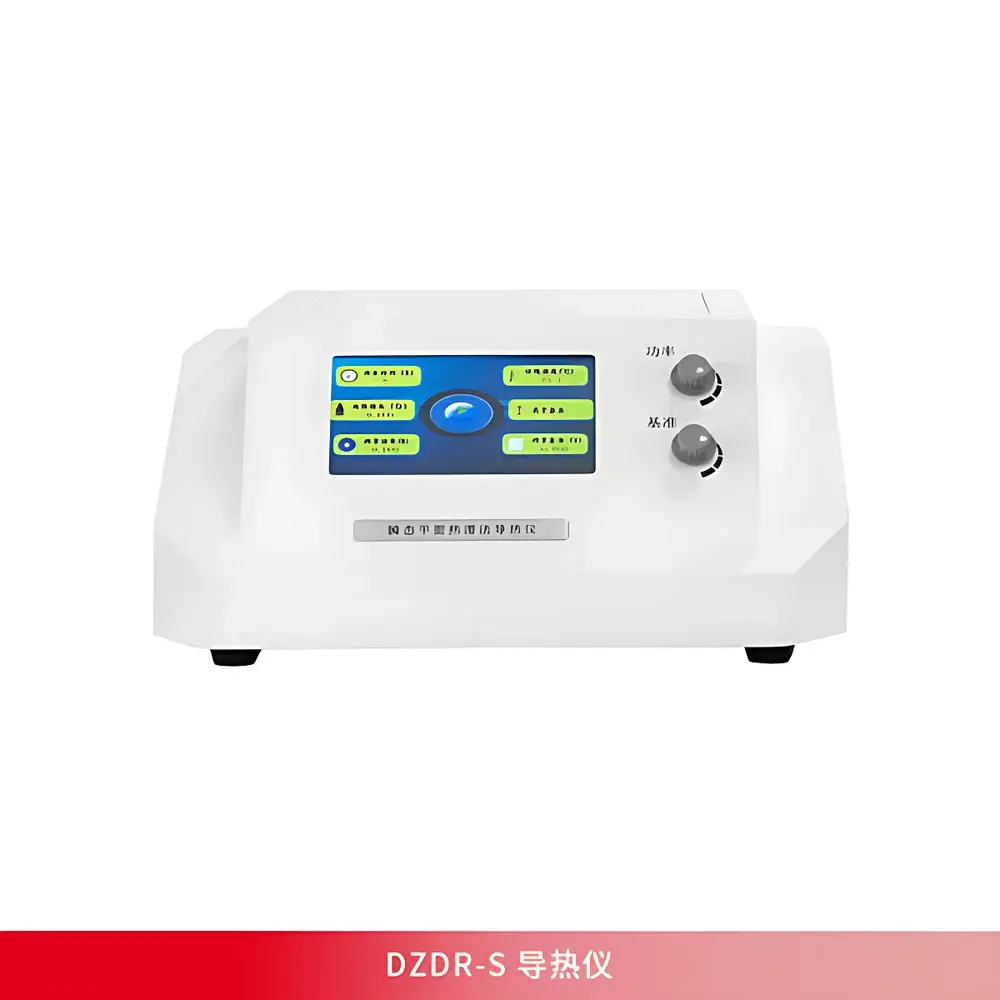
Nanjing Dazhan DZDR-S Transient Plane Source (TPS) Thermal Conductivity Analyzer
| Brand | Nanjing Dazhan |
|---|---|
| Origin | Jiangsu, China |
| Manufacturer Type | Direct Manufacturer |
| Instrument Type | Transient Plane Source (TPS) Method |
| Sample Throughput | Single sample per test |
| Test Environment | Ambient temperature (20–30 °C) |
| Thermal Conductivity Range | 0.0001–300 W/(m·K) |
| Accuracy | ±3% |
| Sample Forms | Liquids, powders, solids, pastes, metals, gels, coatings, thin films, and insulating materials |
| Probe Options | 7.5 mm, 15 mm, and 50 mm diameter dual-spiral probes |
| Measurement Time | 5–160 s (user-configurable) |
| Repeatability | ≤3% |
| Operating Temperature Range | 20–130 °C |
| Power Supply | AC 220 V, <500 W |
| Sample Dimensions (min.) | 15×15×3.75 mm (for 7.5 mm probe), 30×30×7.5 mm (for 15 mm probe), 50×50×7.5 mm (for 50 mm probe) |
| Optional Accessories | Liquid test cell, powder test capsule, custom probe fixtures |
Overview
The Nanjing Dazhan DZDR-S Transient Plane Source (TPS) Thermal Conductivity Analyzer is a precision instrument engineered for rapid, contact-based thermal property characterization of heterogeneous material systems. It operates on the transient plane source principle—a well-established, ISO 22007-2 compliant method—where a thin, double-helical sensor acts simultaneously as both heat source and resistance thermometer. Upon application of a constant current pulse, the sensor’s time-dependent temperature rise is recorded with microsecond resolution. Thermal conductivity (λ) is derived from the slope of the ln(ΔT) vs. ln(t) curve in the mid-time domain, independent of absolute temperature or contact resistance effects. Unlike steady-state guarded-hot-plate or comparative cut-bar techniques, the TPS method eliminates the need for thermal equilibrium, enabling measurements within seconds while preserving sample integrity. The DZDR-S is optimized for routine QC laboratories, R&D facilities, and academic thermal physics groups requiring traceable, reproducible λ data across diverse physical states—including Newtonian and non-Newtonian liquids, suspensions, slurries, polymer melts, phase-change materials, and high-conductivity metallic foams.
Key Features
- Direct, absolute measurement of thermal conductivity without calibration standards—traceable to SI units via fundamental heat diffusion theory.
- Dual-spiral probe architecture with integrated platinum RTD elements ensures uniform heating and high-fidelity signal capture; available in three diameters (7.5 mm, 15 mm, 50 mm) to match sample geometry and conductivity range.
- ARM-based embedded control system enables real-time signal processing, adaptive pulse duration selection, and deterministic response timing—critical for minimizing edge effects and self-heating artifacts.
- High-resolution analog-to-digital acquisition (24-bit ADC) captures thermal transients with sub-millikelvin sensitivity, supporting robust statistical averaging across multiple pulses.
- Modular sample stage accommodates variable thicknesses and surface topographies; no machining, polishing, or interfacial grease required—ideal for soft, fragile, or anisotropic samples.
- Non-destructive operation preserves sample reusability—essential for precious formulations, biological fluids, or limited-batch industrial materials.
- Integrated precision balance (optional) enables density-correlated thermal diffusivity estimation when combined with specific heat data from complementary DSC measurements.
Sample Compatibility & Compliance
The DZDR-S accepts unmodified samples in liquid, paste, granular, solid, and composite forms—including aqueous and organic solvents, silicone oils, molten polymers, ceramic slurries, graphite pastes, and metal powders. Its design conforms to ISO 22007-2:2015 (Plastics — Determination of thermal conductivity and thermal diffusivity — Part 2: Transient plane heat source (hot disc) method) and supports GLP-compliant workflows through timestamped audit logs, user-access controls, and electronic signature-ready reporting. While not FDA 21 CFR Part 11 certified out-of-the-box, the firmware architecture permits integration into validated environments via external LIMS interfaces and encrypted data export protocols (CSV, XML).
Software & Data Management
The instrument ships with Windows-compatible analytical software featuring intuitive wizard-guided test setup, automated probe-sample alignment validation, and real-time thermal decay visualization. Raw voltage-time datasets are stored in HDF5 format with embedded metadata (operator ID, ambient RH/T, probe serial number, pulse parameters). Post-acquisition modules support batch processing, outlier rejection using Grubbs’ test, uncertainty propagation per GUM (JCGM 100:2008), and export to ASTM E1225-compliant reports. All calculations apply the exact TPS solution for finite-thickness, anisotropic, and multi-layer configurations—enabling accurate λ determination even for thin films (<1 mm) or low-conductivity aerogels.
Applications
- Quality assurance of heat-transfer fluids in HVAC, battery thermal management, and semiconductor cooling systems.
- Rapid screening of nanofluid formulations (e.g., Al₂O₃/water, graphene/ethylene glycol) during dispersion optimization.
- Thermal interface material (TIM) development—validating bond-line thickness effects on effective λ under compressive load.
- Pharmaceutical excipient characterization: correlating hydration state, crystallinity, and λ in lyophilized powders and ointment bases.
- Geothermal grout validation: measuring λ of bentonite-cement slurries at varying water-cement ratios and curing times.
- Educational use in materials science labs for hands-on demonstration of Fourier’s law, thermal effusivity, and phonon transport limitations.
FAQ
Does the DZDR-S require calibration with reference materials?
No—TPS is an absolute method. Calibration is performed electronically via probe resistance verification and ambient temperature compensation. NIST-traceable glycerol or Pyroceram® standards may be used for performance verification but are not required for routine operation.
Can it measure thermal conductivity of volatile liquids?
Yes—when used with the sealed liquid test cell (included option), the system maintains vapor containment during 5–120 s measurements, preventing evaporation-induced drift. Recommended for liquids with vapor pressure <10 kPa at 25 °C.
Is the instrument suitable for ISO/IEC 17025 accredited testing?
Yes—the hardware design, documented uncertainty budget (±3% expanded uncertainty, k=2), and full audit trail functionality meet Clause 7.7 requirements for measurement traceability and result validity.
How does probe size selection affect measurement accuracy?
Larger probes improve signal-to-noise ratio for low-λ materials (<0.1 W/(m·K)) but require proportionally larger samples to minimize boundary effects. Smaller probes enable localized mapping of heterogeneous composites or thin-layer systems, subject to minimum thickness constraints.
What maintenance is required for long-term stability?
Annual verification of probe resistance drift (<0.05 Ω), ADC linearity check using calibrated voltage sources, and cleaning of probe surfaces with ethanol and lint-free wipes constitute the full preventive maintenance protocol. No consumables are required.



