
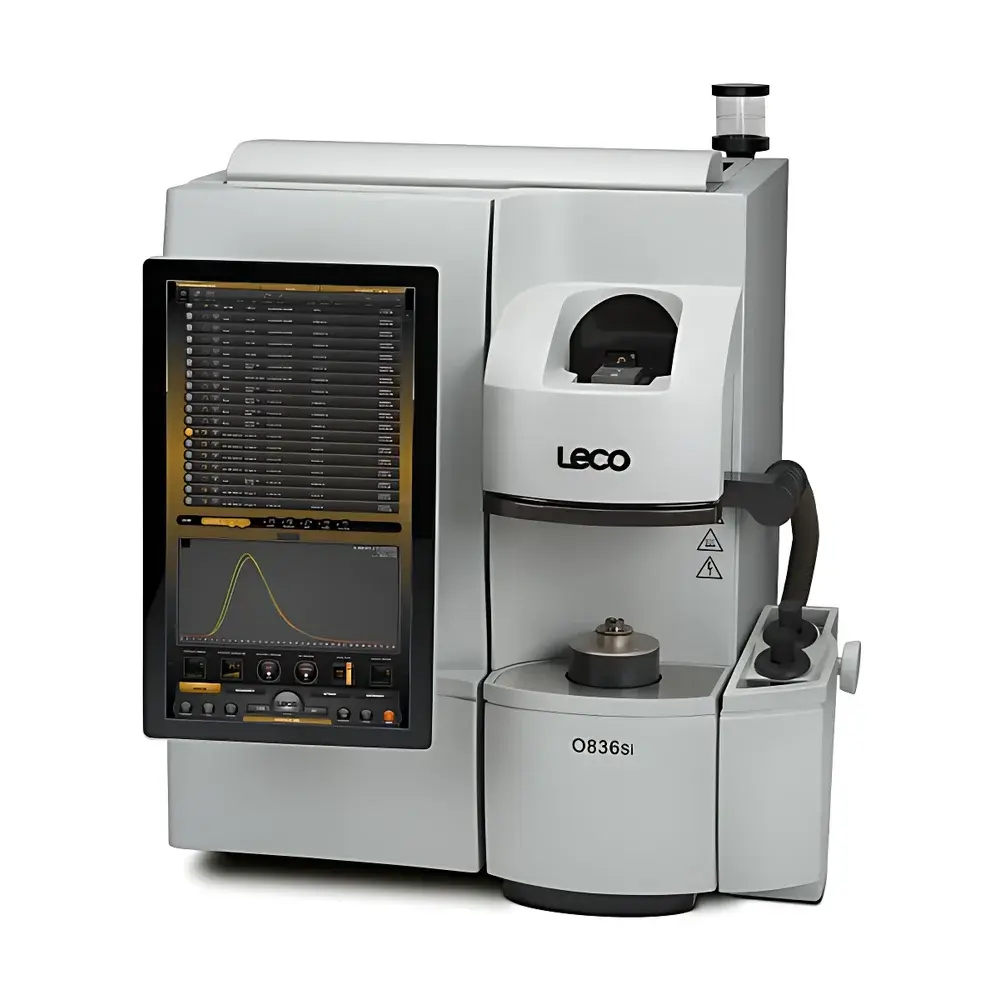
LECO O836Si Oxygen Analyzer for Silicon
| Brand | LECO |
|---|---|
| Origin | USA |
| Manufacturer | LECO Corporation |
| Model | O836Si |
| Instrument Type | Oxygen Analyzer |
| Detection Range | 0.03–150 ppm |
| Analytical Precision | ±0.015 ppm |
| Analysis Time | 110 s |
| Detector | Non-Dispersive Solid-State Infrared (NDIR) |
| Furnace | Programmable Pulse Electrode Furnace with Power & Current Control |
| Sample Introduction | Flip-Action Loading Port |
| Output Units | ppma and ppmw |
| Peak Separation Method | Surface Oxide vs. Bulk Oxide Quantification |
| Blank Level | Ultra-Low Background |
Overview
The LECO O836Si Oxygen Analyzer is a dedicated high-sensitivity elemental analyzer engineered for the quantitative determination of interstitial oxygen in crystalline silicon—particularly monocrystalline and polycrystalline wafers used in semiconductor and photovoltaic manufacturing. It operates on the principle of inert gas fusion infrared absorption: solid silicon samples are rapidly heated to >3,000 °C in a graphite crucible under high-purity helium or argon carrier gas; liberated oxygen reacts with carbon from the crucible to form CO, which is then quantified via non-dispersive solid-state infrared detection at 4.67 µm. This method delivers trace-level sensitivity essential for process control in 300 mm wafer production, where oxygen concentrations directly influence thermal donor formation, crystal lattice stability, and device yield. The system is fully compliant with ASTM F1270–22 (“Standard Test Method for Oxygen in Silicon by Inert Gas Fusion–Infrared Detection”) and supports GLP/GMP-aligned workflows through audit-trail-capable software.
Key Features
- Ultra-low detection limit of 0.03 ppm (30 ppb) with certified precision of ±0.015 ppm, validated across NIST-traceable silicon reference materials (e.g., SRM 2137).
- Programmable pulse electrode furnace with independent power and current regulation enables precise thermal ramping profiles—critical for differentiating surface oxide (SiOx) from bulk interstitial oxygen without over-decomposition.
- Flip-action sample loading port minimizes atmospheric exposure and ensures reproducible positioning of cylindrical silicon rods or wafers, eliminating orientation-dependent bias in oxygen release kinetics.
- Dual-format output (ppma = atoms per million atoms; ppmw = weight ppm) with automatic stoichiometric conversion based on sample mass, density, and atomic weight inputs.
- Proprietary peak separation algorithm deconvolves overlapping CO evolution peaks during fusion, assigning integrated area to surface oxide (released <800 °C) and bulk oxygen (released 1,800–2,800 °C), enabling independent reporting per ASTM F1270 Annex A2.
- Optimized gas path architecture reduces maintenance intervals by 40% versus prior-generation systems—fewer valves, no moving parts in the IR cell, and helium/argon flow stabilization via mass flow controllers calibrated to ISO 6145-7.
Sample Compatibility & Compliance
The O836Si accommodates standard silicon geometries: 150 mm to 300 mm diameter wafers (as cut or polished), cylindrical ingots (up to Ø50 mm × 100 mm), and diced chips (≥50 mg). Sample mass range is 0.1–1.0 g, with optional micro-crucibles for sub-100 mg analyses. All consumables—including high-purity graphite crucibles (ash content <1 ppm), ceramic liners, and metal filters—are certified to meet SEMI F57 purity specifications. The instrument complies with ISO/IEC 17025:2017 for testing laboratories, supports 21 CFR Part 11 electronic signature and audit trail requirements, and includes factory-installed calibration verification using LECO’s proprietary Si-O certified reference materials (CRM-O-Si-01 through CRM-O-Si-05).
Software & Data Management
Control and data acquisition are managed via LECO’s proprietary ONYX™ software v4.2, running on Windows 10 IoT Enterprise. ONYX provides real-time CO signal visualization, automated baseline correction, peak integration with manual override, and customizable report templates conforming to ISO 10012 and ASTM E29. Raw spectral data (absorbance vs. time) and processed results are stored in encrypted SQLite databases with timestamped operator ID, method version, and environmental log (temperature, pressure, gas purity). Data export supports CSV, XML, and PDF formats; optional LIMS integration via ASTM E1461-compliant HL7 or RESTful API.
Applications
- Quantification of interstitial oxygen in Czochralski-grown silicon wafers for IC fabrication process qualification.
- Monitoring oxygen segregation during epitaxial layer growth and rapid thermal processing (RTP).
- Validation of gettering efficiency in backside oxygen-enriched layers.
- Trace oxygen analysis in high-purity copper (≥99.9999% Cu) for advanced packaging substrates—leveraging same furnace/detector architecture with modified calibration matrices.
- Research into oxygen diffusion kinetics in SiC and GaN substrates under controlled annealing atmospheres.
FAQ
What standards does the O836Si comply with for silicon oxygen analysis?
ASTM F1270–22, ISO 14703:2000, and JIS H 0605:2017.
Can the system analyze both surface and bulk oxygen separately?
Yes—via patented peak deconvolution of the CO evolution profile during programmed heating, as defined in ASTM F1270 Annex A2.
Is operator training and method validation support available?
LECO provides on-site installation qualification (IQ), operational qualification (OQ), and performance qualification (PQ) documentation, plus certified operator training aligned with ISO/IEC 17025 competency requirements.
What maintenance schedule is recommended for routine operation?
Graphite crucibles require replacement after 200–300 analyses; IR detector recalibration every 6 months; full gas path inspection annually—documented in the built-in maintenance scheduler within ONYX software.
Does the system support multi-element analysis (e.g., oxygen + nitrogen)?
No—the O836Si is purpose-built for oxygen-only quantification in silicon. For combined O/N/H analysis, LECO recommends the ONH836 platform with dual-detector configuration.





