
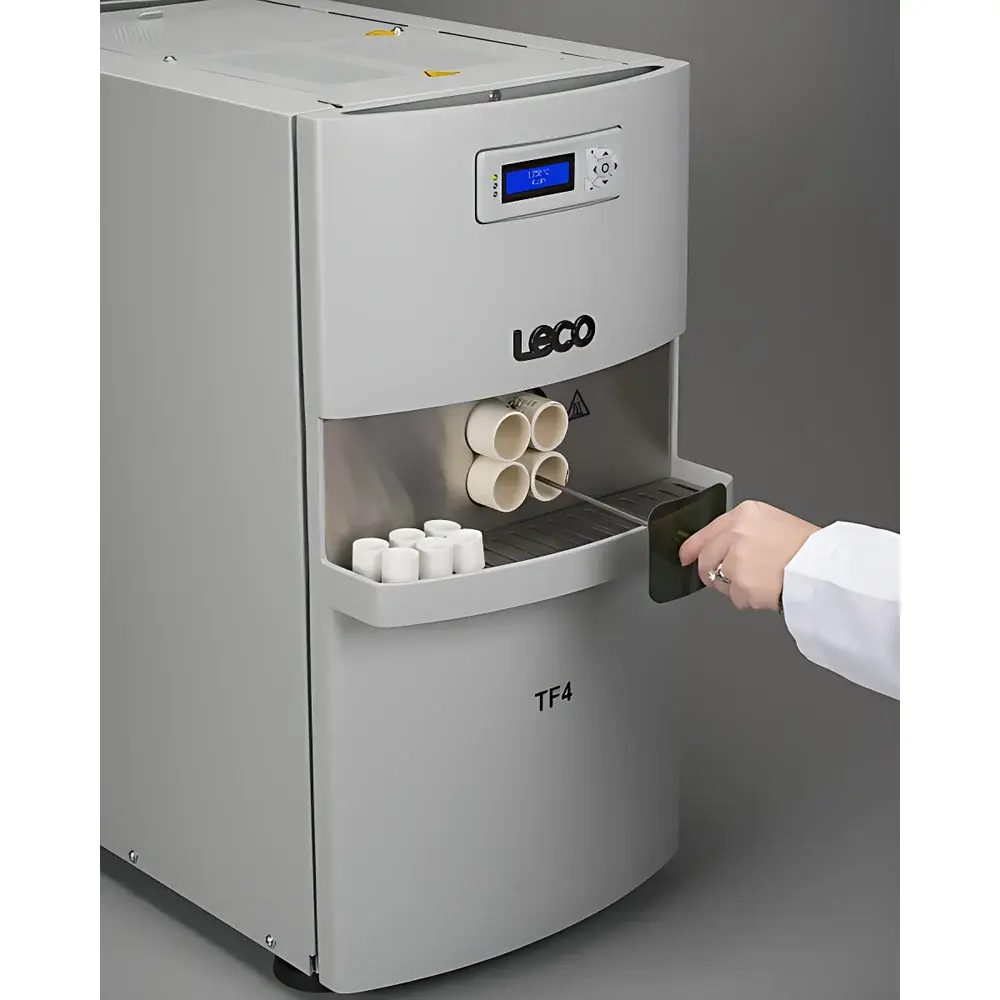
LECO TF4 Tube-Type Crucible Furnace
| Brand | LECO |
|---|---|
| Origin | USA |
| Manufacturer | LECO Corporation |
| Type | Tube Furnace |
| Model | TF4 |
| Maximum Temperature | 1350 °C |
| Temperature Control Accuracy | ±0.5 °C |
| Rated Power | 3520 W |
| Heating Element | Silicon Molybdenum (MoSi₂) Rods |
| Internal Chamber Dimensions | 69 cm (L) × 36 cm (W) × 72 cm (H) |
| Configuration Options | 2-Tube or 4-Tube Modular Arrangement |
| Primary Application | Pre-conditioning of Ceramic Crucibles for Combustion-Based Elemental Analysis (C/S, O/N/H) |
Overview
The LECO TF4 Tube-Type Crucible Furnace is a purpose-engineered thermal conditioning system designed specifically for the high-temperature pre-baking and ashing of ceramic crucibles used in combustion-based elemental analyzers—particularly LECO’s CS-series carbon/sulfur analyzers and ONH oxygen/nitrogen/hydrogen instruments. Operating on resistive heating via dual-zone or quad-zone silicon molybdenum (MoSi₂) heating elements, the TF4 achieves stable, uniform temperatures up to 1350 °C within its insulated refractory chamber. Its tube-based architecture enables spatially segregated, contamination-free crucible processing—critical for minimizing blank contributions during trace-level C/S quantification. Unlike conventional muffle furnaces, the TF4’s modular tube configuration (2-tube or 4-tube variants) permits batch-wise thermal conditioning while preserving crucible integrity and reducing cross-contamination risk between runs. The furnace complies with ASTM E1509–22 (Standard Practice for Calibration of Elemental Analyzers Using Solid Reference Materials) and supports GLP-compliant workflow integration through programmable ramp/soak profiles and digital temperature logging.
Key Features
- High-precision temperature control with ±0.5 °C stability at setpoints up to 1350 °C, achieved via PID-regulated dual thermocouple feedback (one in chamber, one near heating zone)
- Modular tube configuration: independent 2-tube or 4-tube assemblies allow parallel processing of crucibles without thermal interference
- Refractory-lined chamber with low thermal mass insulation ensures rapid heat-up (typical time to 1350 °C: <90 min) and energy-efficient hold cycles
- MoSi₂ heating elements rated for >2000 cycles at 1350 °C, providing long-term repeatability and minimal drift
- Front-access loading with heavy-duty ceramic tube supports and removable quartz or alumina tube liners for easy cleaning and maintenance
- Integrated safety interlocks including over-temperature cutoff, door-open shutdown, and ground-fault circuit interruption
Sample Compatibility & Compliance
The TF4 accommodates standard 25 mL and 35 mL ceramic crucibles (e.g., LECO Part No. 502-185, 502-186) as well as custom crucible geometries up to 80 mm height × 30 mm diameter per tube. Each tube operates as an isolated thermal environment, enabling differential conditioning protocols—for instance, separate ashing (1100 °C, 2 h) and pre-bake (1350 °C, 1 h) sequences across tubes. The furnace meets IEC 61010-1:2010 requirements for laboratory electrical equipment safety and is CE-marked. Its thermal performance aligns with ISO/IEC 17025:2017 clause 6.4.3 (equipment suitability for intended use) and supports audit readiness for FDA 21 CFR Part 11 when paired with LECO’s optional data acquisition module (TF4-DAM).
Software & Data Management
While the base TF4 operates via front-panel digital controller with 10-segment programmable ramp/soak capability, optional integration with LECO’s ThermalLink™ software enables remote monitoring, profile storage, and electronic record generation. All temperature profiles—including ramp rates, dwell times, and actual vs. setpoint deviation logs—are timestamped and exportable as CSV or PDF for QA documentation. Audit trails comply with ALCOA+ principles (Attributable, Legible, Contemporaneous, Original, Accurate), supporting GMP/GLP validation protocols. No cloud dependency: data resides locally on user-configured network drives or USB archives.
Applications
- Pre-conditioning of graphite, ceramic, and metal oxide crucibles prior to carbon/sulfur analysis per ASTM D4294 and ISO 15297
- Residual binder removal from new crucibles to reduce procedural blanks below 0.5 µg C and 0.2 µg S
- Thermal stabilization of crucibles after mechanical cleaning or acid washing
- Controlled ashing of organic residues from previous analyses to prevent carryover contamination
- Calibration verification support: thermal cycling of certified reference materials (CRMs) under identical conditions as routine samples
FAQ
What crucible types are compatible with the TF4?
Standard LECO ceramic crucibles (Part Nos. 502-185, 502-186), high-purity graphite crucibles (e.g., 502-190), and custom alumina/quartz crucibles ≤80 mm tall × 30 mm OD.
Is the TF4 suitable for applications beyond crucible conditioning?
Its design is optimized for crucible thermal pretreatment; it is not intended for general-purpose sintering, annealing, or material synthesis due to fixed tube geometry and lack of atmosphere control.
How does the TF4 minimize blank variability in C/S analysis?
By enabling consistent, high-temperature (1350 °C) oxidative conditioning in inert tube environments, it volatilizes organic residues and stabilizes surface chemistry—reducing background carbon/sulfur signals by >90% versus unconditioned crucibles.
Can the TF4 be integrated into a LIMS or ELN?
Yes—via RS-232 or Ethernet (optional) output, ThermalLink™ software exports metadata and thermal logs compatible with common LIMS/ELN ingestion formats (ASTM E2500, ISA-88).
What maintenance is required for MoSi₂ heating elements?
No periodic replacement is needed under normal operation; visual inspection every 500 cycles and resistance measurement every 1000 cycles are recommended per LECO Maintenance Guide Rev. 4.2.



