
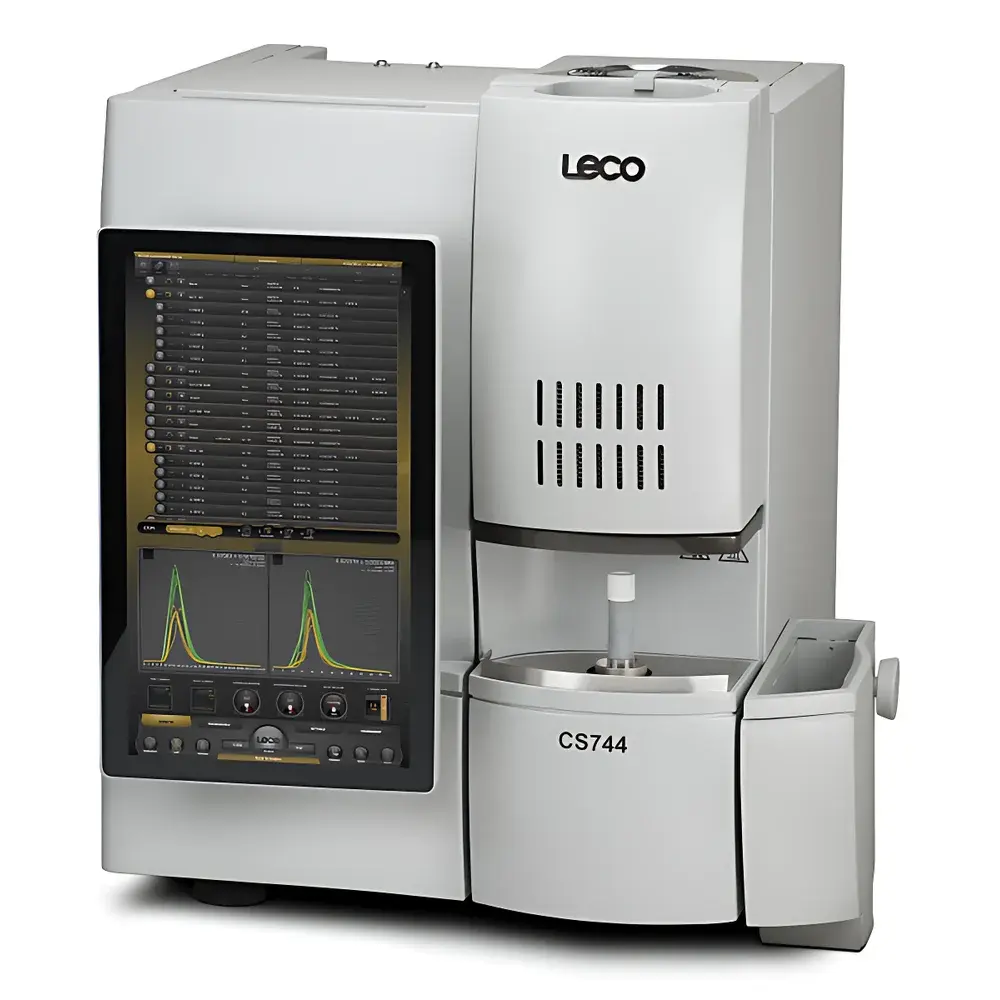
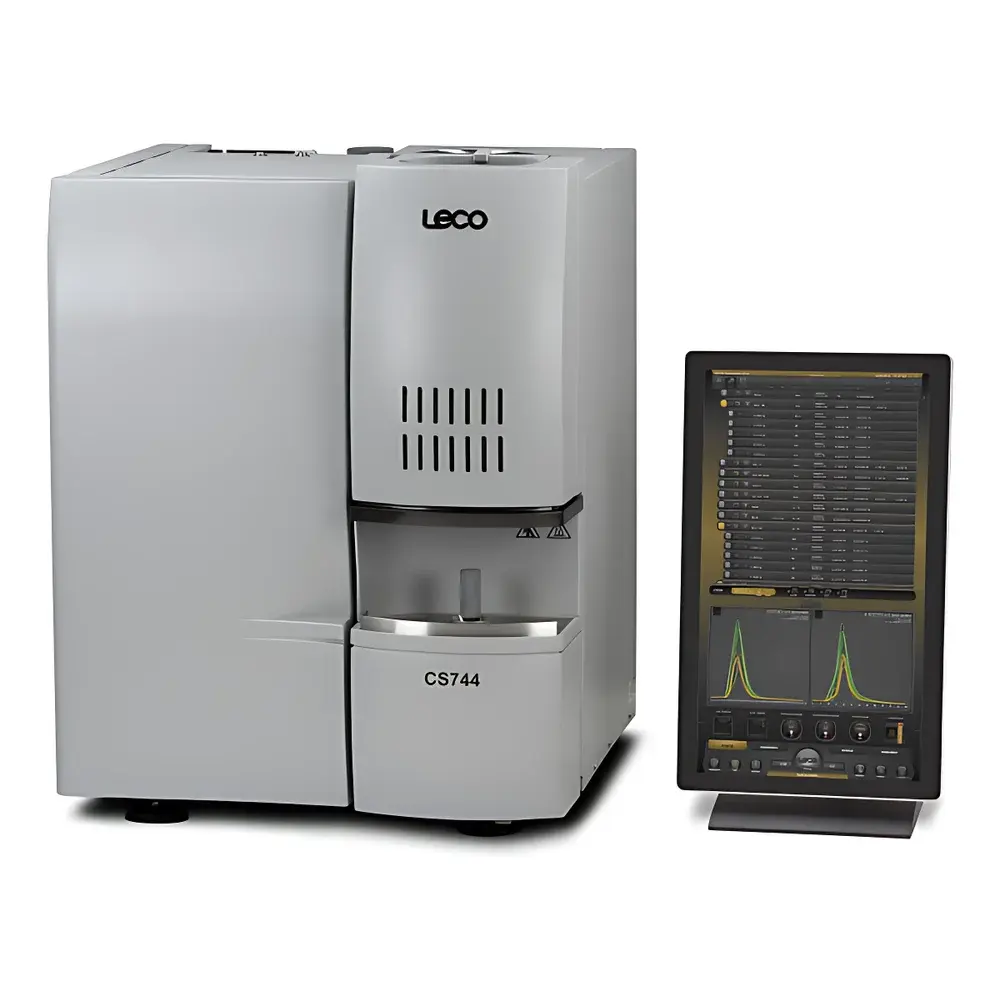
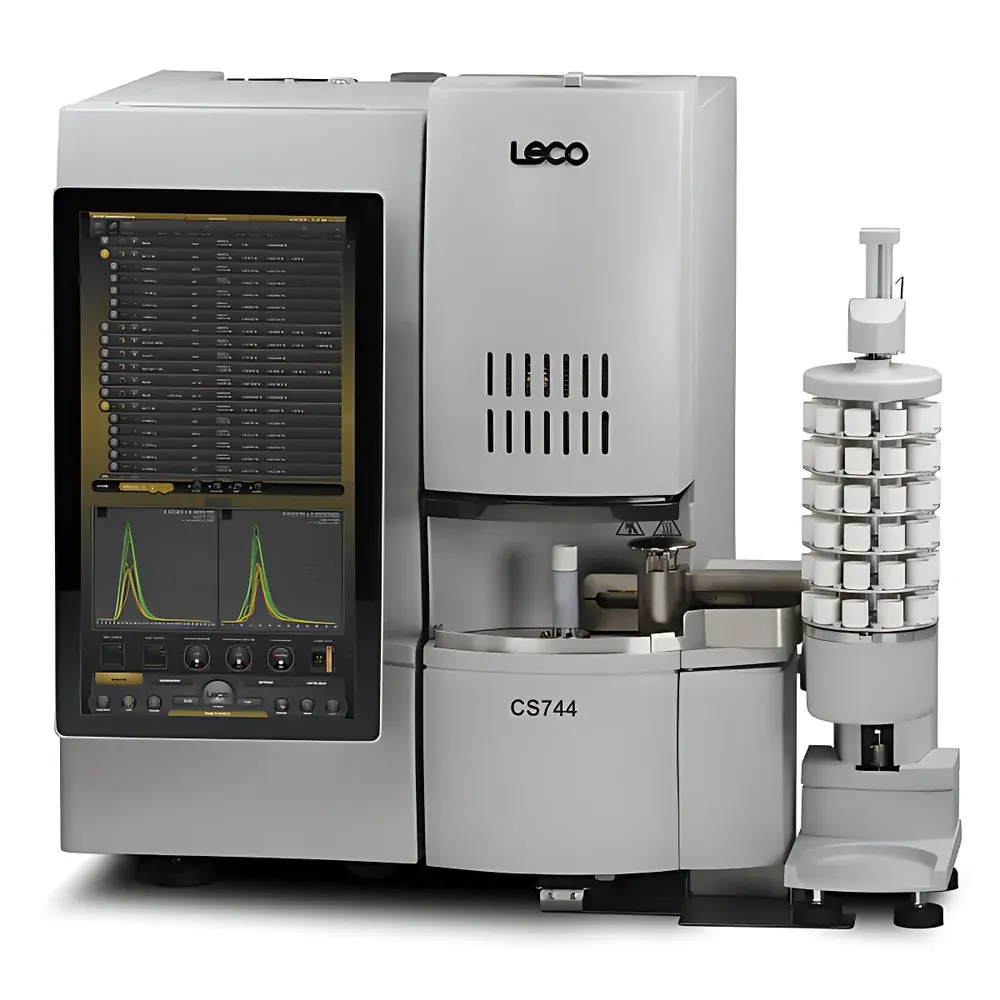
LECO CS744 Carbon and Sulfur Analyzer
| Brand | LECO |
|---|---|
| Origin | USA |
| Manufacturer | LECO Corporation |
| Type | Imported Instrument |
| Model | CS744 |
| Measurement Principle | Infrared Absorption |
| Heating System | High-Frequency Induction Furnace |
| Analysis Time | 40 s |
Overview
The LECO CS744 Carbon and Sulfur Analyzer is a high-precision, dual-element combustion-infrared instrument engineered for quantitative determination of total carbon (C) and total sulfur (S) in inorganic solid materials—including ferrous and non-ferrous metals, ores, slags, ceramics, refractories, and geological samples. It operates on the principle of high-frequency induction combustion followed by selective infrared absorption spectroscopy: sample aliquots are combusted quantitatively in a purified oxygen atmosphere at temperatures exceeding 2,000 °C, converting carbon to CO₂ and sulfur to SO₂; the resulting gases pass through optimized optical cells where proprietary dual-detector IR modules measure absorbance at characteristic wavelengths (4.26 µm for CO₂, 7.35 µm for SO₂) with high spectral resolution and thermal stability. The CS744 integrates a thermally isolated, temperature-controlled detector housing and adaptive source modulation circuitry to minimize drift and ensure long-term baseline integrity—critical for compliance with ISO 15350, ASTM E1019, and GB/T 20123 standards.
Key Features
- High-frequency induction furnace with programmable power ramping (up to 3.5 kW), enabling complete oxidation of refractory carbides and sulfides without manual flux addition
- Dual-channel, thermoelectrically cooled infrared detection system with drift-compensated optics and real-time background subtraction
- Integrated vacuum dust extraction system operating at <10 Pa residual pressure, removing particulates prior to gas flow to protect optical paths and extend cell lifetime
- Thermally stabilized detector architecture with active temperature control (±0.02 °C), decoupled from ambient fluctuations via multi-layer insulation and inert gas purging
- Optional 10-position or 60-position robotic autosampler with integrated crucible handling, weight verification, and positional calibration traceability
- Cornerstone® Mobile-enabled architecture supporting remote monitoring and diagnostics via secure HTTPS interface on iOS, Android, and desktop browsers
- Automated cleaning module for combustion tube and ceramic liner—reducing manual intervention and downtime by >70% versus legacy systems
Sample Compatibility & Compliance
The CS744 accommodates sample masses from 0.1 g to 1.0 g (depending on matrix), with optional high-sensitivity analysis kits for low-carbon steels (<0.001 wt%) and ultra-low-sulfur alloys (<0.0005 wt%). It complies with regulatory data integrity requirements under FDA 21 CFR Part 11 (with electronic signature, audit trail, and role-based access control enabled in Cornerstone® software), supports GLP/GMP workflows, and meets ISO/IEC 17025 method validation documentation needs. All gas delivery subsystems include heated mass-flow controllers (±0.1% full scale), hydrocarbon traps, copper oxide scrubbers, and moisture removal stages to ensure baseline stability and interference-free detection.
Software & Data Management
Cornerstone® Software v5.x provides a unified, context-aware interface for method development, instrument control, real-time spectral visualization, QC charting (X-bar/R, CUSUM), and automated report generation compliant with ISO 9001 and internal QA templates. Data structures support hierarchical sample grouping, batch metadata tagging, and export to LIMS via ASTM E1384-compliant XML or direct ODBC connection. Audit trails record all parameter changes, calibration events, and user actions with timestamps and operator IDs. Optional data encryption (AES-256) and secure LDAP integration are available for enterprise deployment.
Applications
- Quality control of stainless steels, tool steels, and superalloys in foundries and rolling mills
- Grade verification of raw materials (iron ore, limestone, coke) in mining and metallurgical processing
- Research-grade carbon/sulfur speciation studies in advanced ceramics and nuclear graphite
- Environmental monitoring of slag leachates and fly ash per EPA Method 5050
- Regulatory testing for automotive casting suppliers under IATF 16949 process audits
- Third-party certification labs performing ISO/IEC 17025-accredited elemental analysis
FAQ
What is the typical detection limit for sulfur using the CS744?
The standard configuration achieves a sulfur detection limit of 0.1 ppm (mass) in steel matrix, with optional high-sensitivity configurations reaching 0.02 ppm.
Can the CS744 analyze coated or surface-treated samples?
Yes—provided the coating is fully combusted and does not introduce volatile interferences; homogenization or representative sub-sampling is recommended for non-uniform coatings.
Is method transfer supported from older LECO instruments?
Cornerstone® includes backward-compatible method import tools for CS230, CS300, and CS444 platforms, preserving calibration coefficients and correction algorithms.
How often does the infrared detector require recalibration?
Under routine operation with daily QC checks, detector response remains stable for ≥12 months; annual verification against NIST-traceable standards is recommended.
Does the system support automated calibration verification?
Yes—integrated reference gas injection (CO₂/SO₂/N₂ certified mixtures) enables scheduled auto-verification with pass/fail reporting and trend logging.




