
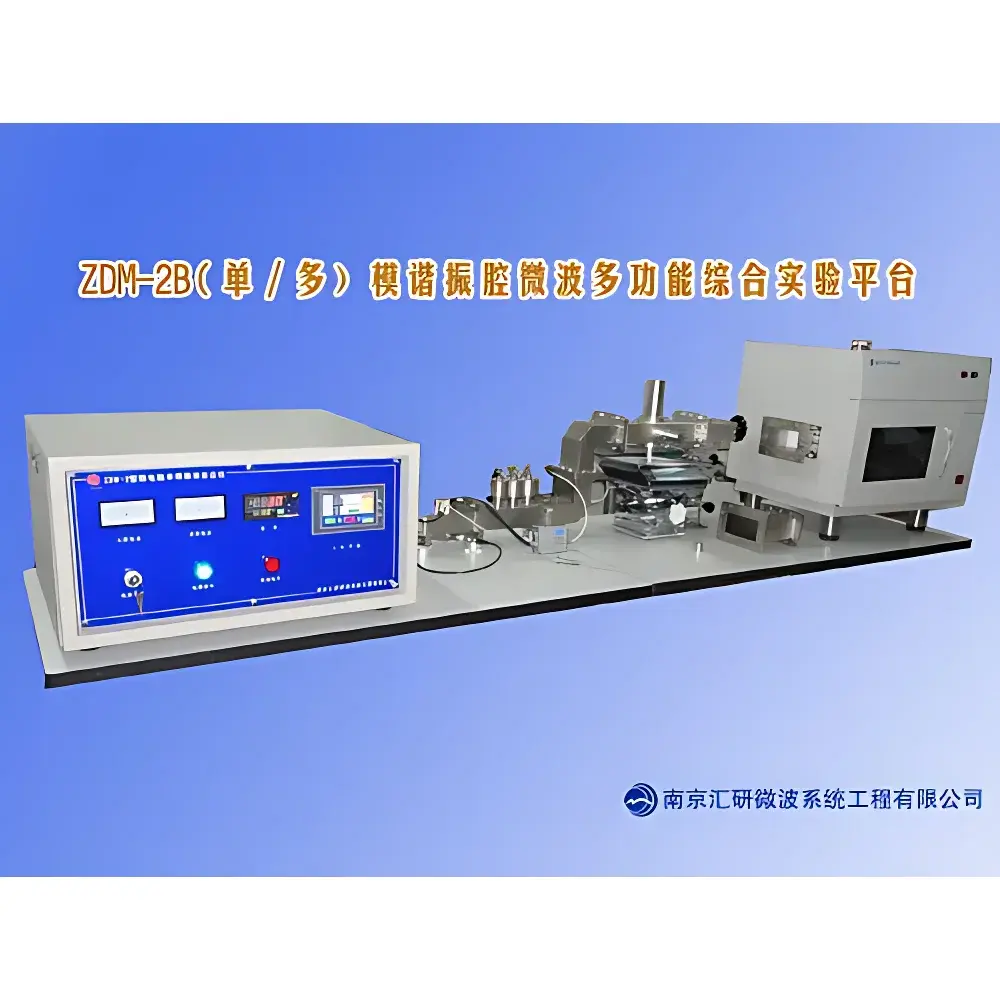
Hyeyan ZDM-2B Dual-Mode (Single-Mode & Multi-Mode) Microwave Resonant Cavity Integrated Experimental Platform
| Brand | Hyeyan |
|---|---|
| Origin | Jiangsu, China |
| Model | ZDM-2B |
| Microwave Frequency | 2450 MHz ± 50 MHz |
| Output Power Range | 0–1500 W (continuous linearly adjustable) |
| Power Control Modes | Continuous mode & programmable pulsed mode |
| Pulse Period & Pulse Width | User-definable via touchscreen interface |
| Temperature Monitoring Range | 0–500 °C |
| Temperature Accuracy | ±1 °C |
| Input Power | 220 V, 50 Hz |
| Waveguide Output | Standard WR-340 |
| Safety Compliance | Meets GB 10436-2008 (China National Standard for Microwave Leakage) |
| Cooling Interface | Reflux port with microwave suppression on multi-mode cavity |
| Stirring Options | Built-in magnetic stirrer (multi-mode cavity) + optional mechanical stirring |
| Tuning System | Terminal tuning & focal point adjustment for single-mode cavity |
| Real-time Diagnostics | Integrated waveguide coupler, crystal detector, and tuner for standing-wave observation and impedance matching |
| Optional Connectivity | RS-485 interface for PC-based control and third-party software integration |
Overview
The Hyeyan ZDM-2B Dual-Mode Microwave Resonant Cavity Integrated Experimental Platform is an engineered research-grade system designed for rigorous microwave-assisted chemical synthesis, materials processing, and reaction mechanism studies. Unlike conventional microwave reactors limited to either single-mode or multi-mode operation, the ZDM-2B integrates two physically independent resonant cavities—each optimized for distinct electromagnetic field distributions—enabling direct comparative experimentation under controlled, reproducible conditions. The single-mode cavity operates on the principle of TE10 wave propagation in a rectangular waveguide, delivering high electric field intensity and spatial confinement ideal for small-volume, high-precision reactions (e.g., catalytic screening or kinetic profiling). The multi-mode cavity relies on stochastic mode distribution within a larger metallic enclosure, providing volumetric energy coupling suitable for scalable batch reactions, heterogeneous catalysis, or solvent-free transformations. Both cavities are fed from a common magnetron source via a dual-output waveguide manifold, with real-time power routing managed by a high-isolation directional coupler assembly.
Key Features
- Dual-resonator architecture: Independent single-mode (focused, high-field) and multi-mode (broad-field, uniform heating) cavities housed in a unified chassis with shared power supply and control logic.
- Two operational power modes: Continuous linear power regulation (0–1500 W) and fully programmable pulse modulation—with independently adjustable pulse width (10 ms–10 s) and period (100 ms–300 s)—enabling precise thermal transient control for exothermic or decomposition-sensitive reactions.
- Full-wave rectified high-voltage power supply with advanced LC filtering ensures stable DC anode voltage, minimizing ripple-induced magnetron instability and extending tube lifetime by >40% versus half-wave designs.
- Real-time microwave diagnostics: Integrated waveguide coupler, calibrated crystal detector, and manual E-H tuner allow in situ measurement and optimization of voltage standing wave ratio (VSWR), critical for maintaining coupling efficiency across varying load impedances.
- Reflux-compatible multi-mode cavity: Top-mounted threaded port (standard ISO-KF 35) accepts condensers, gas inlets, or mechanical stirrers; integrated microwave suppression gasket maintains shielding integrity even during open-port operation.
- Single-mode terminal tuning: Motorized plunger-type tuner enables dynamic impedance matching without physical disassembly—essential for maintaining resonance when changing sample volume or dielectric properties.
- Redundant safety architecture: Interlocked door switches, magnetron overtemperature cutoff, cavity pressure monitoring, and <0.5 mW/cm² leakage at 5 cm (per GB 10436-2008) ensure compliance with laboratory occupational exposure limits.
Sample Compatibility & Compliance
The ZDM-2B accommodates standard laboratory glassware (e.g., 10–100 mL sealed vessels, reflux condensers, Schlenk tubes) as well as custom quartz or ceramic reaction cells. Its dual-cavity design supports both low-dielectric-loss substrates (e.g., silica-supported catalysts) and highly absorbing media (e.g., ionic liquids, aqueous suspensions). All temperature measurements are performed using Pt100 RTD sensors embedded in cavity walls and vessel holders—not infrared pyrometry—ensuring traceable, contact-based thermal validation. The platform meets structural and electrical safety requirements per GB 4793.1-2019 (Safety Requirements for Electrical Equipment for Measurement, Control, and Laboratory Use) and is compatible with GLP documentation workflows through optional audit-trail-enabled software.
Software & Data Management
The onboard industrial-grade microcontroller runs a deterministic real-time OS, interfacing with a 7-inch TFT-LCD touchscreen featuring true-color GUI and capacitive touch response. All process parameters—including power profile, temperature setpoints, pulse timing, and sensor readings—are logged at 1 Hz resolution to internal flash memory (≥10,000 cycles retention). An RS-485 serial interface supports Modbus RTU protocol for integration into centralized lab automation systems. Optional PC software provides remote parameter upload/download, time-stamped CSV export, and synchronized plotting of microwave power vs. temperature vs. time—enabling quantitative correlation of energy deposition with reaction progress. The API supports third-party scripting (Python/LabVIEW) for automated reaction screening protocols.
Applications
- Kinetic studies of microwave-specific non-thermal effects via side-by-side single-mode (localized field) vs. multi-mode (bulk heating) comparisons.
- Development of continuous-flow microwave processes using single-mode cavity adaptors with microfluidic interfaces.
- Synthesis of metal–organic frameworks (MOFs) and covalent organic frameworks (COFs) requiring strict thermal ramp control and rapid nucleation quenching.
- Thermal degradation analysis of polymers and battery electrode materials under controlled pulsed irradiation.
- Green chemistry applications: Solvent-free esterifications, solid-state oxidations, and mechanochemical-microwave hybrid reactions.
- Catalyst testing under variable field polarization—enabled by rotational sample holders (optional accessory).
FAQ
Can the ZDM-2B operate both cavities simultaneously?
No. The system uses a single magnetron source with electronically switched waveguide routing; only one cavity may be energized at a time to maintain power stability and regulatory compliance.
Is calibration of the temperature sensors traceable to national standards?
Yes. Factory calibration is performed against a NIST-traceable dry-block calibrator (±0.1 °C uncertainty); users may perform field verification using certified reference thermometers.
What is the maximum allowable vessel height for the single-mode cavity?
The active zone accommodates vessels up to 120 mm in length; optimal focusing occurs within ±15 mm of the designated axial node position.
Does the system support external trigger inputs for synchronization with analytical instruments?
Yes. A TTL-compatible BNC input allows external start/stop triggering and timestamp alignment with HPLC, FTIR, or Raman systems.
Are replacement magnetrons and waveguide components available as spares?
Yes. Hyeyan supplies OEM-specified magnetrons (2M210-M1), WR-340 waveguides, and tuners with documented insertion loss and VSWR specifications for seamless field replacement.



