
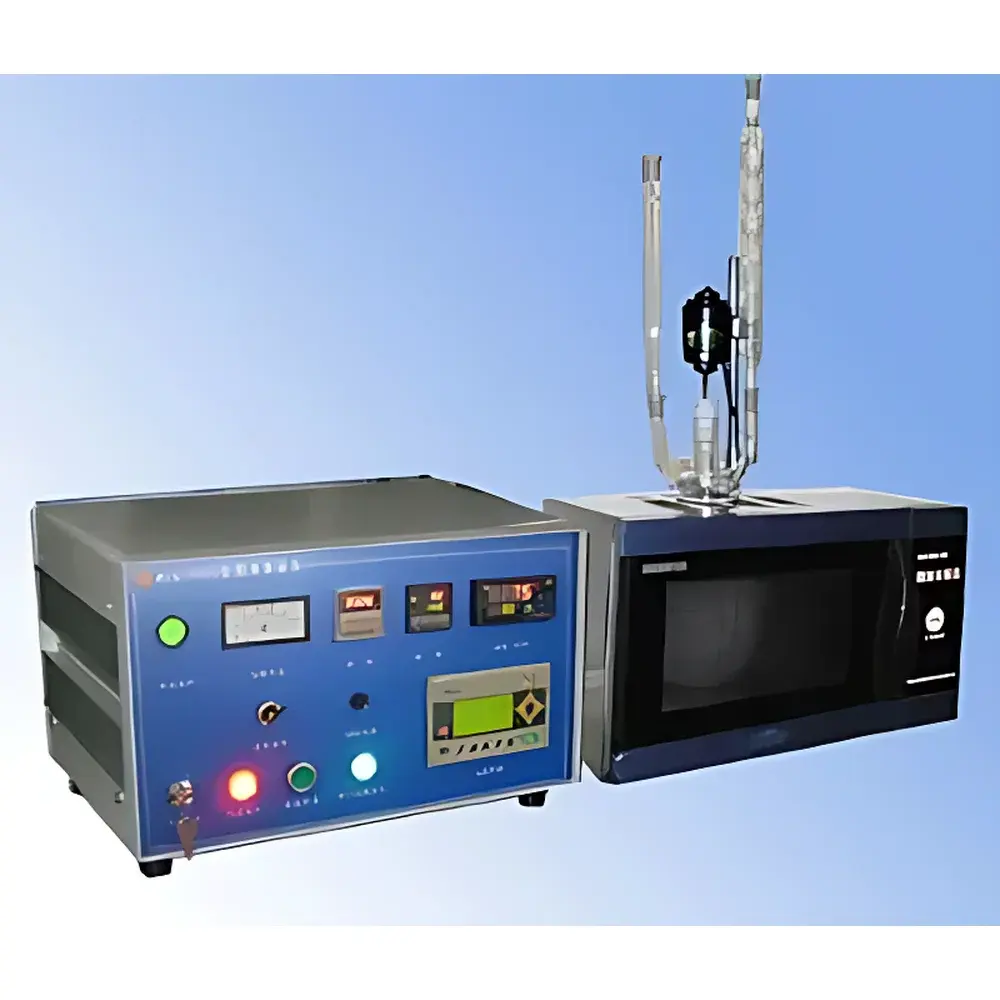
Hyayan MZG1500S Dual-Mode Programmable Microwave Synthesis Reactor
| Frequency | 2450 MHz ±50 MHz |
|---|---|
| Power Output | 0–1500 W (non-pulsed continuous & adjustable pulsed modes) |
| Temperature Range | 0–300 °C, accuracy ±1 °C |
| Temperature Sensor | Pt100 contact probe with corrosion-resistant tip |
| Timing Control | 0–900 min, resolution 1 s |
| Reaction Volume | 10–1000 mL |
| Stirring | Dual-mode (magnetic & mechanical, speed continuously adjustable) |
| Safety | Microwave leakage < GB 10436-2008 limit |
| Control System | Industrial PLC + full-color Chinese touchscreen HMI |
| Safety Interlocks | Magnetron overtemperature protection, door interlock, cavity shielding |
Overview
The Hyayan MZG1500S Dual-Mode Programmable Microwave Synthesis Reactor is engineered for precision-controlled thermal activation of chemical reactions under microwave irradiation. It operates on the principle of dielectric heating—where polar molecules and ionic species absorb electromagnetic energy at 2450 MHz, converting it directly into kinetic energy and localized thermal excitation. Unlike single-mode cavity systems optimized for small-volume high-field homogeneity, the MZG1500S employs a multimode resonant cavity architecture designed for robust scalability across reaction volumes from 10 mL to 1000 mL. Its dual-power modulation strategy—combining non-pulsed continuous-wave (CW) output with user-defined pulsed operation—enables fine-grained control over energy deposition kinetics. This capability supports both steady-state thermal equilibration (e.g., reflux-driven condensation or hydrolysis) and transient thermal profiling (e.g., rapid nucleation in nanoparticle synthesis or selective bond cleavage in catalytic depolymerization). The system integrates an industrial-grade programmable logic controller (PLC) as its deterministic real-time core, ensuring deterministic response latency and repeatable execution of multi-step temperature/time/power protocols.
Key Features
- Dual-mode microwave power delivery: fully adjustable 0–1500 W non-pulsed continuous output, plus configurable pulsed mode with independently set pulse width (1–99 s) and duty cycle (1–99%) via touchscreen interface
- Real-time closed-loop temperature regulation using a shielded, corrosion-resistant Pt100 contact sensor mounted directly in the reaction vessel; measurement range 0–300 °C, accuracy ±1 °C, with automatic PID-based compensation
- Integrated reflux port on cavity ceiling—equipped with integrated microwave suppression choke—enabling simultaneous vapor condensation, liquid addition, phase separation, or overhead mechanical stirring without compromising RF containment
- Redundant safety architecture: magnetron overtemperature cutoff, interlocked door switch, cavity shielding integrity monitoring, and real-time microwave leakage detection compliant with GB 10436-2008 (<5 mW/cm² at 5 cm)
- Two independent stirring modalities: magnetic stirrer (0–1200 rpm, continuous adjustment) and optional overhead mechanical stirrer (0–600 rpm, torque-compensated), both synchronized with temperature ramp profiles
- Full-color 7-inch TFT touchscreen HMI with intuitive workflow navigation, protocol storage (≥100 user-defined methods), and timestamped event logging
Sample Compatibility & Compliance
The MZG1500S accommodates standard borosilicate glass, quartz, and PTFE-lined reaction vessels within the 10–1000 mL volume range. Its cavity geometry and field distribution support heterogeneous mixtures—including slurries, suspensions, and solid-liquid biphasic systems—without requiring specialized waveguide coupling or mode stirrers. Vessel compatibility extends to sealed high-pressure reactors (up to 20 bar, when used with optional pressure-rated accessories) and open-vessel reflux configurations. From a regulatory standpoint, the instrument’s deterministic PLC-based control architecture, audit-trail-capable event logging, and hardware-enforced safety interlocks align with foundational requirements for GLP-compliant method development and routine QC testing. While not pre-certified to IEC 61010-1 or FDA 21 CFR Part 11, its design principles—including parameter traceability, user-accessible calibration logs, and tamper-evident configuration locks—facilitate internal validation against ISO/IEC 17025 or USP analytical instrument qualification frameworks.
Software & Data Management
Operation is managed exclusively through the embedded HMI, which stores all method parameters—including time-temperature-power trajectories, stirring profiles, and alarm thresholds—in non-volatile memory. Each run generates a timestamped log file (.CSV) containing second-resolution records of actual temperature, setpoint, applied power, stir speed, and system status flags (e.g., “door_open”, “mag_temp_high”). Logs are exportable via USB flash drive for offline analysis in MATLAB, Python (pandas), or LIMS-integrated platforms. No cloud connectivity or remote access functionality is implemented—ensuring data sovereignty and eliminating cybersecurity attack surfaces common in networked lab instruments. Calibration constants for temperature and power sensors are stored separately and require administrator-level authentication to modify, supporting documented requalification per laboratory SOPs.
Applications
The MZG1500S serves as a versatile platform for reaction acceleration and pathway selectivity modulation across multiple domains: organic synthesis (e.g., Suzuki couplings, esterifications, heterocycle formation), inorganic material preparation (metal oxide nanoparticle synthesis, MOF crystallization), sample digestion (EPA Method 3051A/3052 adaptations), natural product extraction (accelerated solvent extraction of polyphenols), and polymer modification (grafting, crosslinking, depolymerization). Its precise pulsed-mode control enables studies of thermal inertia effects—such as distinguishing between bulk heating versus interfacial hot-spot generation in catalytic systems. The reflux-compatible cavity design further supports classical synthetic workflows traditionally reliant on oil-bath heating, allowing direct substitution without procedural redesign.
FAQ
Does the MZG1500S support external computer control or RS232/USB command protocols?
No—this model relies solely on its integrated touchscreen HMI and PLC firmware. It does not implement SCPI, Modbus, or vendor-specific ASCII command sets.
Can the instrument be validated for GMP-regulated environments?
Yes, provided users perform IQ/OQ/PQ per internal SOPs; the deterministic PLC control, calibrated Pt100 sensor, and immutable event logging provide necessary traceability foundations.
Is the reflux port compatible with standard Liebig or Graham condensers?
Yes—the 24/40 standard taper port accepts industry-standard ground-glass condensers; optional silicone gasket kits ensure RF-tight sealing during reflux operation.
What maintenance is required for long-term reliability?
Annual verification of magnetron output power (using calibrated calorimetric load), inspection of waveguide choke integrity, and cleaning of cavity interior with non-abrasive ethanol wipes are recommended.
Are third-party reaction vessels supported?
Yes—any vessel conforming to ASTM E2884-13 dimensional tolerances for multimode microwave reactors may be used, though temperature accuracy assumes direct Pt100 contact with reaction medium.



