
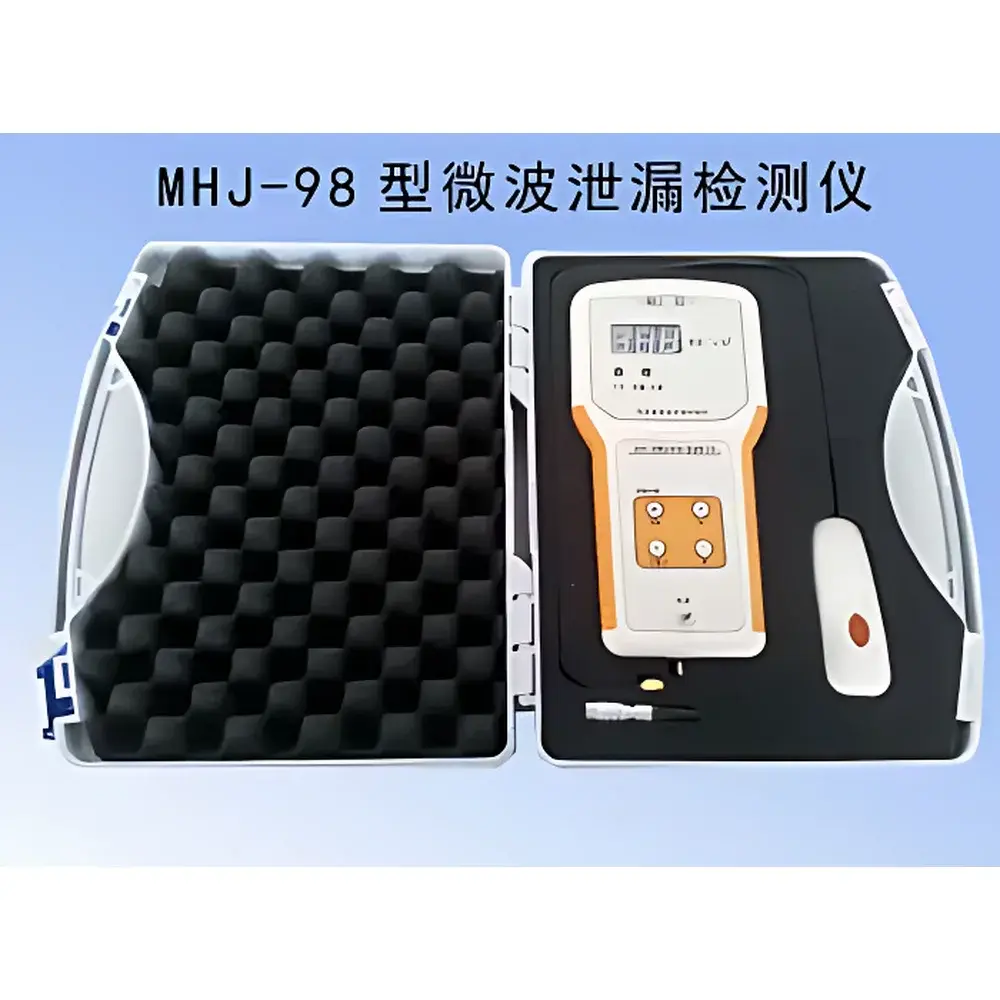
Hywell MHJ-98 Portable Microwave Leakage Detector
| Brand | Hywell |
|---|---|
| Model | MHJ-98 |
| Instrument Type | Microwave Power Density Meter (Radiation Dosimetry Grade) |
| Measurement Principle | Broadband RF Field Detection via Calibrated Diode-Based Sensor |
| Frequency Range | 0.9–3 GHz |
| Power Density Range | 0.01–9.99 mW/cm² |
| Accuracy (Full Scale) | ±1.5% |
| Calibration Uncertainty | ±0.75 dB |
| Operating Environment | −10 °C to +40 °C, RH 51–81%, Light-Shielded Sensor |
| Display | LED Digital, 3½-digit Resolution |
| Alarm Output | Configurable Threshold, Audible + Visual + Dry Contact Switch (DC 24 V / 1 A max) |
| Dimensions | 100 × 210 × 35 mm |
| Weight | 0.5 kg |
| Compliance | Designed for IEC 61326-1 (EMC), IEC 61000-4 Series Immunity Testing |
Overview
The Hywell MHJ-98 Portable Microwave Leakage Detector is a calibrated, handheld radiation measurement instrument engineered for precise quantification of microwave power density in occupational and industrial environments. It operates on the principle of broadband RF field detection using a temperature-compensated, imported diode-based sensor array optimized for the 0.9–3 GHz frequency band—covering common ISM bands used by domestic microwave ovens (2.45 GHz), industrial heating systems, radar transmitters, and communication infrastructure. Unlike generic RF survey meters, the MHJ-98 is specifically validated for continuous-wave (CW) and pulsed microwave emission scenarios, reporting time-averaged power density (mW/cm²) in accordance with IEEE C95.1-2019 and ICNIRP 2020 exposure guidelines. Its compact form factor (100 × 210 × 35 mm), sub-500 g mass, and battery-powered operation enable rapid deployment during routine safety audits, equipment commissioning, or post-maintenance verification—without requiring external power sources or PC tethering.
Key Features
- Calibrated diode sensor with ±0.75 dB traceable field calibration uncertainty, certified against NIST-traceable reference fields
- Dual-mode operation: supports both continuous-wave and pulsed microwave source evaluation with automatic duty-cycle compensation
- User-configurable alarm threshold (0.01–9.99 mW/cm²), adjustable directly via front-panel keypad without software dependency
- Integrated dry-contact switch output (DC 24 V / 1 A max) for direct interlock integration with microwave generator control circuits or PLC-based safety systems
- Self-diagnostic boot sequence and auto-zero function ensure baseline stability prior to each measurement cycle
- High-resolution 3½-digit LED display with real-time numerical readout—no interpretation ambiguity from analog needle deflection
- Robust mechanical design compliant with IP54 ingress protection for dust and splash resistance during field use
Sample Compatibility & Compliance
The MHJ-98 is validated for non-invasive, near-field assessment of microwave leakage from sealed cavity appliances (e.g., domestic and commercial microwave ovens), industrial microwave dryers, plasma generators, and RF heating units. It does not require physical coupling or probe insertion—measurements are performed at standardized distances (e.g., 5 cm from oven door seams per IEC 60335-2-25). The instrument meets electromagnetic compatibility requirements per IEC 61326-1 (industrial environment) and immunity standards IEC 61000-4-2 (ESD), -4-3 (radiated RF), and -4-4 (electrical fast transients). While not a medical device, its metrological performance aligns with QA/QC protocols referenced in ISO/IEC 17025-accredited laboratories performing EMF safety assessments. Documentation includes factory calibration certificate with date, standard field conditions, and uncertainty budget—supporting audit readiness for OSHA, HSE, or corporate EHS programs.
Software & Data Management
The MHJ-98 operates as a standalone field instrument with no embedded firmware update capability or USB/Bluetooth connectivity. All configuration and data capture occur locally via tactile interface and visual feedback. However, its deterministic alarm logic and switch-output signal are fully compatible with third-party SCADA systems, programmable logic controllers (PLCs), and building management systems (BMS) under IEC 61131-3 logic frameworks. For regulatory documentation, users may log timestamped readings manually or integrate the dry-contact output with external dataloggers supporting TTL/relay-triggered acquisition. Calibration records adhere to ISO/IEC 17025 clause 7.7—requiring retention of original certificates, environmental monitoring logs (temperature/humidity during calibration), and traceability statements linking to national metrology institutes.
Applications
- Routine compliance testing of microwave ovens in food service, healthcare, and laboratory settings per FDA 21 CFR §1030.10 and EN 60335-2-25
- Pre- and post-service verification of industrial microwave equipment (e.g., rubber vulcanization, wood drying, ceramic sintering)
- Occupational health and safety surveys in R&D facilities operating magnetrons or klystron-based systems
- Validation of RF shielding integrity in controlled environments (e.g., anechoic chambers, EMC test labs)
- Educational demonstrations of non-ionizing radiation safety principles in physics and biomedical engineering curricula
FAQ
What standards does the MHJ-98 comply with for occupational exposure assessment?
It is designed to support evaluations aligned with ICNIRP 2020 and IEEE C95.1-2019 public exposure limits for frequencies between 0.9–3 GHz. Its calibration methodology follows ISO/IEC 17025-compliant practices.
Can the MHJ-98 measure pulsed microwave signals accurately?
Yes—it computes true average power density over time, compensating for pulse repetition frequency and duty cycle without requiring user input.
Is periodic recalibration required—and how often?
Annual recalibration is recommended under ISO/IEC 17025 guidelines; more frequent intervals may apply in high-use or harsh-environment deployments.
Does the instrument provide traceable calibration documentation?
Each unit ships with a factory calibration certificate listing reference standard, uncertainty budget, environmental conditions, and traceability to national metrology institutes.
How is the switch-output interface electrically isolated?
The dry-contact relay is galvanically isolated with >1 kV AC dielectric strength, rated for industrial control voltage levels up to DC 24 V and 1 A resistive load.
Related Products







