
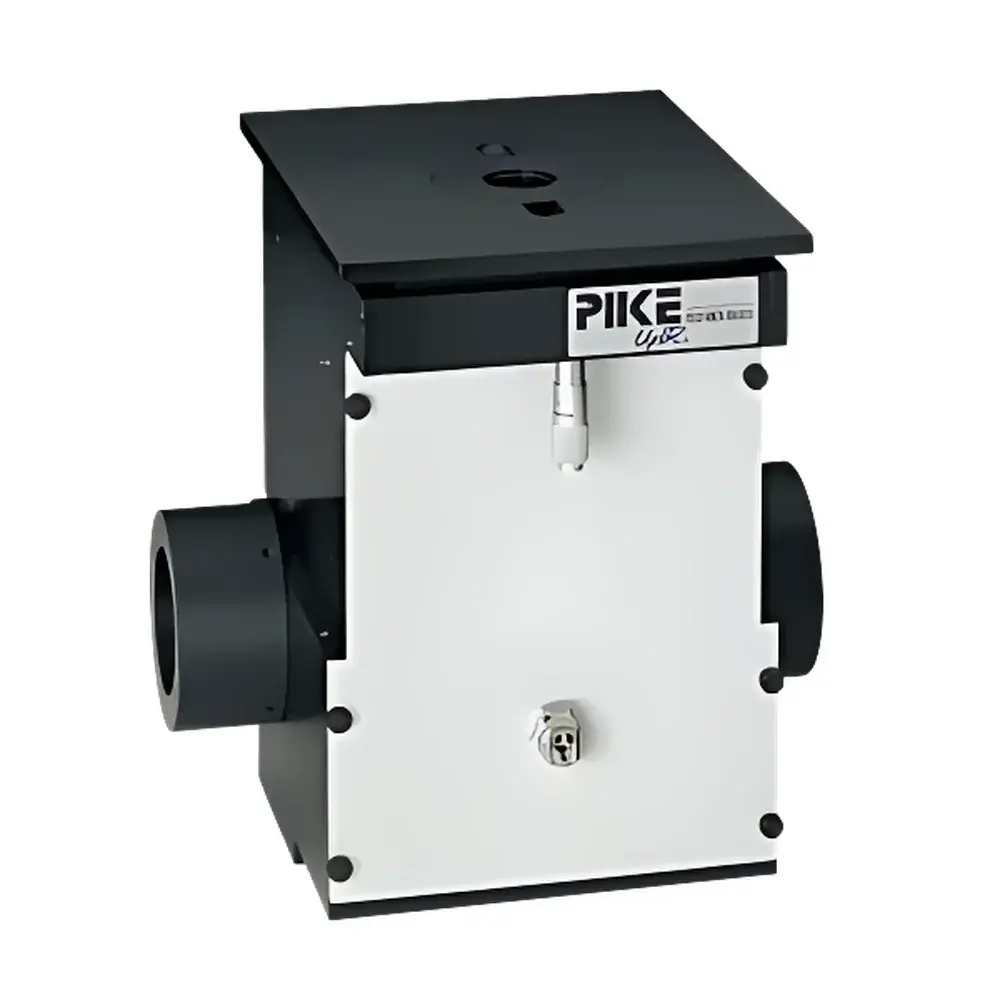
PIKE UpIR Top-Loading Diffuse Reflectance Accessory
| Brand | PIKE |
|---|---|
| Origin | USA |
| Manufacturer Type | Authorized Distributor |
| Origin Category | Imported |
| Model | UpIR |
| Price Range | USD 7,000 – 14,000 |
Overview
The PIKE UpIR Top-Loading Diffuse Reflectance Accessory is an engineered optical interface designed for integration with Fourier Transform Infrared (FTIR) spectrometers to enable quantitative and qualitative analysis of opaque, heterogeneous, or irregularly shaped solid samples. Unlike traditional transmission or specular reflectance configurations, the UpIR employs a top-loading geometry that directs incident IR radiation vertically onto the sample surface, collects diffusely scattered light via a hemispherical integrating sphere, and delivers it to the spectrometer detector with high optical throughput and minimal path-length variability. This configuration adheres to the principles of Kubelka-Munk theory for semi-quantitative absorbance modeling in scattering media, making it particularly suitable for materials where particle size distribution, surface roughness, or bulk density significantly affect spectral response—such as gemstones, mineral aggregates, pharmaceutical tablets, and powdered polymers.
Key Features
- Top-loading sample chamber design enables rapid, tool-free placement of large-volume or irregularly shaped specimens—including whole gemstones, raw mineral fragments, or ceramic tiles—without requiring pelletization or KBr matrix preparation.
- Integrated gold-coated integrating sphere (≥98% reflectivity across 4000–400 cm⁻¹) ensures uniform collection of diffuse reflectance signals while minimizing specular artifacts and angular dependence.
- Optimized beam geometry maintains consistent incidence angle (near-normal) and illumination homogeneity across sample areas up to 35 mm in diameter, supporting reproducible measurement positioning per ASTM E1421 and ISO 18387 guidelines.
- Mechanically stable, alignment-free mounting system compatible with major FTIR platforms including Thermo Nicolet iS series, PerkinElmer Spectrum Two, and Bruker Tensor models via standardized flange interfaces.
- Temperature-stable aluminum housing with black-anodized interior suppresses stray light and thermal drift, contributing to baseline stability over extended acquisition sequences.
Sample Compatibility & Compliance
The UpIR accessory accommodates a broad range of solid-state samples without destructive preparation: intact gemstones (e.g., jadeite, nephrite, sapphire), unground ore samples, pressed powder compacts, polymer granules, and coated substrates. Its open-top architecture eliminates height restrictions typical of bottom-loading accessories, allowing specimens up to 25 mm thick. All optical components comply with RoHS directives; mechanical construction meets IP20 environmental rating for laboratory use. The accessory supports GLP-compliant workflows when paired with FTIR systems configured for 21 CFR Part 11 audit trails and electronic signature validation. Method development aligns with USP for solid-state IR characterization and ASTM E2821 for gemological material identification.
Software & Data Management
No proprietary software is embedded in the UpIR hardware; instead, it operates transparently within the host FTIR instrument’s native acquisition suite (e.g., OMNIC, Spectrum Essential, OPUS). Users retain full control over scan parameters—including resolution (down to 2 cm⁻¹), co-additions (up to 128 scans), apodization functions, and atmospheric compensation algorithms. Spectral processing workflows support Kubelka-Munk transformation, baseline correction (Rubberband, Concave Rubberband), and spectral subtraction for background normalization. Export formats include .spa, .csv, and .jdx, ensuring compatibility with third-party chemometric tools (e.g., Pirouette, Unscrambler X) for PCA, PLS regression, or cluster analysis in multi-sample classification tasks.
Applications
- Gemology and mineralogy: Non-destructive identification of natural vs. synthetic stones, detection of dye treatments in jade, and differentiation of corundum varieties based on hydroxyl and trace-metal absorption features.
- Pharmaceutical QC: Rapid assessment of API crystallinity, excipient distribution homogeneity, and coating integrity in direct-compression tablets.
- Materials science: Characterization of pigment dispersion in composites, oxidation state analysis in transition-metal oxides, and hydration monitoring in zeolitic frameworks.
- Forensics and cultural heritage: In-situ analysis of paint layers, ink binders, and archaeological ceramics without sampling or vacuum requirements.
- Academic research: Teaching spectroscopic principles of scattering media and validating theoretical models of photon transport in particulate systems.
FAQ
Is the UpIR compatible with my existing FTIR spectrometer?
Yes—the UpIR mounts directly to standard FTIR bench ports using a 25.4 mm or 50.8 mm kinematic flange; adapter kits are available for non-standard interfaces.
Can I measure wet or volatile samples?
No—the open-top design is not sealed; samples must be dry and thermally stable below 60 °C during acquisition.
Does the accessory require routine calibration?
No internal calibration is needed; however, daily background collection using the provided PTFE reference tile is recommended per ISO 17025 quality assurance protocols.
What is the minimum sample mass required for reliable spectra?
For powders, ≥100 mg uniformly distributed across the 35 mm aperture yields optimal signal-to-noise; for solids, full coverage of the illuminated area is required.
Is technical support available outside the U.S.?
Yes—PIKE Technologies authorizes regional service partners in Europe, APAC, and Latin America for installation assistance, application consulting, and preventive maintenance scheduling.





