
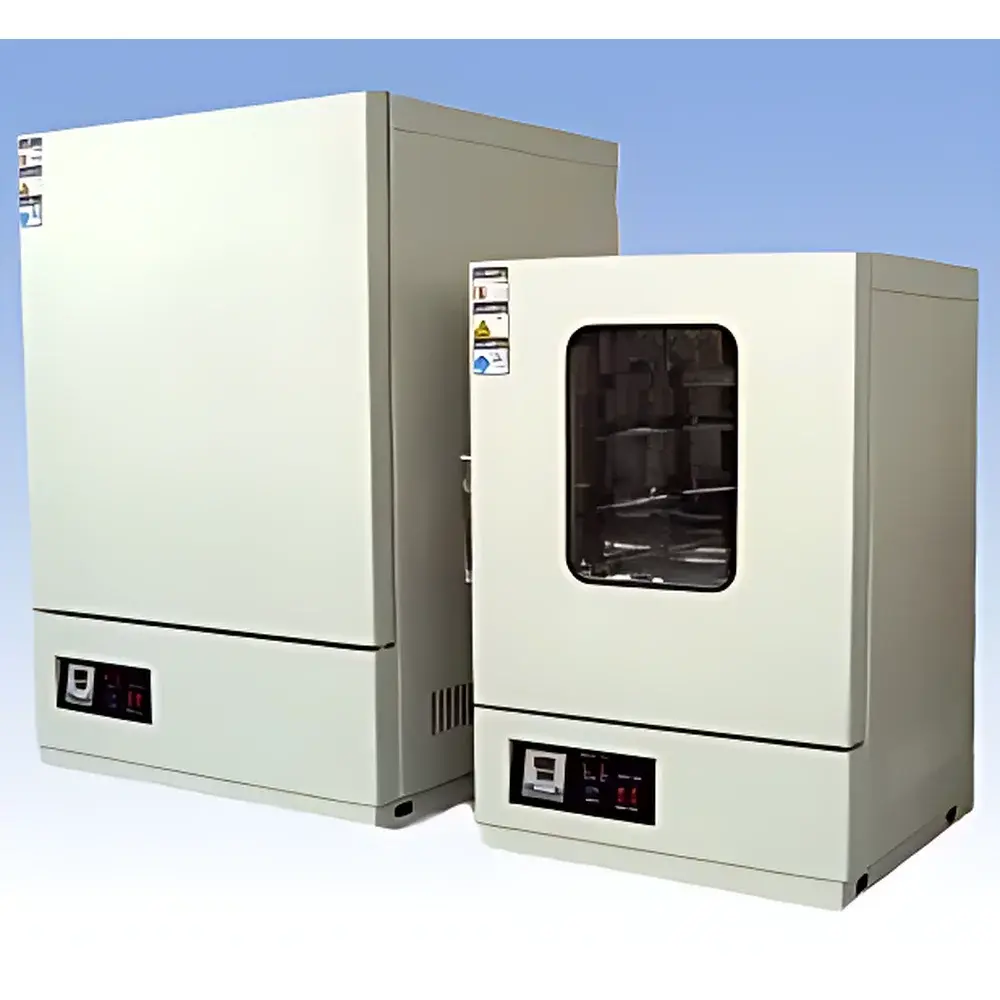
LabCompanion CS101-1EB High-Temperature Precision Industrial Drying Oven
| Brand | LabCompanion |
|---|---|
| Origin | Guangdong, China |
| Manufacturer | LabCompanion (OEM/ODM Producer) |
| Model | CS101-1EB |
| Temperature Range | 50°C to 200°C (optional up to 300°C) |
| Temperature Stability | ±1.0°C |
| Temperature Uniformity | ±2.0–3.0°C (standard), ±3.0–4.0°C (larger chambers) |
| Heating Rate | ~50 min (50°C → 200°C) |
| Interior Dimensions (W×D×H, mm) | 400×350×350 |
| Exterior Dimensions (W×D×H, mm) | 610×670×570 |
| Heating Power | 2000 W |
| Air Circulation | Forced-air convection via sirocco fan (90 W × 1) |
| Chamber Material | Interior – AISI 304 stainless steel |
| Insulation | High-density glass wool |
| Safety Systems | Dual overtemperature limit protection, thermal cut-off fuse, no-fuse circuit breaker |
| Standard Accessories | Mechanical timer, 2 adjustable stainless-steel shelves |
| Power Supply | 220 VAC ±10%, 3-phase or single-phase, 50/60 Hz |
| Current Draw | 10.5 A (1Ø), 12.6 A (3Ø) |
Overview
The LabCompanion CS101-1EB is a high-precision, forced-air industrial drying oven engineered for consistent thermal processing in laboratory and quality control environments. Designed according to the OVEN series architecture—fixed-setpoint operation with programmable variants available—the CS101-1EB delivers stable, repeatable temperature control across its operational range of 50°C to 200°C (with optional 300°C configuration). Its core principle relies on uniform convective heat transfer: a forward-curved sirocco fan ensures laminar, high-velocity airflow across the chamber, while strategically engineered exhaust and inlet ducts minimize thermal stratification. This architecture enables tight temperature stability (±1.0°C) and superior uniformity (±2.0–3.0°C within the working volume), meeting the spatial and temporal repeatability requirements of ASTM E145, ISO 17025-accredited calibration protocols, and internal QC validation procedures.
Key Features
- Forced-air convection system with a 90 W sirocco fan delivering directional, low-turbulence airflow for rapid thermal equilibration and minimal hot/cold spots.
- AISI 304 stainless-steel interior chamber resistant to oxidation, corrosion, and residue buildup—critical for repeated use in moisture-sensitive or solvent-based drying applications.
- Dual-stage overtemperature protection: independent mechanical limit switch + electronic PID controller cutoff, compliant with IEC 61000-4 immunity standards and GLP safety expectations.
- High-efficiency thermal insulation using compressed glass wool (≥80 mm thickness), minimizing energy consumption and external surface temperature rise (<45°C at ambient).
- Standard mechanical timer with audible end-of-cycle alert; compatible with external data loggers via analog output (0–5 V DC) for traceable process recording.
- Modular structural design supporting field serviceability—fan assembly, heating elements, and sensor mounts are accessible without chamber disassembly.
Sample Compatibility & Compliance
The CS101-1EB accommodates standard laboratory sample formats including Petri dishes, weighing boats, crucibles, metal test coupons, polymer film substrates, and pharmaceutical blister packs. Its 400 × 350 × 350 mm internal volume complies with USP dry-heat sterilization validation envelopes and supports batch drying per ISO 5600-2 (innovation management) material conditioning workflows. The unit meets CE marking requirements under the EU Machinery Directive 2006/42/EC and Low Voltage Directive 2014/35/EU. While not intrinsically rated for hazardous locations, its sealed heater housing and grounded chassis satisfy general-purpose electrical safety mandates for non-explosive lab environments per UL 61010-1.
Software & Data Management
As a fixed-setpoint oven, the CS101-1EB does not include embedded digital controllers or proprietary software. However, it integrates seamlessly into regulated environments through third-party validation-ready interfaces: analog voltage output enables connection to certified data loggers (e.g., Omega OM-DAQPRO, Testo 176 T4) configured for 21 CFR Part 11-compliant audit trails. Calibration records—including thermocouple verification (Class 1 accuracy per IEC 60584), uniformity mapping (9-point grid per ASTM E220), and stability profiling—can be archived in LIMS or ELN platforms. Optional PT100 sensor ports support external validation during IQ/OQ/PQ execution per GMP Annex 15 guidelines.
Applications
- Residual solvent removal from coated films, adhesives, and battery electrode slurries prior to SEM or XRD analysis.
- Moisture content determination per AOAC 950.46 and ISO 712 for food, feed, and agricultural commodities.
- Pre-conditioning of ceramic green bodies and composite laminates before sintering or autoclave curing.
- Accelerated aging studies of packaging materials under controlled thermal stress (ASTM F1980).
- Drying of filter membranes and chromatography media without compromising pore integrity or binding capacity.
- Thermal stabilization of reference standards (e.g., NIST SRM 1484) prior to gravimetric calibration.
FAQ
What is the maximum allowable operating temperature for the CS101-1EB?
The standard configuration operates up to 200°C; an optional high-temp variant supports continuous operation at 300°C with upgraded heating elements and insulation.
Can this oven be validated for GMP-compliant processes?
Yes—its mechanical simplicity, dual overtemperature safeguards, stainless-steel chamber, and analog output interface support full IQ/OQ/PQ execution per FDA and EU GMP Annex 15 requirements.
Is the airflow velocity adjustable or controllable?
No—the sirocco fan operates at fixed speed to maintain optimal laminar flow and thermal uniformity; variable-speed control is not implemented to preserve calibration integrity.
Does the unit include a built-in temperature recorder?
No—it provides analog output for external logging but lacks onboard memory or display-based data storage.
What maintenance intervals are recommended for routine operation?
Fan motor lubrication every 12 months, heater resistance verification every 6 months, and quarterly chamber cleanliness inspection using isopropyl alcohol and lint-free wipes.



