
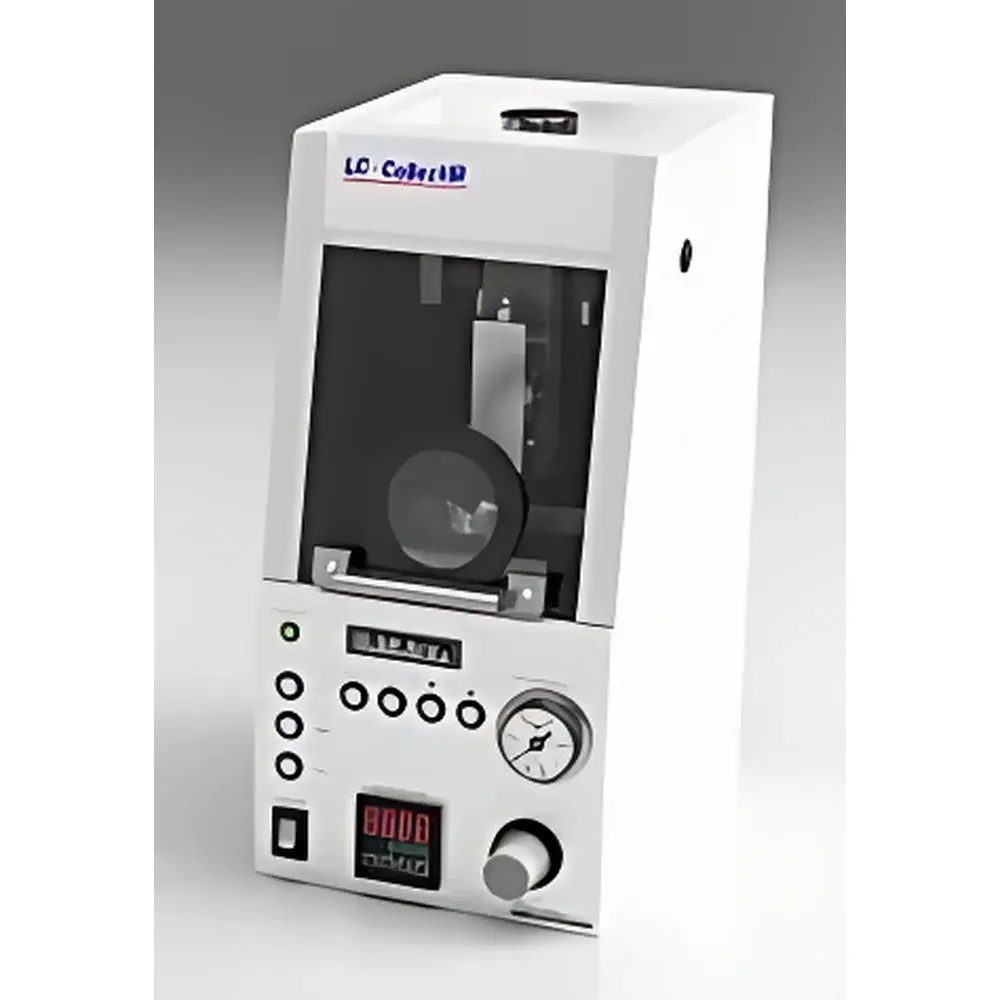
LCColletIR GPC-LC/FTIR Hyphenated System by S.T. Japan
| Brand | S.T. Japan |
|---|---|
| Origin | Japan |
| Manufacturer Type | Authorized Distributor |
| Origin Category | Imported Instrument |
| Model | LCColletIR |
| Price | USD 42,000 (FOB Yokohama) |
Overview
The LCColletIR GPC-LC/FTIR Hyphenated System is an integrated analytical platform engineered for real-time, time-resolved infrared characterization of chromatographically separated components. Developed by S.T. Japan, this system enables seamless coupling between high-performance liquid chromatography (HPLC) or gel permeation chromatography (GPC) and Fourier-transform infrared (FTIR) spectroscopy via a dedicated flow-through IR cell and synchronized data acquisition architecture. Unlike conventional off-line fraction collection followed by manual IR analysis, the LCColletIR performs on-flow, retention-time-matched spectral acquisition—preserving labile functional groups, minimizing sample degradation, and eliminating carryover artifacts associated with fraction handling. The system operates on the principle of transmission-mode FTIR detection within a temperature-stabilized, diamond-windowed microflow cell (pathlength: 50–100 µm), optimized for aqueous and organic mobile phases commonly used in SEC/GPC and reversed-phase HPLC. It is designed for laboratories requiring molecular fingerprinting of eluting species—especially polymers, surfactants, natural product extracts, and synthetic oligomers—where structural heterogeneity, end-group analysis, or branching quantification cannot be resolved by retention time or UV alone.
Key Features
- Real-time hyphenation: Hardware-synchronized triggering between LC/GPC detector output and FTIR data acquisition ensures precise alignment of chromatographic retention time with corresponding IR spectra.
- Dedicated flow-through IR cell: Chemically inert, low-volume (≤ 2 µL) ZnSe or diamond window cell with Peltier temperature control (±0.1 °C) to stabilize baseline and suppress solvent vapor interference.
- Modular interface design: Compatible with major commercial HPLC/GPC systems (e.g., Waters, Agilent, Shimadzu) and benchtop FTIR spectrometers (e.g., Thermo Nicolet iS50, Bruker Tensor series) via TTL/RS-232 and analog voltage I/O.
- Automated fraction-triggered IR collection: Configurable spectral accumulation per time slice (e.g., 1 spectrum/0.5 s), with dynamic co-addition based on signal-to-noise requirements.
- Robust mechanical architecture: Vibration-damped optical bench, sealed purge path for dry-air/N₂ purging, and EMI-shielded electronics to maintain interferometer stability during long-duration runs.
Sample Compatibility & Compliance
The LCColletIR supports a broad range of sample matrices including synthetic polymers (PS, PMMA, PE, PEO), biopolymers (dextran, chitosan), surfactant micelles, pharmaceutical excipients, and crude natural product fractions. Mobile phase compatibility includes THF, chloroform, DMF, DCM, methanol/water, and acetonitrile/water mixtures—subject to IR transparency and cell wetting characteristics. The system conforms to ISO/IEC 17025:2017 general requirements for competence of testing and calibration laboratories. Data acquisition software supports audit trail logging and user access control, aligning with FDA 21 CFR Part 11 requirements for electronic records when deployed in regulated QC environments. All hardware components meet CE marking directives for electromagnetic compatibility (2014/30/EU) and low-voltage safety (2014/35/EU).
Software & Data Management
Control and data processing are managed through LCColletIR Control Suite v3.2—a Windows-based application supporting dual-instrument orchestration, spectral library matching (NIST, Polymer, Bio-IR libraries), and peak correlation mapping between chromatograms and spectral absorbance profiles. Raw interferograms are stored in standardized JCAMP-DX format; processed spectra are exportable as ASCII, CSV, or OPUS files. Time-resolved spectral stacks can be visualized as contour plots (wavenumber vs. retention time), enabling rapid identification of co-eluting species with distinct functional group signatures (e.g., carbonyl stretch at 1730 cm⁻¹ vs. hydroxyl at 3400 cm⁻¹). The software includes batch-processing tools for second-derivative preprocessing, atmospheric compensation, and baseline correction using asymmetric least squares (ALS) algorithms—essential for quantitative interpretation of overlapping bands in complex mixtures.
Applications
- Branching analysis in polyolefins: Correlating CH₃/CH₂ intensity ratios across GPC fractions to determine short-chain branching distribution.
- End-group quantification in telechelic polymers: Detecting terminal –OH, –COOH, or –NH₂ vibrations in narrow-Mw fractions isolated by SEC.
- Surfactant degradation monitoring: Tracking ester hydrolysis or ethoxylation degree shifts in real time during oxidative stress testing.
- Natural product dereplication: Assigning glycosidic linkages or aglycone scaffolds directly from crude plant extract chromatograms without isolation.
- Process impurity profiling: Identifying structurally related degradants in pharmaceutical intermediates where UV response is non-distinctive but IR absorption differs significantly.
FAQ
What types of FTIR spectrometers are compatible with the LCColletIR?
The system interfaces with any FTIR equipped with external trigger input, analog output for detector signal, and software API support for spectral acquisition control—primarily Thermo Scientific, Bruker, and PerkinElmer benchtop models.
Can the LCColletIR be used with aqueous mobile phases?
Yes, provided the flow cell windows are ZnSe or CaF₂ (not KBr), and the spectral region of interest avoids strong water absorption bands (e.g., 1800–1500 cm⁻¹); deuterated solvents or background subtraction protocols are recommended for enhanced sensitivity.
Is offline fraction recovery supported?
Yes—the system includes a programmable six-port switching valve that diverts eluent either to the IR cell or to a fraction collector, enabling parallel spectral acquisition and material recovery for NMR or MS follow-up.
What maintenance is required for the flow cell?
Routine cleaning with appropriate solvents (e.g., THF for organics, IPA/water for polar residues) and periodic inspection of window integrity and seal compression; no consumables beyond standard HPLC tubing and frits.
Does the system support GMP/GLP documentation workflows?
Yes—audit trail, electronic signature, and instrument qualification templates (IQ/OQ) are included in the software package, compliant with Annex 11 and ALCOA+ data integrity principles.




