
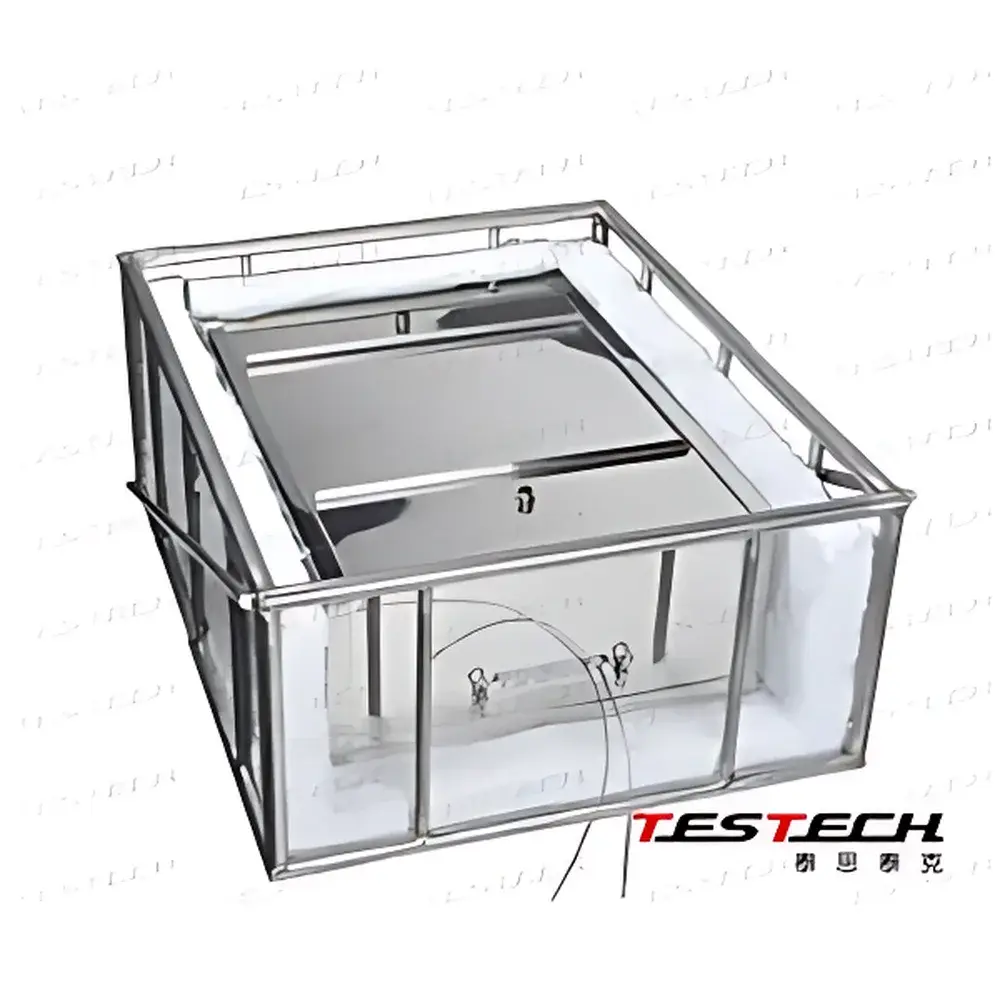
TESTech TTech-GBT17430 Adiabatic Material Maximum Use Temperature Tester
| Brand | TESTech |
|---|---|
| Origin | Jiangsu, China |
| Manufacturer Type | Direct Manufacturer |
| Model | TTech-GBT17430 |
| Compliance | GB/T 17430–1998, ASTM C411–82, ASTM C447–85, ISO 8142:1990 Annex A |
| Heating Plate | 900 × 450 mm SUS304, 5-point K-type thermocouple array (±0.5% accuracy, 0–1100 °C) |
| Heating Tubes | Three SUS304 tubes (Ø88/108/133 mm, L=2 m), each with helical 90°-spaced thermocouples at 0.3 m intervals |
| Temperature Control | PLC-based, touch-screen HMI, programmable ramp rates (3 or 5 °C/min) |
| Data Acquisition | 2-minute interval logging, real-time thermal curve display, audit-ready reporting |
| Thermal Response | <0.5 s thermocouple response time, ±0.5 °C temperature error, ±1 s/h timing accuracy |
| Accessories | 1 m straightedge, 0.03/0.05 mm feeler gauges, two sample cans |
| Power Input | 6 kW |
Overview
The TESTech TTech-GBT17430 Adiabatic Material Maximum Use Temperature Tester is an engineered laboratory instrument designed to determine the upper thermal service limit of industrial thermal insulation materials under controlled, steady-state heating conditions. It operates on the principle of thermal stability assessment via hot-surface exposure—where specimens are subjected to precisely regulated surface temperatures while monitoring physical integrity, dimensional stability, and irreversible degradation onset. This method aligns with internationally recognized protocols for defining “maximum use temperature” as the highest temperature at which a material retains its structural integrity, insulating performance, and dimensional fidelity over extended exposure without irreversible chemical or physical change. The system is purpose-built for compliance-driven testing environments in R&D labs, quality assurance departments, and third-party certification bodies evaluating mineral wool, ceramic fiber blankets, calcium silicate boards, flexible elastomeric foams, preformed pipe insulation, and loose-fill cellulose or fiberglass products.
Key Features
- Robust dual-test configuration: Independently configurable heating plate (900 × 450 mm) and triple-tube furnace assembly (Ø88/108/133 mm, 2 m length) accommodate flat and cylindrical geometries per ASTM C447 and ISO 8142 Annex A.
- High-fidelity thermal control architecture: PLC-driven closed-loop regulation with programmable ramp rates (3 or 5 °C/min), real-time thermal curve visualization via industrial-grade touch-screen HMI, and automatic hold-step execution.
- Traceable temperature measurement: Five K-type thermocouples (0.4 mm diameter, ±0.5% accuracy, 0–1100 °C range) embedded in heating plate—four at diagonal corners (150 mm from edges) and one at center; additional helical thermocouple arrays (90° spacing, 0.3 m pitch) on each tube ensure uniform surface temperature mapping.
- Thermal uniformity validation: Automatic verification that no measured point deviates by more than ±5% or ±15 °C (whichever is smaller) from setpoint—meeting strict requirements of GB/T 17430–1998 Section 6.2 and ASTM C411–82 Annex A.
- Audit-ready data infrastructure: Integrated acquisition module logs temperature and time every 120 seconds; all data stamped with UTC timestamp, operator ID, and test sequence number; exportable CSV/PDF reports support GLP/GMP documentation workflows.
- Mechanical integrity verification suite: Includes calibrated 1 m stainless steel straightedge and precision feeler gauges (0.03 mm / 0.05 mm) for quantitative翘曲度 (warping) assessment before and after exposure—critical for assessing dimensional stability per ISO 8142 Clause 7.3.
Sample Compatibility & Compliance
The TTech-GBT17430 accommodates diverse insulation forms: loose-fill granules, flexible batts and blankets, rigid boards and blocks, and preformed pipe sections (including multi-layer composite shells). Its modular heater design ensures representative thermal loading across heterogeneous microstructures—e.g., non-uniform density in mineral wool or anisotropic conductivity in ceramic fiber felts. The instrument fully satisfies mandatory test criteria defined in GB/T 17430–1998 (China’s national standard for maximum use temperature evaluation), ASTM C411–82 (hot-face performance of high-temperature insulation), ASTM C447–85 (thermal stability classification), and ISO 8142:1990 Annex A (specific methodology for preformed mineral wool pipe insulation). All thermal sensors comply with IEC 60584-2 for K-type thermocouple tolerance class 2; data acquisition firmware adheres to FDA 21 CFR Part 11 requirements for electronic records and signatures when configured with user authentication and audit trail modules.
Software & Data Management
The embedded Windows-based test software provides full lifecycle management—from test setup (specimen ID, geometry, target temperature, ramp rate, dwell duration) to automated pass/fail evaluation against predefined degradation thresholds (e.g., visible charring, cracking >0.5 mm, or warping exceeding 2% of specimen thickness). Raw temperature-time series are stored in encrypted SQLite databases with immutable timestamps. Reporting templates conform to ISO/IEC 17025 clause 7.8.2 for test report content, including uncertainty statements derived from thermocouple calibration certificates and system repeatability studies (typically ≤±1.2 °C at 650 °C, n=10). Export options include PDF (with digital signature), CSV (for statistical process control integration), and XML (compatible with LIMS platforms such as LabWare or Thermo Fisher SampleManager).
Applications
- Determining service temperature ceilings for ASTM C612-compliant calcium silicate insulation in refinery piping systems.
- Validating long-term thermal stability of low-biopersistent ceramic fibers used in aerospace engine shrouds per SAE AMS2750E pyrometry requirements.
- Supporting UL 1715 fire-test certification by correlating maximum use temperature with char formation onset during flame exposure.
- Enabling comparative analysis of next-generation aerogel composites versus traditional mineral wool under identical thermal stress profiles.
- Generating technical dossiers for CE marking under EU Construction Products Regulation (CPR) Annex ZA, where thermal classification impacts Declaration of Performance (DoP) parameters.
FAQ
What standards does the TTech-GBT17430 explicitly support?
It is fully aligned with GB/T 17430–1998, ASTM C411–82, ASTM C447–85, and ISO 8142:1990 Annex A—including hardware layout, sensor placement, ramp rate tolerances, and reporting formats.
Can the system test both flat and tubular specimens simultaneously?
No—plate and tube modes operate independently; however, sequential testing is enabled via quick-change mounting fixtures and auto-recall of profile settings.
Is calibration traceability provided with the instrument?
Yes—each unit ships with NIST-traceable calibration certificates for all thermocouples and temperature controllers, valid for 12 months from commissioning.
How is thermal uniformity verified during operation?
The system performs real-time deviation checks across all five plate thermocouples and six tube thermocouple rings; alarms trigger if any channel exceeds ±5% or ±15 °C of setpoint.
Does the software support 21 CFR Part 11 compliance?
When deployed with optional user role management, electronic signature capture, and audit log archiving, it meets core technical requirements for Part 11 adherence in regulated pharmaceutical and medical device manufacturing QA labs.



