
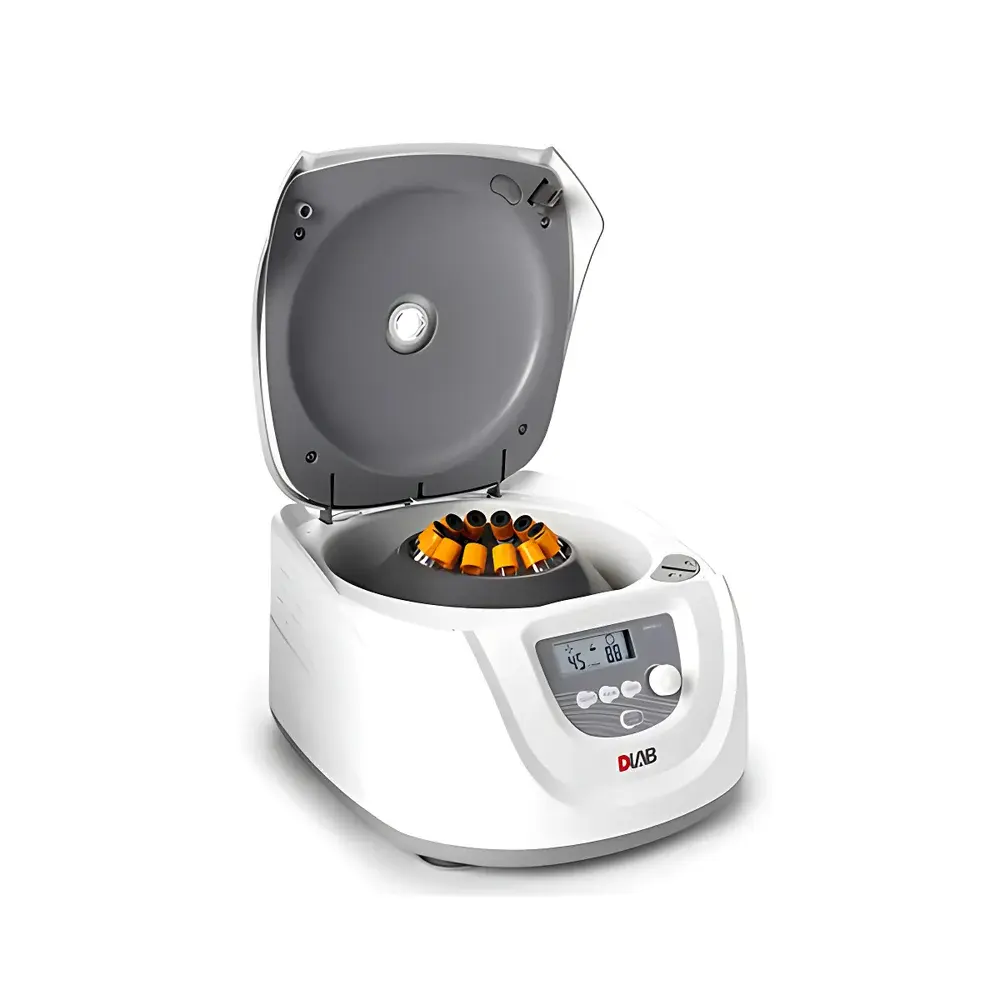
DLAB DM0412 Benchtop Low-Speed Centrifuge
| Brand | DLAB |
|---|---|
| Origin | Beijing, China |
| Manufacturer Type | Direct Manufacturer |
| Product Category | Domestic |
| Model | DM0412 |
| Instrument Type | Benchtop Centrifuge |
| Speed Range | 300–4500 rpm (100 rpm increments) |
| Max RCF | 2490 ×g (100 ×g increments) |
| Rotor Compatibility | A12-10P (5/7/10 mL ×12 or 15 mL ×8) or A6-50P (15/50 mL ×6), mutually exclusive |
| Timer | 30 s – 99 min + continuous mode |
| Acceleration/Deceleration | A12-10P: 20 s↑ / 13 s↓ |
| A6-50P | 20 s↑ / 20 s or 90 s↓ (selectable) |
| Motor | Brushless DC motor |
| Display | LCD with rpm/RCF toggle |
| Safety | Interlocked lid, overspeed protection, real-time diagnostics |
| Noise Level | <56 dB(A) |
| Dimensions (L×W×H) | 354×304×215 mm |
| Weight | 6 kg |
| Power Supply | 100–240 V AC, 50/60 Hz, 3 A, 70 W |
| Certifications | CE, cTÜVus |
| Additional Features | Instant centrifugation, audible alert, automatic lid opening post-run, run progress indicator, error code display |
Overview
The DLAB DM0412 is a compact, high-reliability benchtop low-speed centrifuge engineered for routine separation tasks in clinical laboratories, academic research settings, and quality control environments. It operates on the principle of sedimentation under controlled centrifugal force—generating relative centrifugal force (RCF) up to 2490 ×g at a maximum rotational speed of 4500 rpm. Designed for applications requiring gentle yet effective phase separation—including blood component isolation, cell pellet recovery, and precipitate clarification—the DM0412 delivers consistent performance without compromising operational safety or acoustic comfort. Its brushless DC motor ensures maintenance-free operation over extended service life, while precision-machined plastic-alloy rotors—balanced to ISO 21501-4 tolerances—minimize vibration and sustain stable rotor dynamics across all speed ranges.
Key Features
- Intuitive dual-parameter display: Real-time switching between rotational speed (rpm) and relative centrifugal force (×g) on an integrated LCD screen, enabling method-driven protocol execution aligned with ISO 15189 and CLSI EP15-A3 guidelines.
- Programmable deceleration profiles: Two selectable braking modes for the A6-50P rotor (20 s or 90 s deceleration), supporting both rapid sample handling and temperature-sensitive protocols where gradual heat dissipation is critical.
- Automated post-run workflow: Lid automatically unlocks and opens upon completion, accompanied by an audible alert—reducing manual intervention and facilitating passive sample cooling, particularly beneficial for serum separation prior to downstream ELISA or clinical chemistry analysis.
- Robust mechanical architecture: Reinforced polymer housing, precision-balanced rotor assembly, and optimized airflow design collectively achieve noise emission below 56 dB(A) at full load—meeting WHO-recommended ambient noise thresholds for shared laboratory spaces.
- Comprehensive safety system: Electromechanical door interlock prevents operation with lid unlatched; microprocessor-based overspeed detection halts rotation if deviation exceeds ±20 rpm tolerance; embedded diagnostics report fault codes (e.g., E01: lid sensor failure, E03: imbalance detection) for rapid troubleshooting.
Sample Compatibility & Compliance
The DM0412 supports two interchangeable rotor configurations: the A12-10P angle rotor (12-position, accommodating tubes from 5–15 mL) and the A6-50P angle rotor (6-position, compatible with 15–50 mL conical tubes). Rotors are not cross-compatible—each requires dedicated calibration and validation per IEC 61010-2-020 requirements. All rotors comply with ISO 15189 Annex A.3 for traceable calibration and undergo dynamic balancing verification per ISO 21501-4. The instrument’s CE and cTÜVus certifications confirm conformity with EU Machinery Directive 2006/42/EC and UL 61010-1 safety standards. While not inherently 21 CFR Part 11 compliant, audit trails for run parameters (time, speed, RCF, rotor ID) can be manually logged to support GLP/GMP documentation workflows.
Software & Data Management
The DM0412 operates via embedded firmware with no external software dependency. All user-defined parameters—including speed, time, acceleration/deceleration profile, and rpm/RCF preference—are stored in non-volatile memory and persist through power cycles. Run history is not retained beyond active session; however, the LCD displays real-time elapsed time and remaining duration, and error codes are logged until cleared. For laboratories requiring electronic record retention, integration with LIMS is achievable via optional RS-232 or USB-to-serial adapters (sold separately), enabling export of timestamped run metadata including start/stop times, final speed, and fault events—supporting alignment with ISO/IEC 17025 clause 7.7 on result reporting integrity.
Applications
- Clinical hematology: Separation of whole blood into serum/plasma and cellular fractions using standard 15 mL polypropylene tubes.
- Microbiology: Pellet recovery of bacterial cultures (e.g., E. coli, S. aureus) prior to DNA extraction or antibiotic susceptibility testing.
- Pharmaceutical QC: Clarification of suspension formulations and excipient compatibility studies per USP <711> dissolution methodology.
- Environmental testing: Sedimentation of suspended solids from water samples per EPA Method 160.1.
- Academic teaching labs: Demonstrating sedimentation kinetics, density gradient principles, and rotor physics fundamentals under controlled, low-risk conditions.
FAQ
Is the DM0412 suitable for use with infectious or biohazardous samples?
Yes—when operated with sealed tube carriers and appropriate biosafety containment (e.g., BSL-2 cabinet), provided rotors are decontaminated per CDC/NIH Biosafety in Microbiological and Biomedical Laboratories (BMBL) guidelines.
Can both A12-10P and A6-50P rotors be used interchangeably without recalibration?
No—rotor-specific acceleration/deceleration profiles and RCF calculations require separate selection and verification; swapping rotors mandates manual reconfiguration via front-panel interface.
Does the instrument support programmable ramp rates?
Acceleration is fixed at 20 s to maximum speed; deceleration offers two preset options only for the A6-50P rotor (20 s fast stop or 90 s soft stop); no user-defined ramp curves are available.
What maintenance is required for long-term reliability?
Brushless DC motor requires no scheduled servicing; periodic cleaning of rotor chamber and inspection of lid seal integrity every 6 months is recommended per manufacturer’s preventive maintenance schedule.
Is remote monitoring or network connectivity supported?
No native Ethernet or Wi-Fi capability exists; optional serial interface enables basic parameter logging but does not support real-time telemetry or cloud synchronization.



