
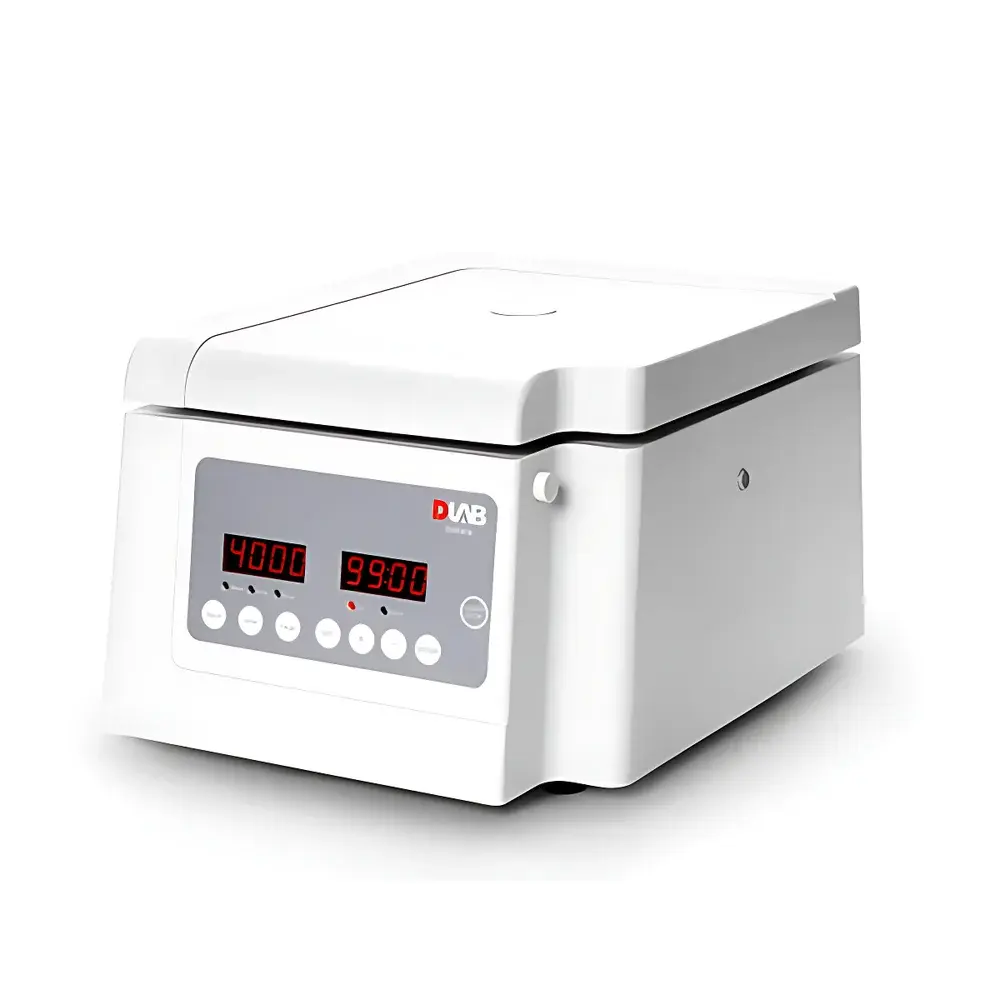
DLAB DM0408 Benchtop Low-Speed Centrifuge
| Brand | DLAB |
|---|---|
| Origin | Beijing, China |
| Manufacturer Type | Direct Manufacturer |
| Instrument Type | Benchtop Centrifuge |
| Speed Range | 300–4000 rpm (100 rpm increments) |
| Max RCF | 1900 × g |
| Max Capacity | 8 × 15 mL or 10 × 12 mL angular rotors (standard) |
| Timer Range | 1–99 min or continuous mode |
| Acceleration/Deceleration | 25 s / 35 s |
| Noise Level | ≤60 dB(A) |
| Dimensions (W×D×H) | 286 × 367 × 227 mm |
| Weight | 9.2 kg |
| Motor | Brushless DC |
| Display | LED with real-time parameter feedback |
| Safety | Single-door electronic lock, operational status diagnostics, audible end-of-run alert, auto-lid opening post-centrifugation |
| Pre-set Protocols | Blood (3200 rpm, 10 min), Urine (1800 rpm, 5 min), Feces (1300 rpm, 10 min) |
| Power Supply | 100–240 V AC, 50/60 Hz |
Overview
The DLAB DM0408 is a compact, microprocessor-controlled benchtop low-speed centrifuge engineered for routine clinical and general laboratory sample preparation tasks. It operates on the principle of sedimentation under controlled gravitational force (RCF), enabling efficient separation of biological suspensions—including whole blood, urine sediments, and stool homogenates—based on particle density and size. Designed specifically for high-frequency, low-intensity applications in hospital laboratories, point-of-care testing units, and academic teaching labs, the DM0408 delivers consistent performance at rotational speeds up to 4000 rpm (1900 × g), well within the operational envelope defined by ISO 15195:2018 for clinical centrifugation equipment. Its brushless DC motor ensures long-term reliability, minimal maintenance, and stable torque delivery across the full speed range—critical for reproducible hematocrit determination, urinalysis sediment concentration, and microbiological specimen clarification.
Key Features
- Intuitive LED interface displaying real-time speed (rpm), RCF, remaining time, and operational status—no interpretation required during active runs.
- Three pre-programmed clinical protocols (Blood, Urine, Feces) stored in non-volatile memory; recall via single-button activation to eliminate manual parameter entry errors.
- Optimized acceleration and deceleration profiles (25 s ramp-up, 35 s ramp-down) minimize sample turbulence and preserve pellet integrity—especially critical for fragile cellular components in peripheral blood mononuclear cell (PBMC) isolation workflows.
- Electronically interlocked lid with fail-safe detection: centrifugation halts immediately if lid opens unexpectedly, and rotor cannot spin unless fully engaged and verified.
- Low-noise operation (≤60 dB[A] at 1 m distance) achieved through precision-balanced angular rotors fabricated from reinforced polymer alloy and vibration-damping chassis design—compliant with WHO Laboratory Biosafety Manual noise guidelines for diagnostic environments.
- Auto-lid release function activates upon completion, facilitating rapid thermal equilibration of samples and reducing operator wait time between sequential runs.
Sample Compatibility & Compliance
The DM0408 accommodates standard clinical tube formats including 5 mL, 7 mL, 10 mL, 12 mL, and 15 mL conical and round-bottom polypropylene tubes—compatible with common anticoagulant tubes (EDTA, heparin, citrate) and urine collection containers. Its angular rotor configuration supports both fixed-angle and swing-out compatible geometries, ensuring uniform sediment compaction without wall adhesion artifacts. The instrument meets IEC 61010-1:2010 safety requirements for electrical laboratory equipment and adheres to EN 61326-1:2013 electromagnetic compatibility standards. While not certified for GLP/GMP production environments, its diagnostic-grade repeatability (±100 rpm speed accuracy, ±1 min timer tolerance) satisfies CLIA-waived test system validation criteria per CAP checklist COM.40550 and aligns with ISO 15189:2022 clause 5.3.2 for equipment suitability assessment in medical laboratories.
Software & Data Management
The DM0408 operates as a standalone device with embedded firmware—no external software or driver installation required. All operational parameters are stored locally in EEPROM with write-protection logic to prevent accidental overwrites. Though it lacks USB or Ethernet connectivity, its deterministic control architecture supports audit-ready traceability: each run logs start time, selected protocol, final speed, duration, and error codes (e.g., imbalance detection, lid fault) accessible via diagnostic mode. This architecture complies with FDA 21 CFR Part 11 foundational principles for electronic record integrity, particularly when paired with laboratory information systems (LIS) that capture barcode-scanned sample IDs alongside centrifuge metadata during downstream analysis.
Applications
- Routine hematology: plasma separation from whole blood (e.g., for glucose, electrolyte, or coagulation assays); packed cell volume (PCV) estimation.
- Clinical chemistry: concentration of urinary sediments prior to microscopic examination per CLSI GP16-A3 recommendations.
- Microbiology: pelleting of stool suspensions for culture inoculation or antigen extraction in enteric pathogen screening workflows.
- Research education: demonstration of sedimentation kinetics, density gradient setup preparation, and basic centrifugal force calculations in undergraduate biophysics curricula.
- Point-of-care settings: rapid sample conditioning for lateral flow immunoassays requiring clarified supernatants or concentrated particulates.
FAQ
What is the maximum relative centrifugal force (RCF) achievable with the DM0408?
The DM0408 generates a maximum RCF of 1900 × g at 4000 rpm using the standard 15 mL angular rotor.
Can the DM0408 accommodate 5 mL tubes in the 10-position rotor?
Yes—the 10 × 12 mL angular rotor accepts 5 mL, 7 mL, and 10 mL tubes without adapters due to its tapered cavity geometry and radial alignment design.
Is the DM0408 suitable for use in biosafety cabinets?
Its compact footprint (286 mm depth) and low heat dissipation (<15 W standby, <120 W peak) permit safe integration into Class II A2 cabinet workspaces, provided airflow balance is verified post-installation.
Does the DM0408 support rotor calibration or user-defined protocols?
No—only the three factory-loaded clinical protocols are available; however, manual speed/time entry allows ad hoc method development within the 300–4000 rpm and 1–99 min operating envelope.
How does the DM0408 ensure rotor imbalance detection?
Vibration sensors monitor axial displacement in real time; if oscillation amplitude exceeds ISO 1940-1 G6.3 threshold during acceleration, the system pauses, displays “E03”, and sounds an alert—requiring manual load redistribution before restart.



