
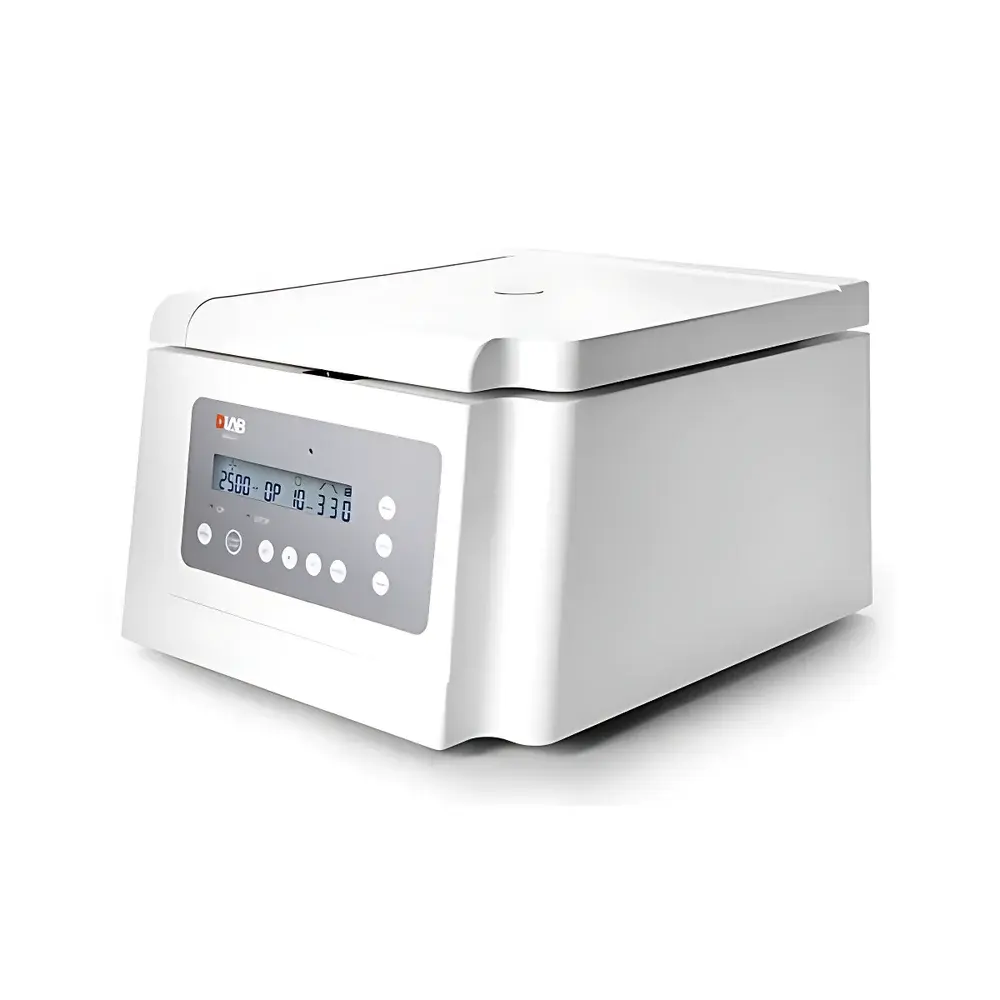
DLAB DM0424 Benchtop Low-Speed Centrifuge
| Brand | DLAB |
|---|---|
| Origin | Beijing, China |
| Manufacturer Type | Direct Manufacturer |
| Instrument Type | Benchtop Centrifuge |
| Speed Range | 500–4000 rpm (100 rpm increments) |
| Max RCF | 2500 × g |
| Speed Accuracy | ±100 rpm |
| Rotor Configurations | Horizontal rotor (6 × 15 mL / 4 × 50 mL) |
| Timer | 1–99 min or continuous mode |
| Acceleration | 3 preset levels |
| Deceleration | 4 preset levels |
| Motor | Brushless DC motor |
| Display | LCD with real-time parameter and error-code feedback |
| Safety | Single-door electromagnetic lock, overspeed protection, self-diagnostic system |
| Power Supply | 100–240 V AC, 50/60 Hz |
| Dimensions (W×D×H) | 364 × 440 × 268 mm |
| Weight | 14.5 kg |
| Noise Level | ≤62 dB(A) |
Overview
The DLAB DM0424 is a precision-engineered benchtop low-speed centrifuge designed for routine clinical and general laboratory separation tasks requiring reliable, quiet, and repeatable performance. Operating on the principle of sedimentation under centrifugal force, it separates heterogeneous mixtures—such as whole blood, urine sediments, fecal suspensions, and cell culture supernatants—based on particle density, size, and shape. With a maximum rotational speed of 4000 rpm and a corresponding relative centrifugal force (RCF) of 2500 × g, the DM0424 delivers sufficient force for pelleting erythrocytes, leukocytes, platelets, and larger cellular debris while preserving sample integrity in sensitive biological matrices. Its brushless DC motor ensures stable torque delivery across the full speed range (500–4000 rpm), minimizing thermal drift and mechanical wear over extended operational cycles.
Key Features
- Three-step acceleration and four-step deceleration profiles enable precise control over sample shear exposure—critical for fragile cells or viscous clinical specimens.
- Electromagnetic door lock system with integrated status diagnostics prevents accidental opening during operation and provides immediate fault indication via LCD error codes (e.g., E01 for lid sensor failure, E03 for rotor imbalance).
- High-strength composite horizontal rotors and aluminum angle rotors undergo dynamic balancing to ≤0.5 g·mm residual unbalance, contributing to vibration-free operation at all speeds and noise levels ≤62 dB(A) at 1 m distance.
- LCD interface displays real-time rpm, RCF, remaining time, and elapsed time; supports quick-access preprogrammed protocols for common clinical workflows (e.g., blood: 3200 rpm × 10 min; urine: 1800 rpm × 5 min; stool: 1300 rpm × 10 min).
- Universal power input (100–240 V AC, 50/60 Hz) ensures compatibility with global laboratory electrical infrastructure without external transformers.
Sample Compatibility & Compliance
The DM0424 accommodates standard clinical tube formats including 15 mL conical polypropylene tubes, 50 mL centrifuge tubes, and 10 mL round-bottom tubes—enabling direct integration into existing diagnostic lab workflows. Its rotor configurations comply with ISO 15195:2019 (clinical laboratory equipment — requirements for centrifuges) for mechanical safety and operational stability. While not certified for Class II biosafety containment, the unit meets IEC 61010-1:2010 requirements for electrical safety in laboratory environments. The absence of refrigeration limits its use to ambient-temperature separations only; it is not intended for cryopreservation or temperature-sensitive protein isolation.
Software & Data Management
The DM0424 operates as a standalone instrument with no embedded software or network connectivity. All operational parameters are stored locally in non-volatile memory and persist after power cycling. The LCD display logs the last five executed run parameters—including speed, time, rotor type, and error events—for traceability during internal quality audits. Though lacking FDA 21 CFR Part 11-compliant electronic signatures or audit trails, its deterministic control architecture and error-code-based diagnostics support GLP-aligned documentation practices when paired with manual logbook entries or LIMS-integrated run records.
Applications
- Routine hematology: Separation of serum/plasma from whole blood using horizontal 6 × 15 mL rotors.
- Urinalysis: Pellet formation from centrifuged urine samples for microscopic sediment examination (CLSI GP16-A3 guidelines).
- Fecal occult blood testing: Clarification of stool homogenates prior to immunochemical assay.
- Tissue homogenate clarification: Removal of cellular debris from lysates prior to ELISA or biochemical assays.
- Microbiology: Harvesting bacterial pellets from broth cultures for Gram staining or antibiotic susceptibility testing.
FAQ
What is the maximum tube capacity for the horizontal rotor configuration?
The horizontal rotor supports either six 15 mL tubes or four 50 mL tubes simultaneously, optimized for high-volume clinical sample processing.
Does the DM0424 include refrigeration?
No. This is a non-refrigerated centrifuge intended for ambient-temperature applications only.
Can the unit be validated for GMP environments?
While the device meets IEC 61010-1 safety standards and offers reproducible mechanical performance, formal IQ/OQ/PQ validation requires user-defined protocols aligned with site-specific SOPs and regulatory expectations.
Is rotor imbalance detection automated?
Yes. The built-in diagnostic system continuously monitors vibration amplitude and automatically halts operation if imbalance exceeds safe thresholds, displaying error code E03.
What maintenance intervals are recommended?
DLAB recommends visual inspection of rotor threads and lid seal every 100 runs, lubrication of rotor spindle every 6 months, and annual calibration verification of speed and timer accuracy using NIST-traceable tachometry tools.



