
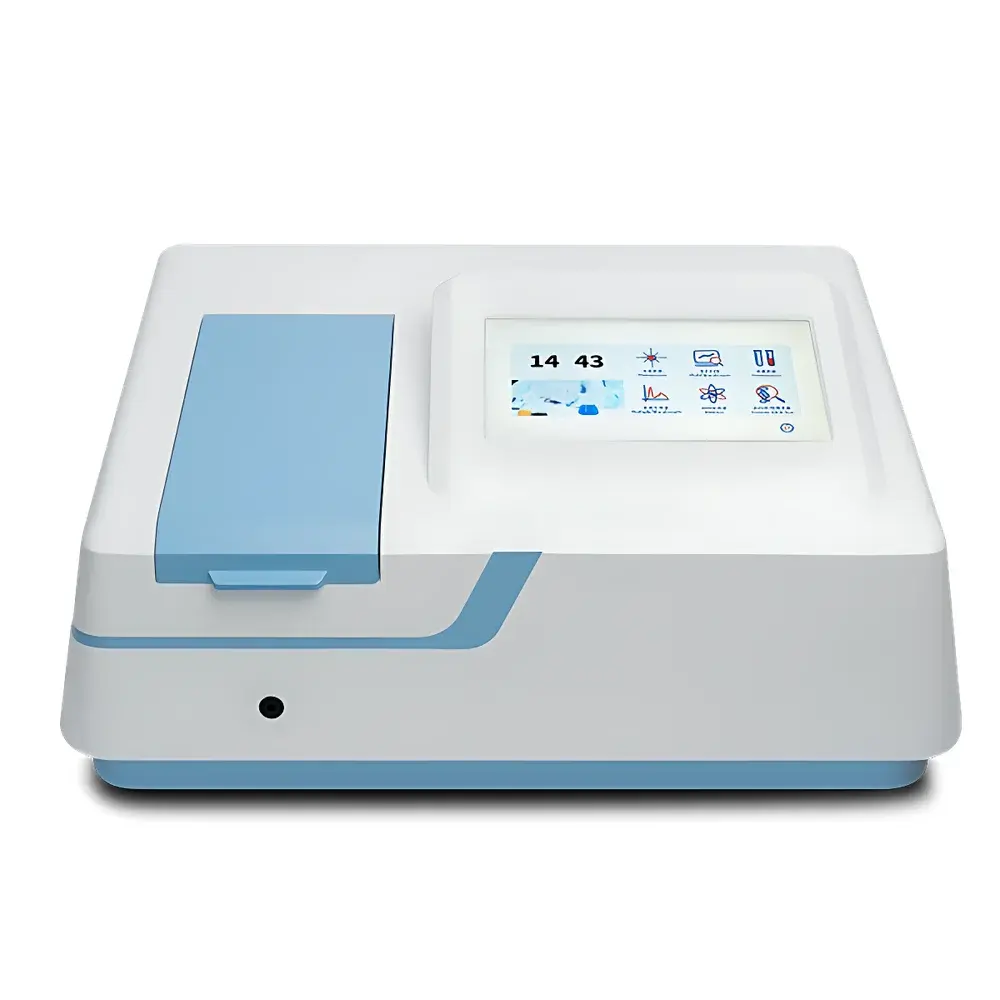
DLAB SP-UV2101 Ultraviolet-Visible Spectrophotometer
| Brand | DLAB |
|---|---|
| Origin | Beijing, China |
| Manufacturer Type | Original Equipment Manufacturer (OEM) |
| Instrument Architecture | Single-Beam |
| Wavelength Range | 190–1000 nm |
| Spectral Bandwidth | 1.0 nm |
| Wavelength Accuracy | ±0.1 nm at 656.1 nm, ±0.3 nm across full range |
| Wavelength Repeatability | ≤0.1 nm |
| Stray Light | ≤0.03% T at 220 nm and 360 nm |
| Display | 10.1-inch color capacitive touchscreen (1024 × 600 resolution) |
| Compliance | GLP/GMP-ready software architecture with audit trail, user management, and electronic record retention |
Overview
The DLAB SP-UV2101 Ultraviolet-Visible Spectrophotometer is a precision single-beam optical instrument engineered for quantitative and qualitative analysis across research laboratories, quality control environments, and educational institutions. Based on the fundamental principle of Beer–Lambert law absorption spectroscopy, it measures the intensity of light transmitted through or reflected from a sample as a function of wavelength in the ultraviolet (190 nm) to near-infrared (1000 nm) spectral region. Its optical design integrates a holographic grating monochromator and a digitally calibrated photodiode detector array, ensuring high photometric linearity, low noise, and minimal stray light interference—critical for trace-level analyte detection and high-fidelity spectral profiling. The instrument’s core architecture supports both standalone operation via embedded firmware and PC-based remote control, enabling seamless integration into regulated laboratory workflows.
Key Features
- 10.1-inch high-resolution color capacitive touchscreen interface (1024 × 600) with intuitive graphical navigation and real-time spectral visualization
- Single-beam optical path optimized for stability and cost-effective maintenance without compromising photometric accuracy
- Holographic grating monochromator delivering consistent 1.0 nm spectral bandwidth across the entire 190–1000 nm range
- Advanced wavelength drive mechanism achieving ≤0.1 nm repeatability and ±0.1 nm accuracy at the hydrogen alpha line (656.1 nm), with full-range tolerance of ±0.3 nm
- Low-stray-light performance: ≤0.03% T at 220 nm and 360 nm—meeting ISO 9001 and ASTM E275 validation benchmarks for UV-Vis instrumentation
- Integrated power-loss recovery: automatic parameter and measurement state retention after unexpected shutdown
- Standard USB 2.0 port for direct data export to external storage or LIMS-compatible systems without proprietary drivers
Sample Compatibility & Compliance
The SP-UV2101 accommodates standard 10 mm square cuvettes (quartz, glass, or plastic), microvolume cells, and solid samples via optional accessories—including variable-pathlength holders, integrating spheres for diffuse reflectance, temperature-controlled cell holders (±0.1 °C stability), and angled solid-sample stages. All hardware interfaces comply with IEC 61000-4 electromagnetic compatibility standards. The embedded firmware and optional PC software adhere to GLP and GMP requirements per FDA 21 CFR Part 11: user authentication levels (admin/operator/auditor), time-stamped electronic logs, immutable data archiving, and configurable report templates with digital signature support. Data integrity is further reinforced by checksum-verified file storage and automatic backup to removable media.
Software & Data Management
The instrument ships with DLAB UV-Pro v3.x PC software—a validated application supporting spectral scanning, kinetic assays, multi-wavelength quantitation, DNA/protein A260/A280 ratio analysis, and enzyme activity kinetics. Raw absorbance, transmittance, and concentration data are stored in vendor-neutral CSV and XML formats. The software implements role-based access control, audit-trail generation (including parameter changes, calibration events, and user logins), and customizable PDF/Excel report exports compliant with ISO/IEC 17025 documentation standards. All spectral scans retain full wavelength-intensity point data (≥1 nm resolution), enabling post-acquisition baseline correction, peak deconvolution, and derivative analysis.
Applications
- Pharmaceutical QC: assay verification of active pharmaceutical ingredients (APIs) per USP and EP 2.2.25
- Biochemical analysis: nucleic acid quantification (dsDNA, ssDNA, RNA), protein concentration (Bradford/Lowry/BCA), and enzyme kinetics (e.g., LDH, ALP)
- Environmental testing: nitrate, phosphate, and heavy metal ion determination in water per EPA Method 353.2 and ISO 15681-1
- Materials science: thin-film thickness estimation via interference fringe analysis and bandgap calculation of semiconductor coatings
- Food & beverage: colorimetric assessment of pigments (anthocyanins, carotenoids), preservative content (sulfites, benzoates), and oxidation markers (peroxide value proxies)
FAQ
Does the SP-UV2101 support compliance with 21 CFR Part 11?
Yes—the PC software includes electronic signatures, audit trails, and secure user roles required for FDA-regulated environments.
Can the instrument perform kinetic measurements over extended time periods?
Yes; time-scan mode supports up to 9999 data points with user-defined intervals from 0.1 s to 60 min per interval.
Is calibration traceable to NIST standards?
Wavelength calibration is verified using NIST-traceable holmium oxide and didymium filters; photometric calibration employs certified neutral density filters.
What is the maximum data storage capacity onboard?
Internal memory retains ≥10,000 spectra or quantitative results; external USB drives extend capacity indefinitely.
Are optional accessories validated for regulatory use?
All GMP-grade accessories—including thermostatted cell holders and integrating spheres—include factory calibration certificates and installation qualification (IQ) documentation.




