
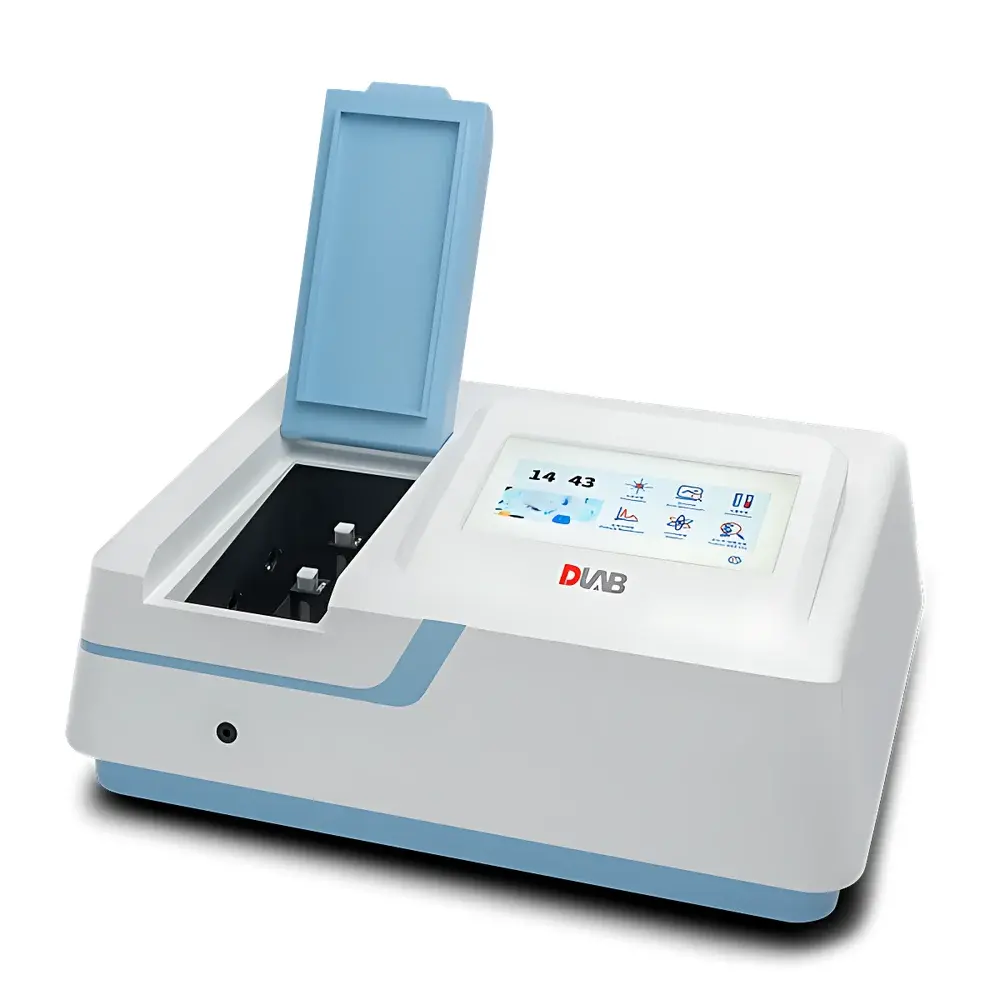
DLAB SP-UV3101 Dual-Beam Ultraviolet-Visible Spectrophotometer
| Brand | DLAB |
|---|---|
| Origin | Beijing, China |
| Manufacturer Type | Original Equipment Manufacturer (OEM) |
| Instrument Architecture | Dual-Beam |
| Wavelength Range | 190–1100 nm |
| Spectral Bandwidth | 1.0 nm |
| Wavelength Accuracy | ±0.1 nm at 656.1 nm, ±0.3 nm across full range |
| Wavelength Repeatability | ≤0.1 nm |
| Stray Light | ≤0.02% T at 220 nm and 360 nm |
| Photometric Range | –0.3 to 3 A, 0–9999 C (0–9999 F) |
| Photometric Accuracy | ±0.0015 A (0–0.5 A), ±0.002 A (0.5–1 A) |
| Photometric Repeatability | ±0.001 A (0–0.5 A), ±0.0015 A (0.5–1 A) |
| Baseline Stability | ≤0.001 A/h at 500 nm (after 1-hour warm-up) |
| Detector | Digital Photodiode Array |
| Light Sources | Tungsten Halogen Lamp (HYBEC, Japan) and Deuterium Lamp (Miras, Korea) |
| Display | 10.1-inch color capacitive touchscreen (1024 × 600) |
| Interfaces | USB port, parallel printer port |
| Power Supply | 110/220 V, 50/60 Hz, 120 W |
| Dimensions (L × W × H) | 570 × 440 × 210 mm |
| Weight | 20 kg |
Overview
The DLAB SP-UV3101 is a high-performance dual-beam ultraviolet-visible (UV-Vis) spectrophotometer engineered for precision absorbance, transmittance, and concentration measurements across the 190–1100 nm spectral range. Its optical architecture employs a holographic grating monochromator coupled with digitally calibrated photodiode array detection—ensuring low stray light (<0.02% T), minimal electronic noise, and exceptional baseline stability (≤0.001 A/h after 1-hour thermal equilibration). The dual-beam design continuously compensates for source intensity drift and environmental fluctuations by splitting the light path into reference and sample channels, thereby delivering high reproducibility in kinetic assays, spectral scanning, and multi-point quantitative analysis. This instrument is designed for routine QC/QA laboratories, academic research facilities, and pharmaceutical development environments where regulatory traceability and measurement integrity are essential.
Key Features
- Dual-beam optical system with real-time reference beam correction for enhanced photometric stability and long-term measurement fidelity
- 10.1-inch capacitive touchscreen interface (1024 × 600 resolution) enabling intuitive navigation, method setup, and on-device data visualization without external PC dependency
- Holographic grating monochromator with 1.0 nm spectral bandwidth, optimized for resolution–throughput balance in both narrow-band and broad-spectrum applications
- High-precision wavelength drive mechanism achieving ±0.1 nm accuracy at the deuterium lamp’s 656.1 nm hydrogen alpha line and ≤0.1 nm repeatability across full scan range
- Low-noise digital photodiode detector with extended dynamic range (–0.3 to 3 A) and photometric accuracy of ±0.0015 A in the clinically and analytically critical 0–0.5 A range
- Modular accessory support including thermostatted cuvette holders, integrating spheres, variable-pathlength cells, film and micro-volume adapters, and automated 8-position cuvette changers
Sample Compatibility & Compliance
The SP-UV3101 accommodates standard 10 mm pathlength quartz or glass cuvettes in its fixed holder, with optional accessories extending compatibility to microvolume samples (down to 2 µL), solid films, reflective surfaces, and turbid suspensions. It supports compliance-critical workflows through built-in GLP/GMP-enabling features: user-level access control (admin/operator/guest roles), tamper-evident audit trails, timestamped method and result logs, and encrypted data storage with version-controlled export (CSV, PDF, XML). All software operations conform to FDA 21 CFR Part 11 requirements for electronic records and signatures when deployed with validated configurations. The instrument meets ISO/IEC 17025 metrological traceability expectations for calibration verification using NIST-traceable standards.
Software & Data Management
The embedded firmware and optional PC-based SpectraLab Pro software provide synchronized functionality for method development, spectral acquisition, kinetic profiling, DNA/protein quantification (using ε₂₈₀ and ε₂₆₀ coefficients), and multi-wavelength ratio analysis. Data files retain full metadata—including instrument ID, operator ID, calibration history, environmental conditions (if logged), and raw spectral arrays—ensuring full analytical traceability. USB 2.0 interface enables direct export of spectra, kinetics curves, and reports to external drives; all exported files include embedded checksums for integrity validation. Internal memory retains ≥10,000 spectra or ≥500 full-method protocols, with automatic backup upon power interruption (non-volatile memory retention).
Applications
The SP-UV3101 serves as a foundational tool in diverse analytical domains: quantitative determination of nucleic acids and proteins in molecular biology labs; assay validation and dissolution testing per USP and ; colorimetric enzyme kinetics (e.g., LDH, ALP) in clinical chemistry; quality control of dyes, pigments, and UV filters in materials science; and purity assessment of organic intermediates in fine chemical synthesis. Its robust stray-light suppression and wide dynamic range make it suitable for low-concentration trace metal analysis via complexometric colorimetry (e.g., Fe²⁺/1,10-phenanthroline) and high-absorbance pharmaceutical formulations (e.g., sunscreen actives at 320 nm).
FAQ
What wavelength calibration standards are recommended for routine verification?
NIST-traceable holmium oxide and didymium filters are recommended for wavelength accuracy checks at 241.1, 279.4, 287.5, 333.7, 360.9, 418.5, 460.0, 484.5, 536.2, and 637.5 nm.
Is the instrument compatible with third-party LIMS integration?
Yes—via ASCII-based serial command protocol (RS-232) or structured CSV export; API documentation and driver libraries are available under NDA for validated LIMS interfacing.
Can the SP-UV3101 perform simultaneous multi-wavelength kinetic measurements?
Yes—up to 10 user-defined wavelengths can be monitored concurrently during time-scan mode, with configurable sampling intervals from 0.1 s to 600 s.
Does the software support pharmacopeial compliance templates (e.g., USP, EP)?
SpectraLab Pro includes preconfigured templates for USP endotoxin testing, USP dissolution, and EP 2.2.25 UV-Vis validation protocols, including system suitability criteria and acceptance thresholds.
What is the warm-up time required to achieve specified photometric stability?
Optimal baseline stability (≤0.001 A/h) is achieved after a 60-minute warm-up period with both lamps operating at nominal intensity.




