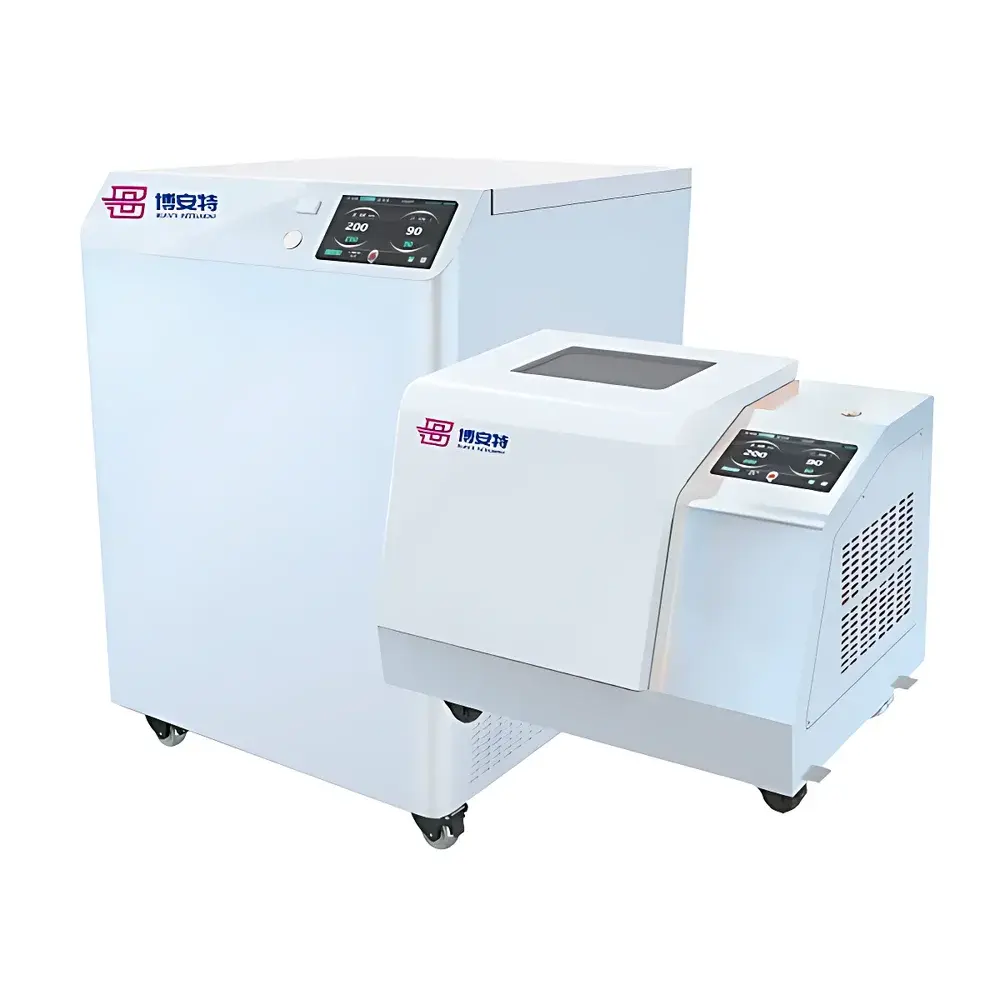
Brookfield BAT-LGF Series Vertical Forced-Air Constant-Temperature Drying Oven
| Brand | Brookfield |
|---|---|
| Model | BAT40/80/150/240/300-LGF |
| Origin | Hubei, China |
| Type | General-Purpose Forced-Convection Drying Oven |
| Temperature Range | RT+10°C to 250°C |
| Temperature Uniformity | ±3% of setpoint |
| Temperature Fluctuation | ±1°C |
| External Dimensions (W×D×H) | 485×505×815 mm (BAT40-LGF) |
| Internal Chamber Dimensions (W×D×H) | 300×350×400 mm (BAT40-LGF) |
| Interior Material | Mirror-Finish Stainless Steel (SUS304) |
| Control System | LCD Display with PID Algorithm |
| Sensor | PT100 Platinum Resistance Thermometer |
| Air Circulation | Rear-Mounted Horizontal Forced-Air System with Three-Speed Adjustable Centrifugal Blower |
| Safety Features | Over-Temperature Alarm with Audible and Visual Alert |
| Optional Accessories | Touchscreen Controller (5″), USB Data Logging, RS485 Interface for PC Integration, Remote Monitoring via WeChat Mini-Program |
Overview
The Brookfield BAT-LGF Series Vertical Forced-Air Constant-Temperature Drying Oven is engineered for precision thermal processing in research laboratories, quality control environments, and industrial R&D settings. Utilizing a robust forced-convection architecture, this oven maintains stable, uniform temperature distribution across the entire working chamber through a rear-mounted horizontal airflow system. The design adheres to fundamental principles of convective heat transfer—ensuring rapid thermal equilibration after door opening and minimizing spatial temperature gradients. Its operational range extends from ambient +10°C to 250°C, making it suitable for applications including moisture content determination (per ASTM D2298 and ISO 787-2), pre-conditioning of polymer samples, drying of glassware and filtration media, and thermal stabilization of reagents prior to analytical testing. The oven’s structural integrity derives from laser-cut and welded stainless steel chassis, finished with electrostatic powder coating for corrosion resistance and long-term dimensional stability.
Key Features
- Mirror-finish SUS304 stainless steel interior chamber with seamless, radius-corner construction—facilitating cleaning validation and reducing microbial retention risk in GLP-compliant workflows.
- Microprocessor-based PID temperature controller with real-time LCD display; supports both time-based and temperature-setpoint operation modes with programmable duration up to 999 hours.
- High-response PT100 platinum RTD sensor mounted directly within the chamber air stream—minimizing self-heating error and delivering sub-second thermal step response.
- Triple-layer sealing system: high-temperature silicone gasket, isolated hinge mechanism, and dual-point latching handle—achieving consistent chamber integrity under thermal cycling conditions.
- Double-pane tempered glass observation window with low-emissivity surface treatment—enabling non-intrusive visual monitoring without compromising thermal efficiency.
- Three-speed adjustable centrifugal circulation blower—allowing airflow optimization for heat-sensitive samples or high-mass loading scenarios.
- Removable, height-adjustable stainless steel shelves (standard configuration: 2–3 layers depending on model)—supporting flexible load arrangement and validated placement studies per USP <1211>.
Sample Compatibility & Compliance
The BAT-LGF series accommodates standard laboratory containers—including Petri dishes, weighing boats, crucibles, volumetric flasks, and sample trays—within its fully accessible vertical chamber. Its internal geometry conforms to ISO 17025 requirements for environmental conditioning equipment used in accredited testing laboratories. The oven meets CE marking criteria for electrical safety (EN 61000-6-3, EN 61000-6-4) and thermal hazard mitigation (EN 60529 IP20). While not certified for Class I Division 1 hazardous locations, its construction complies with general-purpose lab equipment standards under IEC 61010-1. For GxP-regulated operations, optional RS485 interface and USB data logging support 21 CFR Part 11–compliant audit trails when integrated with validated third-party software platforms.
Software & Data Management
Standard operation requires no external software—parameters are configured locally via the front-panel LCD interface. Optional upgrades include a 5-inch capacitive touchscreen controller featuring embedded data logging (up to 30 days at 1-min intervals), CSV export via USB flash drive, and RS485 Modbus RTU protocol compatibility for integration into centralized SCADA or LIMS systems. Remote supervision is enabled through a secure WeChat Mini-Program interface—providing real-time temperature telemetry, alarm status notifications, and historical trend visualization. All logged data retain traceability metadata (timestamp, operator ID, setpoint, actual reading), satisfying documentation requirements for ISO/IEC 17025 Clause 7.7 and FDA guidance on electronic records.
Applications
- Moisture loss-on-drying assays for pharmaceutical excipients (USP <731>) and food-grade powders (AOAC 950.46).
- Pre-drying of filter membranes prior to gravimetric particulate analysis (EPA Method 160.1).
- Thermal aging of elastomeric seals and packaging materials per ASTM D573 and ISO 188.
- Conditioning of ceramic substrates and printed circuit boards before solder paste application.
- Stabilization of hygroscopic reference standards in metrology labs (NIST SP 800-142).
- Post-sterilization drying of reusable surgical instruments in hospital central supply departments (AAMI ST79).
FAQ
What is the maximum allowable load mass for stable temperature control?
The oven maintains specified uniformity and fluctuation performance with up to 70% chamber volume occupied by inert, thermally conductive loads. For optimal recovery time post-door-opening, avoid exceeding 50% volume fill with dense, low-thermal-diffusivity materials.
Is the PT100 sensor calibrated and traceable to NIST standards?
The factory-installed PT100 sensor is calibrated against a certified reference thermometer (±0.05°C uncertainty) at three points (100°C, 150°C, 200°C); full calibration certificates with NIST-traceable documentation are available upon request.
Can the oven be validated for IQ/OQ/PQ protocols?
Yes—the mechanical and control architecture supports installation qualification (IQ), operational qualification (OQ), and performance qualification (PQ) per ASTM E2500 and EU Annex 15 guidelines; validation templates and sensor mapping kits are provided with optional PQ packages.
Does the RS485 interface support Modbus TCP over Ethernet?
No—the standard RS485 port implements Modbus RTU only; Ethernet connectivity requires an external RS485-to-Ethernet gateway configured in transparent bridge mode.
What maintenance intervals are recommended for the circulation blower and heating elements?
Inspect blower bearings and clean inlet filters every 500 operating hours; replace heating elements only upon measured resistance deviation >10% from nominal value—typically beyond 10,000 hours of continuous use at ≤200°C.