
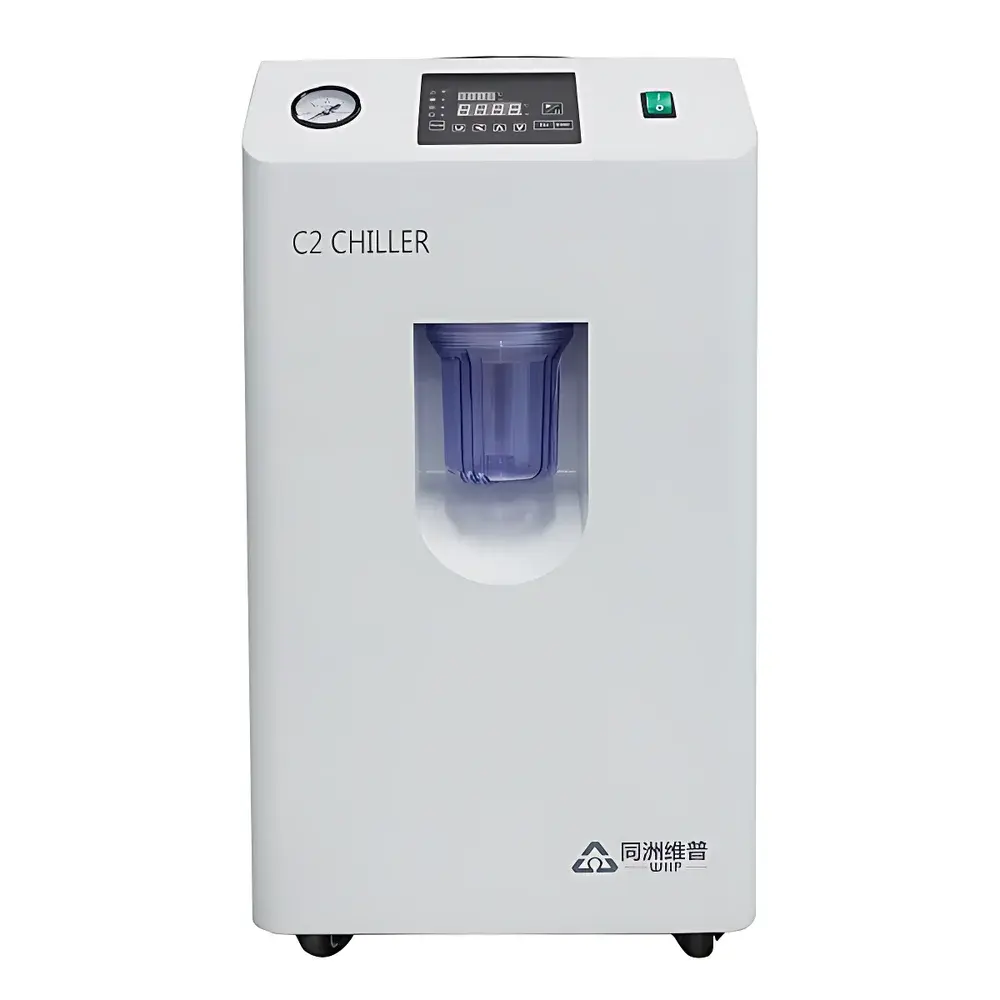
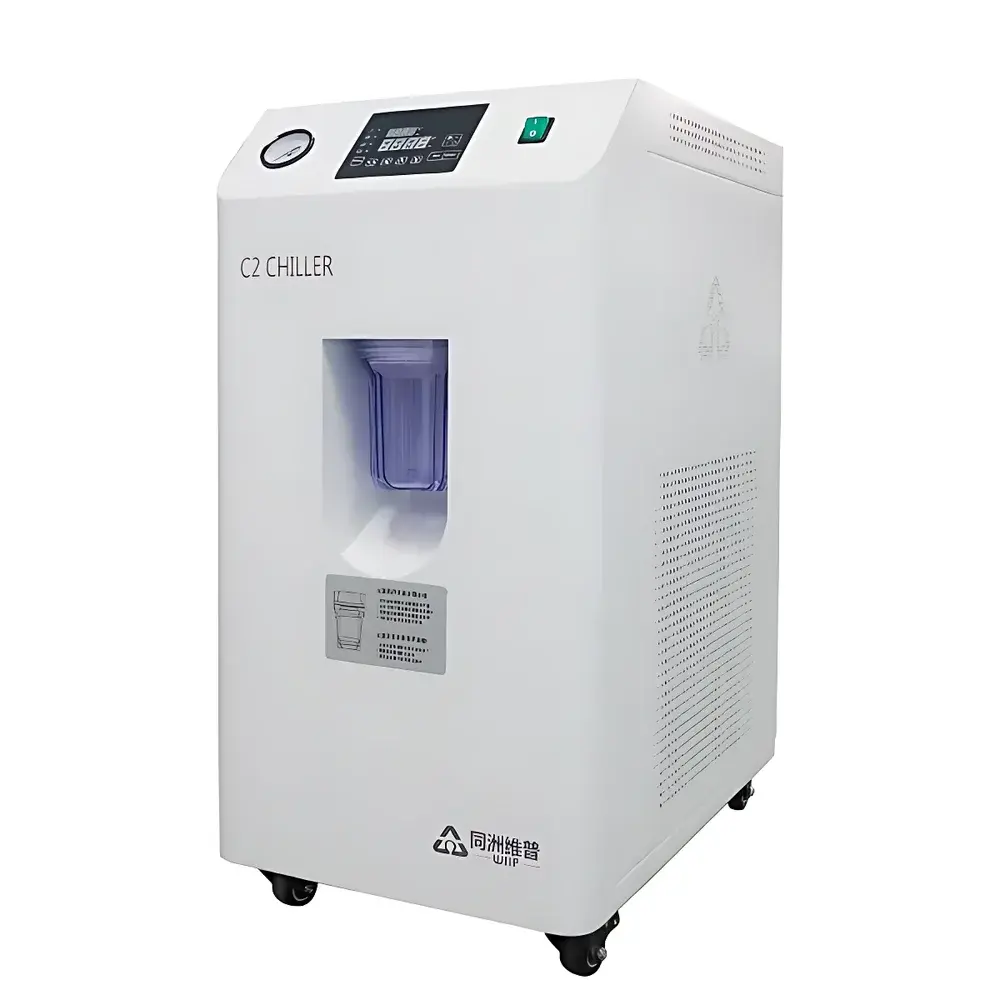
Tongzhou Weipu C2 Circulating Chiller for ICP-OES
| Brand | Tongzhou Weipu |
|---|---|
| Origin | Beijing, China |
| Manufacturer Type | Direct Manufacturer |
| Product Category | Domestic |
| Model | C2 Circulating Chiller for ICP-OES |
| Instrument Type | Integrated Unit |
| Cooling Method | Water-Cooled |
| Temperature Control Range | 5–35 °C |
| Cooling Capacity | 1600 W |
| Temperature Stability | ±0.1 °C |
| Reservoir Volume | 20 L |
| Operating Principle | Phase-Change Refrigeration |
Overview
The Tongzhou Weipu C2 Circulating Chiller is an integrated, water-cooled refrigeration system engineered specifically to support high-precision analytical instrumentation requiring stable, continuous thermal management. Designed for seamless integration with inductively coupled plasma optical emission spectrometers (ICP-OES), the C2 employs phase-change refrigeration technology to deliver precise temperature control across a 5–35 °C operating range. Its 1600 W cooling capacity ensures consistent heat dissipation from plasma torches, RF generators, and detector assemblies—critical for maintaining spectral resolution, signal-to-noise ratio, and long-term calibration stability in ICP-OES workflows. Unlike air-cooled alternatives, the C2’s closed-loop water circulation architecture minimizes ambient thermal interference and eliminates condensation risks near sensitive optical paths or vacuum interfaces. The system operates independently of facility chilled water infrastructure, making it suitable for laboratories with variable utility availability or space-constrained instrument rooms.
Key Features
- Integrated design with compact footprint (W × D × H < 450 × 500 × 800 mm), optimized for placement beneath or adjacent to ICP-OES consoles
- High-stability temperature regulation with ±0.1 °C fluctuation over 24-hour operation—verified per ASTM E740 and ISO/IEC 17025 environmental monitoring guidelines
- 20 L stainless-steel reservoir with level sensor, corrosion-resistant fluid path (compatible with deionized water and 30% ethylene glycol mixtures)
- Intelligent flow monitoring: adjustable pump pressure (0.1–2.0 bar) and real-time flow rate display (0.5–10 L/min), configurable via front-panel interface
- Over-temperature, low-flow, and dry-run protection circuits compliant with IEC 61000-6-2 electromagnetic compatibility standards
- RS485 communication port supporting Modbus RTU protocol for remote status interrogation and setpoint adjustment via laboratory network
Sample Compatibility & Compliance
The C2 chiller is validated for thermal coupling with ICP-OES systems from major vendors including Agilent, Thermo Fisher Scientific, PerkinElmer, and Shimadzu. It also supports ancillary equipment requiring stable coolant supply: RF generators (e.g., 27.12 MHz or 40.68 MHz), charge-coupled device (CCD) and solid-state photomultiplier detectors, vacuum pumps, and plasma torch cooling jackets. All wetted materials meet USP Class VI biocompatibility requirements; fluid pathways are certified free of leachable heavy metals per EPA Method 6020B. The unit complies with CE marking directives (2014/30/EU EMC, 2014/35/EU LVD) and conforms to GLP audit expectations for documented temperature traceability and alarm logging.
Software & Data Management
While the C2 operates autonomously via its embedded microcontroller, optional firmware upgrade enables time-stamped event logging (start/stop cycles, alarm triggers, setpoint changes) stored internally for ≥30 days. Data export is supported via USB flash drive in CSV format, compatible with LIMS platforms such as LabWare LIMS and Thermo Fisher SampleManager. Audit trail functionality satisfies FDA 21 CFR Part 11 requirements when paired with validated user access controls on host systems. No proprietary software installation is required—configuration and diagnostics are accessible through a browser-based interface (HTTP/HTTPS) when connected to local Ethernet.
Applications
- Continuous thermal stabilization of ICP-OES plasma sources during multi-hour elemental quantitation runs (e.g., EPA Method 200.7, ISO 17294-2)
- Cooling of high-power RF matching networks to prevent impedance drift and reflected power excursions
- Thermal conditioning of monochromator housings and detector dewar assemblies to suppress dark current and thermal noise
- Support for automated sample introduction systems, including ultrasonic nebulizers and desolvating spray chambers
- Secondary cooling loop for auxiliary instruments: glovebox antechambers, SEM stage coolers, and vacuum turbomolecular pumps
FAQ
What is the recommended coolant composition for extended service life?
Deionized water is preferred; for sub-ambient operation or freeze-prone environments, a mixture of 30% USP-grade ethylene glycol and 70% DI water is approved—no additives or inhibitors required.
Can the C2 be integrated into a centralized lab monitoring system?
Yes—via RS485 Modbus RTU or optional Ethernet module, enabling real-time temperature, flow, and fault status reporting to BMS or SCADA platforms.
Is validation documentation available for GMP-compliant facilities?
Factory calibration certificates (NIST-traceable temperature and flow verification), IQ/OQ templates, and risk assessment summaries are provided upon request.
How often does the system require preventive maintenance?
Filter replacement every 6 months; full refrigerant circuit inspection and leak testing recommended annually per ISO 5149-1 guidelines.
Does the C2 support dual-temperature zone operation?
No—the C2 is a single-loop system; dual-zone capability requires the C2-DX variant with independent PID channels and secondary pump manifold.



