
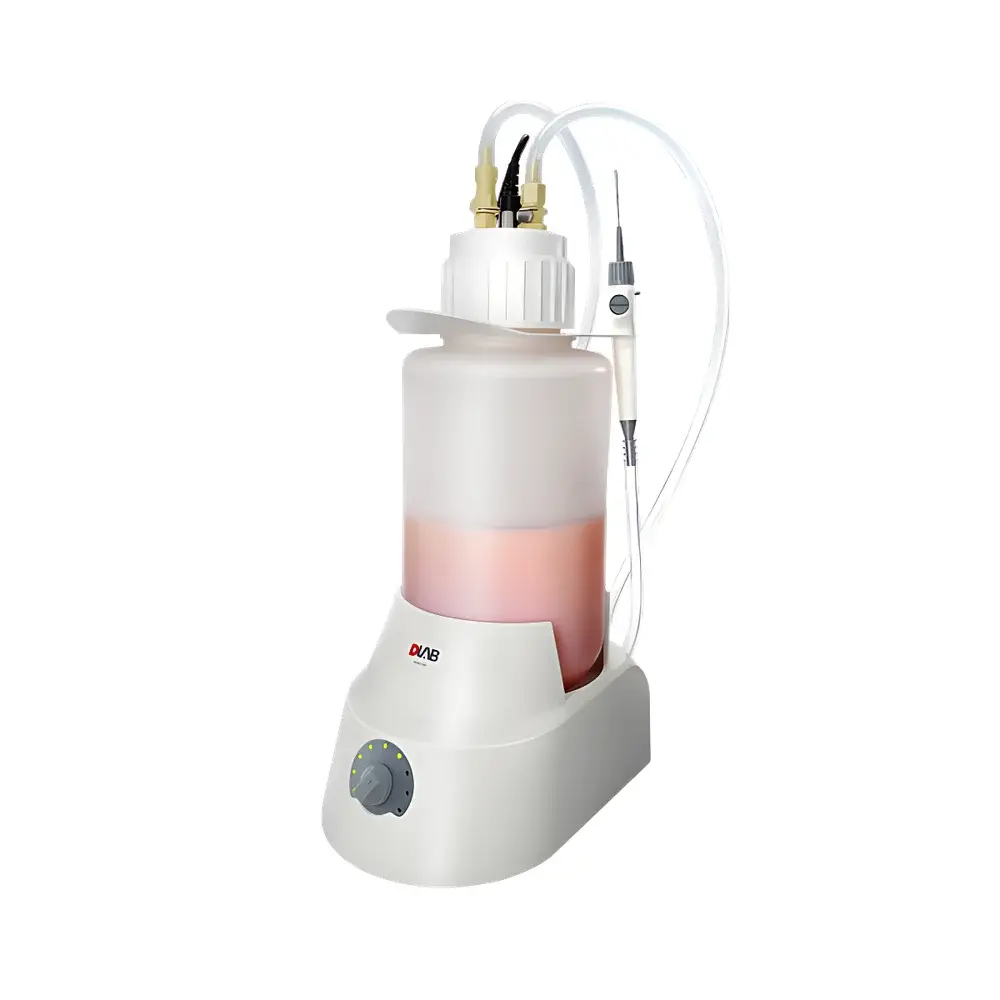
DLAB SafeVac 4L Vacuum Liquid Aspiration System
| Brand | DLAB |
|---|---|
| Origin | Beijing, China |
| Manufacturer Type | Manufacturer |
| Model | SafeVac 4L |
| Ultimate Vacuum | 600 mbar |
| Maximum Air Flow Rate | 15 L/min |
| Noise Level | ≤55 dB(A) |
| Power Supply | 100–240 VAC, 50/60 Hz |
| Dimensions (L×W×H) | 180 × 240 × 450 mm |
| Weight | 3 kg |
| Liquid Aspiration Rate | 17 mL/s |
| Collection Bottle Capacity | 4 L |
| Sterilizable Components | Pipette Tip, Collection Bottle, Handheld Aspirator Handle (autoclavable at 121 °C, 2 bar) |
Overview
The DLAB SafeVac 4L Vacuum Liquid Aspiration System is an engineered solution for controlled, safe, and repeatable liquid removal in biosafety cabinets, laminar flow hoods, and general laboratory workstations. It operates on a regulated vacuum principle—using a brushless diaphragm pump to generate adjustable negative pressure within a sealed aspiration circuit—enabling precise control over aspiration speed and endpoint detection. Unlike passive gravity-based or fixed-vacuum systems, the SafeVac 4L integrates real-time vacuum regulation and intelligent liquid-level sensing to prevent overflow, cross-contamination, and aerosol generation during aspiration of cell culture supernatants, centrifuged media, spent buffers, or diagnostic samples. Its compact footprint (180 × 240 × 450 mm) and lightweight construction (3 kg) allow seamless integration into space-constrained environments without compromising structural stability or acoustic performance (≤55 dB[A] at 1 m distance).
Key Features
- Adjustable vacuum control via intuitive rotary dial—providing continuous regulation from 0 to 600 mbar absolute pressure for application-specific optimization (e.g., gentle aspiration of fragile monolayers vs. rapid bulk fluid removal).
- Integrated capacitive liquid-level sensor in the 4 L polypropylene collection bottle triggers automatic pump shutoff upon reaching the fill limit—eliminating overflow risk and safeguarding downstream vacuum source integrity.
- Full autoclavability (121 °C, 2 bar, 20 min) of all wetted components: aspirator handle, silicone suction tubing, and collection bottle—ensuring compliance with ISO 13485 and GLP-aligned decontamination protocols.
- Low-noise brushless diaphragm pump with integrated thermal protection and voltage-independent operation (100–240 VAC, 50/60 Hz), enabling stable performance across global laboratory power infrastructures.
- LED status indicators display active vacuum range in three discrete bands (low/medium/high), facilitating rapid visual verification without requiring external gauges or software interfaces.
- Ergonomic handheld aspirator with non-slip grip and integrated valve actuation—designed for extended single-hand use while maintaining consistent tip-to-surface angle and aspiration consistency.
Sample Compatibility & Compliance
The SafeVac 4L is validated for aspiration of aqueous solutions, saline buffers, cell culture media, serum-containing fluids, and low-viscosity reagents (≤10 mPa·s). It is not intended for organic solvents, corrosive acids/bases, or high-particulate suspensions without inline filtration. All wetted materials—including FDA-compliant silicone tubing, autoclavable PP bottle, and chemically resistant EPDM seals—meet USP Class VI biocompatibility requirements. The system complies with IEC 61000-6-3 (EMC emission standards) and IEC 61000-6-2 (immunity), and its electrical design conforms to IEC 61010-1 for laboratory equipment safety. Documentation supports audit readiness for ISO/IEC 17025, CLIA, and cGMP environments where traceable aspiration records and sterilization logs are required.
Software & Data Management
The SafeVac 4L operates as a standalone hardware-controlled system with no embedded firmware or cloud connectivity. All operational parameters—including vacuum setpoint, runtime duration, and sterilization cycle history—are manually logged by the user per institutional SOPs. For laboratories requiring electronic recordkeeping, optional integration with LIMS or ELN platforms can be achieved via external footswitch-triggered timers or vacuum-pressure transducer outputs (available upon request with OEM interface module). Audit trails for autoclave validation (e.g., Bowie-Dick tests) must be maintained separately per local quality management system requirements.
Applications
- Aspiration of spent media from adherent mammalian cell cultures in T-flasks and multiwell plates under sterile hood conditions.
- Removal of supernatant following centrifugation of blood, urine, or microbial pellets—minimizing resuspension artifacts and operator exposure.
- Decanting of wash buffers during ELISA, Western blotting, and immunostaining workflows.
- Safe evacuation of biohazardous liquids in BSL-2 containment labs when paired with HEPA-filtered exhaust adapters (sold separately).
- Routine maintenance of electrophoresis tanks, staining trays, and hybridization ovens where rapid, residue-free fluid removal is critical.
FAQ
Can the SafeVac 4L be used with organic solvents such as ethanol or acetone?
No. The wetted materials are not chemically rated for prolonged exposure to halogenated or aromatic solvents. Use only with aqueous or low-polarity buffers.
Is the vacuum level digitally displayed or only indicated by LED bands?
Vacuum level is shown via three-color LED bands (green/yellow/red); no digital readout is included. For quantitative monitoring, an external calibrated vacuum gauge may be connected to the service port.
What is the maximum recommended tubing length between the aspirator handle and collection bottle?
For optimal flow rate and response time, keep suction tubing ≤1.2 m in length and ≤8 mm inner diameter. Longer or narrower tubing reduces effective aspiration rate and delays sensor response.
Does the system meet FDA 21 CFR Part 11 requirements for electronic records?
No—this is a non-software-based device. Electronic records must be generated externally using compliant documentation systems.
How often should the diaphragm pump be serviced?
Under typical usage (≤4 hrs/day), the pump requires no scheduled maintenance. Replace the integrated particulate filter every 6 months or after 200 autoclave cycles, whichever occurs first.



