
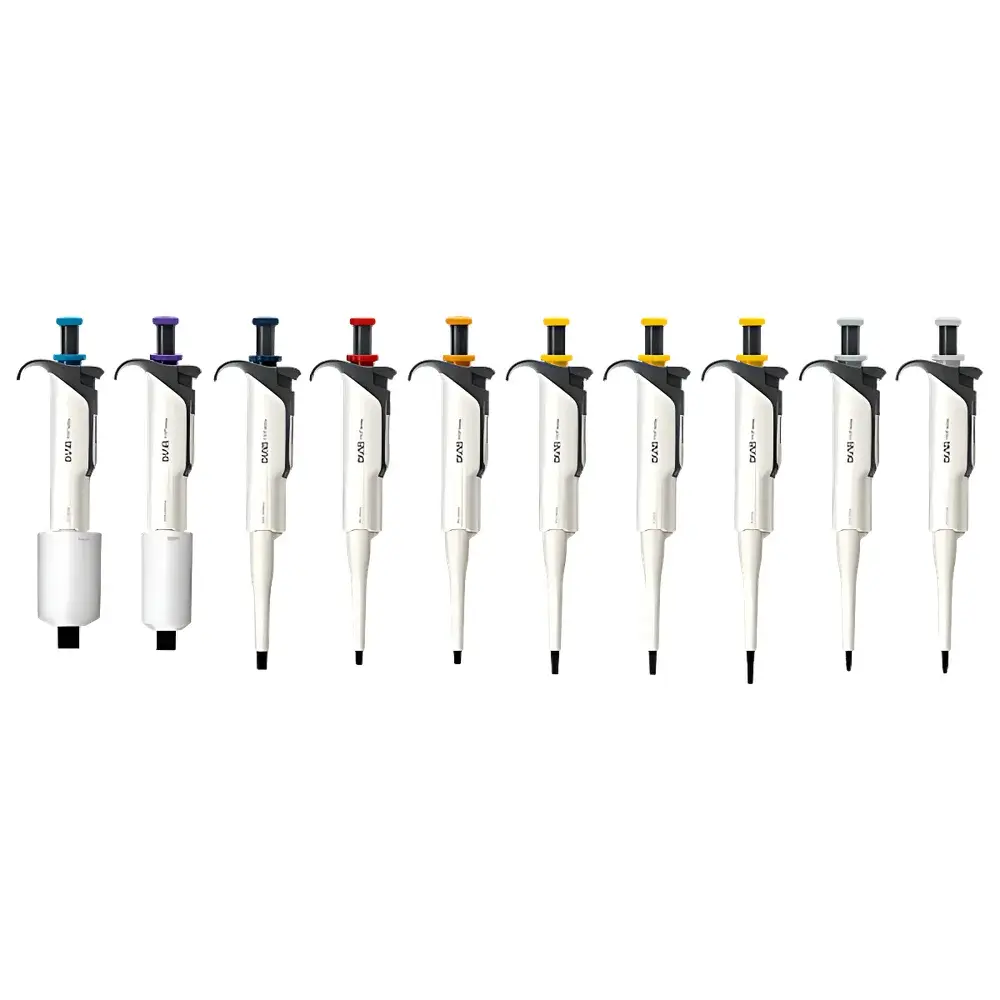
DLAB HiPette Manual Single-Channel Adjustable-Volume Color-Coded Pipette
| Brand | DLAB |
|---|---|
| Origin | Beijing, China |
| Manufacturer Type | Direct Manufacturer |
| Product Category | Domestic (China-Made) |
| Model | HiPette Manual Single-Channel Adjustable-Volume Pipette |
| Instrument Type | Single-Channel Pipette |
| Automation Level | Manual |
| Channel Count | 1 |
| Volume Range | 0.1–2.5 µL, 0.5–10 µL, 2–20 µL, 5–50 µL, 10–100 µL, 20–200 µL, 30–300 µL, 100–1000 µL, 500–5000 µL, 1000–10000 µL |
| Maximum Capacity | 10,000 µL |
| Accuracy | ±0.02 µL ±0.7%, ±0.02 µL ±1.5%, ±0.02 µL ±6.0%, ±0.04 µL ±0.4%, ±0.04 µL ±0.8%, ±0.02 µL ±1.8%, ±0.06 µL ±0.3%, ±0.06 µL ±0.6%, ±0.03 µL ±1.5%, ±0.15 µL ±0.3%, ±0.20 µL ±0.8%, ±0.08 µL ±1.6%, ±0.20 µL ±0.2%, ±0.15 µL ±0.3%, ±0.10 µL ±1.0%, ±0.40 µL ±0.2%, ±0.30 µL ±0.3%, ±0.14 µL ±0.7%, ±0.60 µL ±0.2%, ±0.45 µL ±0.3%, ±0.21 µL ±0.7%, ±2.00 µL ±0.2%, ±1.00 µL ±0.2%, ±0.60 µL ±0.6%, ±10.00 µL ±0.2%, ±7.5 µL ±0.3%, ±3.00 µL ±0.6%, ±20.00 µL ±0.2%, ±10 µL ±0.2%, ±6.00 µL ±0.6% |
Overview
The DLAB HiPette Manual Single-Channel Adjustable-Volume Pipette is a precision-engineered liquid handling instrument designed for high-reproducibility volumetric transfer in academic, clinical, pharmaceutical, and industrial laboratories. Based on the positive displacement principle, it employs an air-cushion mechanism with a sealed piston system to deliver accurate and consistent aspiration and dispensing across ten discrete volume ranges—from ultra-low volumes (0.1 µL) up to 10 mL. Its color-coded volume scale provides immediate visual identification of nominal range, reducing operational errors during high-throughput workflows or multi-user environments. The device complies with ISO 8655-2:2022 (Piston-operated volumetric apparatus — Part 2: Piston pipettes) for metrological performance and mechanical durability, supporting traceable calibration and routine verification under GLP/GMP-aligned quality systems.
Key Features
- Color-Coded Volume Identification: Each volume range is assigned a standardized international color (e.g., yellow for 10–100 µL, blue for 100–1000 µL), enabling rapid visual differentiation—critical for minimizing cross-range selection errors in shared lab settings.
- Ergonomic Lightweight Design: Total mass 100 transfers per session.
- Two-Stage Plunger Mechanism: First stop (4 N actuation force) for aspiration; second stop (10 N) for blow-out—ensuring complete dispense of viscous or volatile liquids without residual carryover.
- One-Touch Volume Lock: Prevents accidental volume adjustment during handling or transport; especially critical for low-volume applications (<10 µL) where minor dial shifts cause significant relative error.
- Full-Assembly Autoclavability: Entire pipette body withstands repeated cycles at 121 °C / 1 bar (20 min), including UV sterilization (254 nm, ≥30 min) and exposure to common laboratory solvents (e.g., 70% ethanol, isopropanol, dilute acids/bases).
- Integrated Filter Tip Compatibility: Optional hydrophobic PTFE filters installed at the tip cone prevent aerosol ingress into the internal piston chamber—mitigating contamination risk from volatile organic compounds, RNase/DNase, or biohazards.
- Micrometer-Grade Volume Adjustment: Digital-style volume display with 0.001 µL resolution per full scale (e.g., 1000 µL range displays increments of 1 µL); smooth, backlash-free dial rotation ensures tactile feedback and repeatability.
Sample Compatibility & Compliance
The HiPette pipette supports aqueous solutions, buffers, cell suspensions, serum, and low-viscosity organic solvents (e.g., acetonitrile, methanol). For high-viscosity or dense media (e.g., glycerol >30%, whole blood), reverse pipetting methodology is recommended. All models are certified compliant with ISO 8655-2:2022 for accuracy, precision, and mechanical robustness. Calibration documentation adheres to ISO/IEC 17025 requirements when performed by accredited service providers. The design facilitates audit-ready maintenance logs per FDA 21 CFR Part 11 guidelines when paired with DLAB’s optional calibration management software (HiCal v3.2).
Software & Data Management
While the HiPette is a manual instrument, its calibration records integrate seamlessly with DLAB’s HiCal platform—a secure, cloud-accessible database for instrument lifecycle tracking. Users can store calibration certificates, maintenance history, user assignments, and deviation reports. Audit trails comply with ALCOA+ principles (Attributable, Legible, Contemporaneous, Original, Accurate) and support electronic signatures per 21 CFR Part 11. Export functions generate PDF or CSV reports compatible with LIMS integration (e.g., LabWare, STARLIMS) via RESTful API.
Applications
- Quantitative PCR (qPCR) master mix preparation requiring sub-microliter precision
- Cell culture passaging with serum-containing media
- ELISA plate coating and reagent dilution series
- Standards preparation for HPLC and GC calibration curves
- CRISPR-Cas9 guide RNA complex assembly
- High-content screening (HCS) assay setup in 384-well microplates
- Environmental water testing for trace metal analysis (EPA Method 200.8)
- Quality control of biopharmaceutical intermediates under ICH Q5 guidelines
FAQ
Is the HiPette pipette suitable for sterile applications?
Yes—its full autoclavability (121 °C, 20 min, 1 bar) and UV resistance enable routine sterilization without disassembly. Filter tips are recommended for biosafety level 2 (BSL-2) work.
Can it be calibrated in-house?
Yes—DLAB supplies NIST-traceable gravimetric calibration kits (ASTM E542, ISO 8655-6) and certified reference weights. Full-service calibration is available through DLAB’s global network of ISO/IEC 17025-accredited labs.
What is the recommended recalibration interval?
Per ISO 8655-5, recalibration is advised every 3–6 months for daily use; more frequently if exposed to aggressive chemicals or mechanical shock.
Does the color-coding follow ISO 8655 standards?
The color scheme aligns with widely adopted industry conventions (e.g., yellow = 10–100 µL), though ISO 8655 does not mandate specific hues—it requires unambiguous visual distinction between volume classes.
How is maintenance performed without specialized tools?
The lower sleeve detaches with finger pressure; piston assembly removal requires only the included hex-key tool. Service intervals are documented in the user manual (EN/ES/DE/FR versions provided).



