
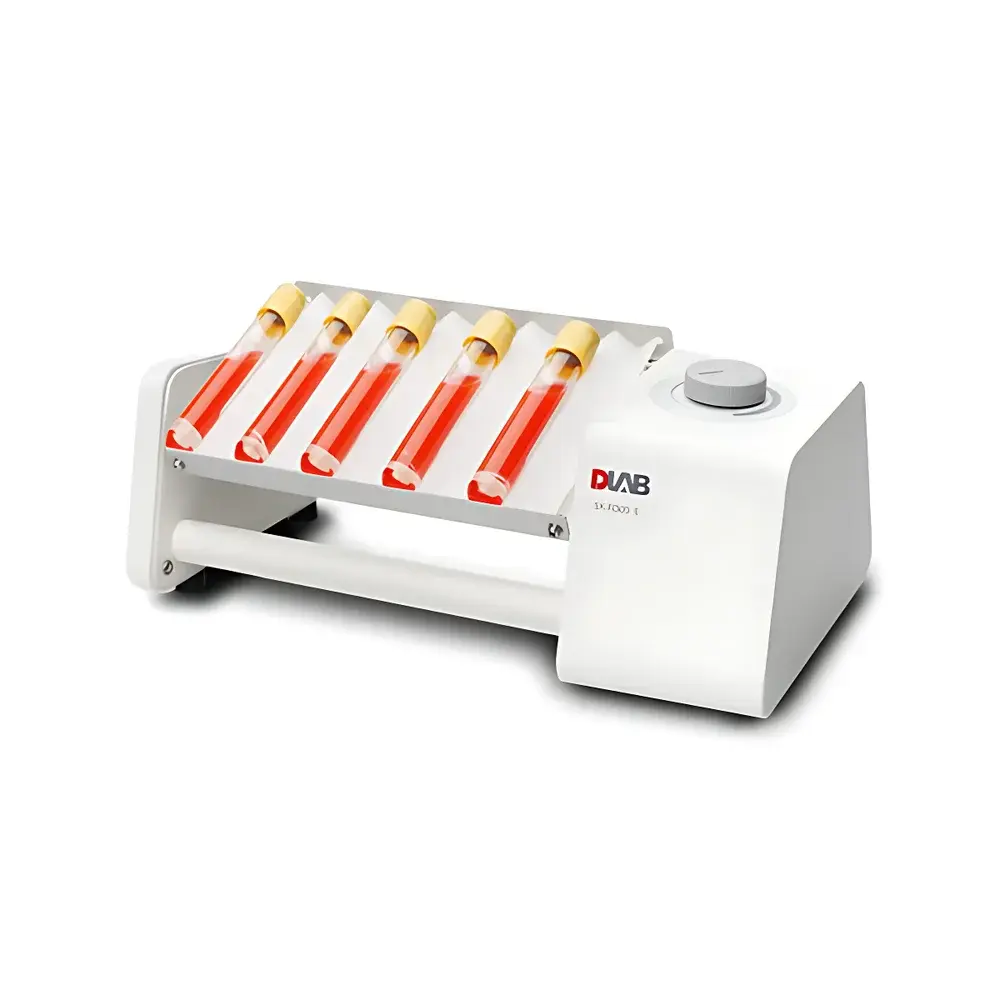
DLAB SK-R30S-E Tilt-Platform Orbital Mixer
| Brand | DLAB |
|---|---|
| Origin | Beijing, China |
| Manufacturer Type | Direct Manufacturer |
| Product Category | Domestic (China) |
| Model | SK-R30S-E |
| Instrument Type | Mixing & Homogenization Equipment |
| Timing Function | None |
| Oscillation Frequency | Continuous Operation |
| Oscillation Angle | 30 ± 3° |
| Temperature Control Range | 5–40 °C |
| Number of Platforms | 1 |
| Speed Range | 0–30 rpm |
| Motor Type | Brushless DC Motor |
| Platform Load Capacity | 1 kg |
| Dimensions (W × D × H) | 295 × 160 × 120 mm |
| Input Voltage | 100–240 V AC, 50/60 Hz |
| Power Consumption | 15 W |
| Net Weight | 1.8 kg |
| Operating Environment | 5–40 °C, ≤80% RH |
| Sample Compatibility | Up to 10 × 5–10 mL centrifuge tubes or 4 × 50 mL tubes with optional silicone mats |
Overview
The DLAB SK-R30S-E Tilt-Platform Orbital Mixer is a compact, benchtop mixing instrument engineered for consistent, low-shear homogenization of liquid samples in life science and clinical laboratory workflows. It operates on the principle of orbital tilting motion—where a single platform rotates about a fixed axis while maintaining a fixed inclination angle of 30 ± 3°—generating gentle yet effective fluid agitation without vortex formation or excessive foaming. This mechanism ensures uniform suspension of particulates, reagent resuspension, and thorough mixing of viscous or density-stratified solutions, particularly suited for blood sample preparation, ELISA plate pre-incubation, antibody dilution, and cell culture maintenance prior to analysis. Unlike rotary shakers with horizontal or vertical motion profiles, the SK-R30S-E’s tilt-platform design delivers enhanced mixing efficiency at low rotational speeds (0–30 rpm), minimizing mechanical stress on sensitive biological components such as cells, proteins, or nucleic acid complexes.
Key Features
- Fixed 30 ± 3° tilt-angle platform optimized for orbital motion-induced laminar flow, ensuring reproducible mixing across diverse tube formats.
- Brushless DC motor providing continuous, maintenance-free operation with high torque stability and extended service life—ideal for unattended overnight protocols.
- Wide-input voltage compatibility (100–240 V AC, 50/60 Hz) enables stable performance in global laboratory environments, including regions with fluctuating power infrastructure.
- Compact footprint (295 × 160 × 120 mm) and lightweight design (1.8 kg) support flexible placement on biosafety cabinets, cold rooms, or multi-instrument benches.
- Thermally stable operating envelope (5–40 °C, ≤80% RH) permits integration into temperature-controlled workspaces without risk of condensation or thermal drift.
- Single-platform architecture supports interchangeable silicone mat configurations—enabling secure accommodation of up to ten 5–10 mL centrifuge tubes or four 50 mL conical tubes with minimal cross-contamination risk.
Sample Compatibility & Compliance
The SK-R30S-E accommodates standard polypropylene, glass, and polycarbonate tubes used in clinical diagnostics and molecular biology applications. Its non-vibratory, low-acceleration tilt motion complies with general handling requirements for ISO 15189-accredited medical laboratories performing pre-analytical sample conditioning. While not an active incubator, its ambient temperature range aligns with CLSI GP44-A4 guidelines for specimen transport and storage prior to centrifugation or assay setup. The device does not incorporate temperature regulation beyond passive thermal equilibrium with its surroundings; users requiring active thermal control must pair it with external environmental chambers or refrigerated workstations. No regulatory certifications (e.g., CE IVD, FDA 510(k)) are claimed for this model, as it functions solely as a mechanical mixing aid—not a diagnostic or analytical instrument.
Software & Data Management
The SK-R30S-E operates as a standalone analog-controlled instrument with no embedded microprocessor, digital interface, or data logging capability. Speed adjustment is performed via manual potentiometer, and operation is limited to continuous mode only—without programmable timing, ramping, or endpoint signaling. Consequently, it does not generate electronic records, audit trails, or user-accessible firmware. This design intentionally omits software dependencies to ensure operational reliability under GLP/GMP conditions where validation complexity must be minimized. Laboratories implementing 21 CFR Part 11 compliance protocols may document usage manually (e.g., in lab notebooks or LIMS entries) referencing batch numbers, operator IDs, and run durations—consistent with Annex 11 principles for non-computerized equipment.
Applications
- Pre-centrifugation mixing of whole blood, serum, or plasma specimens to prevent clot retraction and sedimentation artifacts.
- Resuspension of lyophilized reagents, antibodies, or enzyme conjugates in immunoassay workflows.
- Homogenization of bacterial cultures prior to OD600 measurement or plating.
- Equilibration of PCR master mixes containing temperature-sensitive polymerases or modified nucleotides.
- Low-shear blending of hydrogels, agarose solutions, or cell-laden bioinks prior to dispensing or casting.
- Supporting sample preparation steps compliant with ISO/IEC 17025 method validation requirements for repeatability and intermediate precision assessment.
FAQ
Does the SK-R30S-E include a timer or programmable start/stop function?
No. The unit operates exclusively in continuous mode and lacks any timing circuitry or digital control interface.
Can this mixer be used inside a 4 °C cold room?
Yes—provided ambient humidity remains below 80% RH and condensation does not form on internal electronics or motor housing.
Is the platform compatible with microcentrifuge tubes (1.5–2.0 mL)?
Not natively. Tube retention relies on silicone mat geometry; dedicated small-tube adapters are not supplied but may be fabricated per institutional SOPs.
What safety certifications apply to this instrument?
It meets basic IEC 61010-1:2010 requirements for electrical safety in laboratory equipment, verified during factory testing. No third-party certification documentation is provided with shipment.
How is speed accuracy validated during routine use?
Users should verify rotational speed using an external tachometer at least quarterly; deviation tolerance is ±2 rpm across the 0–30 rpm range per manufacturer specification.




