
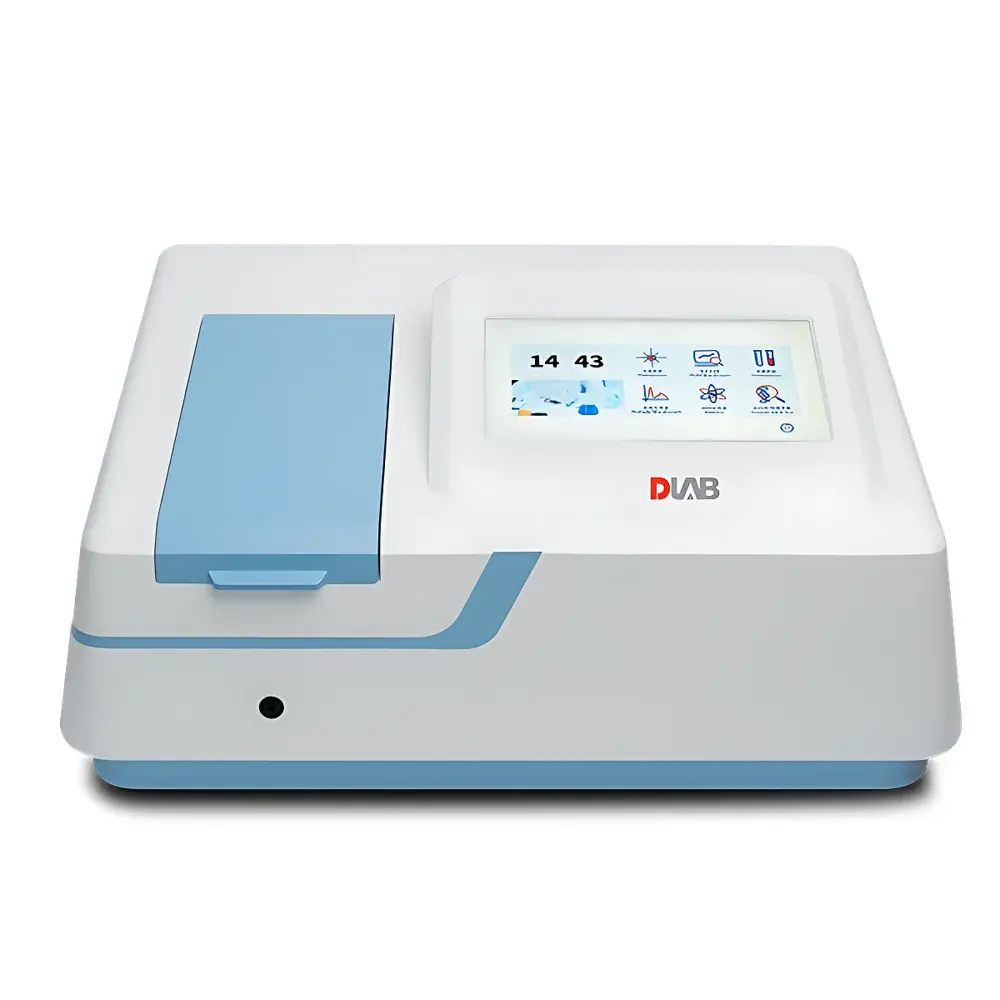
DLAB SP-UV2102 Ultraviolet-Visible Spectrophotometer
| Brand | DLAB |
|---|---|
| Origin | Beijing, China |
| Manufacturer Type | Original Equipment Manufacturer (OEM) |
| Instrument Architecture | Single-Beam |
| Wavelength Range | 190–1100 nm |
| Spectral Bandwidth | 2.0 nm |
| Wavelength Accuracy | ±0.1 nm at 656.1 nm, ±0.3 nm across full range |
| Wavelength Repeatability | ≤0.1 nm |
| Stray Light | ≤0.05% T at 220 nm and 360 nm |
| Photometric Range | –0.3 to 3.0 A, 0–9999 C (Concentration), 0–9999 F (Factor) |
| Photometric Accuracy | ±0.002 A (0–0.5 A), ±0.003 A (0.5–1.0 A) |
| Photometric Repeatability | ±0.001 A (0–0.5 A), ±0.0015 A (0.5–1.0 A) |
| Baseline Stability | ≤0.001 A/h at 500 nm (after 1-hour warm-up) |
| Sample Compartment | 4-cell cuvette holder (10 mm pathlength standard) |
| Display | 10.1-inch color capacitive touchscreen (1024 × 600 resolution) |
| Interfaces | USB port, parallel printer port |
| Power Supply | 110/220 V AC, 50/60 Hz, 120 W |
| Dimensions (L×W×H) | 570 × 440 × 210 mm |
| Weight | 20 kg |
Overview
The DLAB SP-UV2102 Ultraviolet-Visible Spectrophotometer is a precision single-beam optical instrument engineered for quantitative and qualitative analysis across research laboratories, quality control environments, and educational institutions. It operates on the fundamental principle of Beer–Lambert law-based absorbance measurement, utilizing a high-stability dual-lamp system (tungsten halogen lamp for visible/NIR region and deuterium lamp for UV region) to deliver continuous spectral coverage from 190 nm to 1100 nm. The optical path incorporates a holographic grating monochromator and a digitally calibrated photodiode detector, ensuring low stray light (<0.05% T), minimal electronic noise, and high photometric linearity. Its robust mechanical architecture—featuring a newly designed wavelength drive mechanism—enhances long-term wavelength repeatability (≤0.1 nm) and reduces operational vibration and acoustic emission during scanning.
Key Features
- 10.1-inch full-color capacitive touchscreen interface (1024 × 600 px) with intuitive graphical user interface (GUI) enabling standalone operation for photometric measurement, quantitative analysis, spectral scanning, kinetic assays, DNA/protein quantification, and multi-wavelength evaluation
- Single-beam optical design optimized for cost-effective, high-reproducibility routine analysis in regulated and non-regulated settings
- Holographic grating monochromator with 2.0 nm spectral bandwidth delivering sharp spectral resolution and consistent peak shape fidelity
- Dual-lamp source system: Japanese HYBEC tungsten lamp (visible–NIR) and Miras deuterium lamp (UV), each independently controlled and auto-switched at 340 nm
- Advanced baseline stability: ≤0.001 A/h at 500 nm after 60-minute thermal equilibration, supporting extended kinetic and time-course experiments
- Comprehensive data integrity framework: built-in audit trail, user-level access control (administrator/operator/guest), timestamped event logging, and encrypted local storage compliant with GLP/GMP documentation requirements
- USB host interface for direct export of spectra, calibration curves, and reports to external storage devices; parallel port supports optional impact or thermal printers
Sample Compatibility & Compliance
The SP-UV2102 accommodates standard 10 mm pathlength quartz, glass, or plastic cuvettes via its four-position manual sample holder. Optional accessories—including automatic 8-cell or 16-cell turret holders, variable-pathlength cells (1–100 mm), temperature-controlled cell holders (±0.1 °C stability), integrating spheres (for diffuse reflectance/transmittance), film holders, and micro-volume adapters—extend its applicability to solid films, turbid suspensions, opaque samples, and low-volume biological specimens. The instrument meets key international performance standards including ISO 9001:2015 (quality management), ASTM E275–22 (standard practices for ultraviolet and visible spectrophotometry), and USP (spectrophotometric absorption measurements). Its software architecture supports 21 CFR Part 11 readiness through configurable electronic signatures, role-based permissions, and immutable log retention—facilitating validation in pharmaceutical QC labs operating under GxP frameworks.
Software & Data Management
The optional PC-based control software provides full remote instrument operation, advanced spectral processing (baseline correction, peak integration, derivative spectroscopy, spectral subtraction), and customizable report generation (PDF, CSV, XML). All measurement data—including raw absorbance/transmittance values, calibration parameters, method metadata, and operator IDs—are stored with cryptographic hashing to prevent tampering. Audit logs record every critical action: parameter modification, calibration execution, user login/logout, and data export events. Data files adhere to FAIR principles (Findable, Accessible, Interoperable, Reusable) and support seamless import into LIMS or ELN platforms via standardized file formats. Local instrument memory retains ≥10,000 spectra and ≥500 quantitative methods with full version history.
Applications
- Quantitative determination of nucleic acids (A260/A280 ratios) and proteins (Bradford, BCA, Lowry assays) in molecular biology workflows
- Pharmaceutical assay validation per ICH Q2(R2), including content uniformity, dissolution testing, and excipient interference studies
- Environmental water quality monitoring: nitrate, phosphate, COD, and heavy metal ion (e.g., Cr(VI), Fe(II)) quantification using colorimetric protocols
- Polymer characterization: degradation kinetics, additive concentration profiling, and UV stabilizer efficacy assessment
- Food and beverage QA/QC: pigment analysis (anthocyanins, carotenoids), preservative quantitation (sulfites, benzoates), and authenticity verification
- Educational use in undergraduate chemistry and biochemistry laboratories for teaching spectroscopic fundamentals and analytical method development
FAQ
Is the SP-UV2102 compliant with FDA 21 CFR Part 11?
Yes—the optional PC software includes configurable electronic signature workflows, audit trail generation, and user authentication mechanisms aligned with Part 11 requirements for electronic records and signatures.
Can the instrument perform kinetic measurements over extended time periods?
Yes—its thermal stabilization design and low-drift optics enable reliable kinetic acquisition up to 24 hours, with programmable sampling intervals from 0.1 s to 60 min.
What types of cuvettes are supported natively?
Standard 10 mm square cuvettes made of quartz (190–2500 nm), optical glass (340–2500 nm), or polystyrene (340–800 nm); custom pathlengths and specialized holders require optional accessories.
Does the system support spectral scanning in both absorbance and transmittance modes?
Yes—real-time switching between A, %T, and C modes during scanning; all modes are simultaneously recorded and exportable.
How is wavelength calibration verified and maintained?
The instrument supports internal holmium oxide and didymium oxide reference filters for periodic verification; factory calibration is traceable to NIST SRM 2034 and SRM 930e.





