
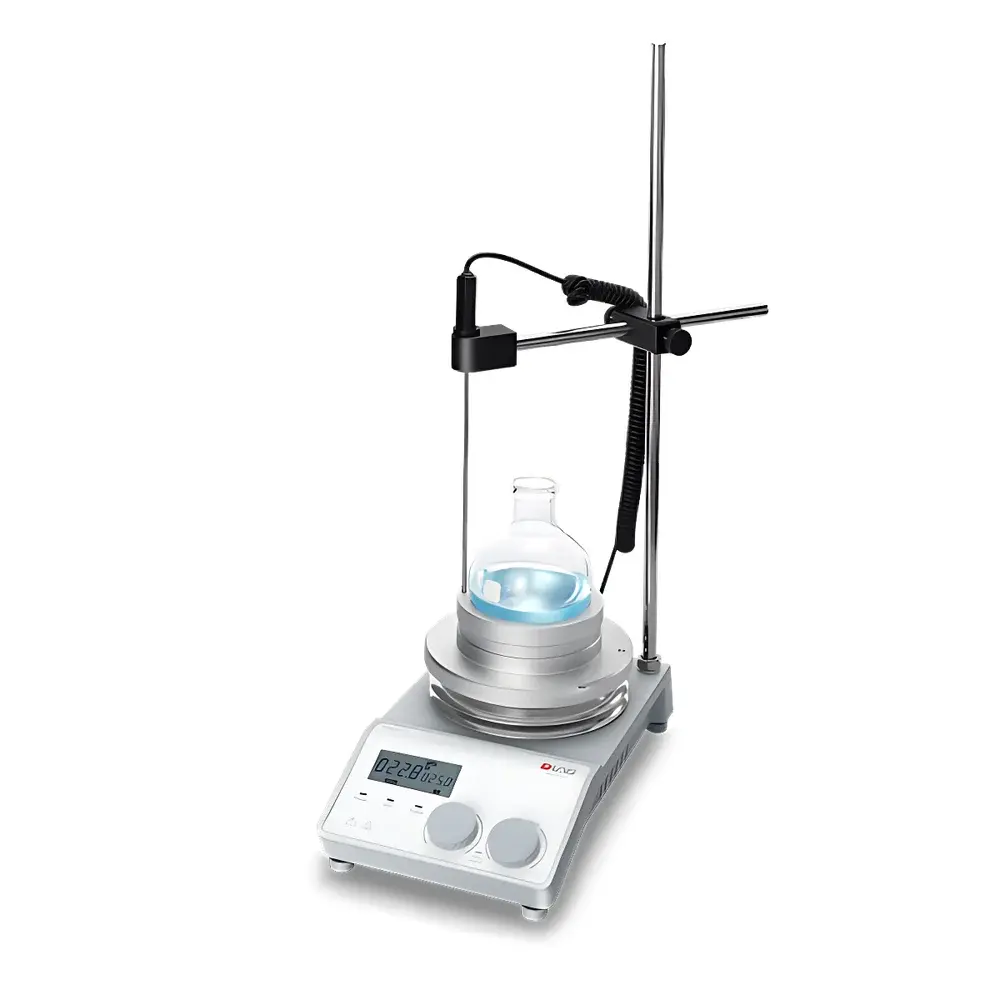
DLAB MS-H-ProM LCD Digital Timer-Enabled Magnetic Stirrer with Heating
| Brand | DLAB |
|---|---|
| Origin | Beijing, China |
| Manufacturer Type | Direct Manufacturer |
| Model | MS-H-ProM |
| Maximum Stirring Volume | 20 L |
| Speed Range | 100–1500 rpm |
| Temperature Control Range | Ambient to 340 °C (1 °C increments) |
| Timer Range | 1 min – 99 h 99 min |
Overview
The DLAB MS-H-ProM is a precision-engineered magnetic stirrer with integrated digital heating and programmable timing functionality, designed for reproducible thermal mixing in research laboratories, quality control environments, and industrial R&D settings. It operates on the principle of rotating magnetic coupling—where a microprocessor-controlled motor drives an internal permanent magnet array beneath a chemically resistant ceramic-coated aluminum heating plate. This induces synchronous rotation of PTFE- or glass-coated magnetic stir bars immersed in samples, enabling homogeneous mixing without mechanical shaft penetration. The device supports continuous operation under elevated temperatures up to 340 °C, making it suitable for solvent evaporation, polymer dissolution, catalyst activation, and high-viscosity reaction monitoring. Its closed-loop PID temperature regulation ensures minimal overshoot and stable setpoint maintenance, while the dual independent safety circuits provide hardware-level redundancy against thermal runaway.
Key Features
- High-torque neodymium magnet drive system optimized for viscous media (e.g., glycerol, silicone oil, polymer melts), maintaining consistent rotational stability across the full 100–1500 rpm range
- LCD interface with real-time display of speed, temperature, elapsed time, and remaining timer duration; intuitive navigation via membrane keypad
- Three configurable heating profiles: Profile A (rapid ramp-up for time-sensitive protocols), Profile B (standard linear ramp for general-purpose use), and Profile C (gradual, low-thermal-stress ramp ideal for heat-sensitive compounds)
- Intelligent timer logic: Upon completion of the preset duration, heating terminates automatically while stirring continues—preventing thermal degradation of thermolabile samples during post-heating homogenization
- Residual heat warning system: Integrated surface thermistor continuously monitors plate temperature; if >50 °C after power-off, the display flashes “HOT” until surface cools below threshold—enhancing lab safety awareness
- Dual redundant safety architecture: Primary thermal cutoff (bimetallic switch) and secondary electronic sensor monitor plate temperature independently; simultaneous fault detection triggers immediate heater shutdown and audible alert
- RS232 and USB interfaces support bidirectional communication with laboratory PCs, enabling remote parameter setting, real-time data logging, and integration into LIMS or ELN workflows
Sample Compatibility & Compliance
The MS-H-ProM accommodates vessels from 10 mL test tubes to 20 L jacketed reactors (with appropriate stir bar sizing). Its ceramic-coated aluminum plate resists corrosion from common solvents (e.g., acetone, ethanol, HCl aqueous solutions) and withstands repeated thermal cycling. The unit complies with IEC 61010-1:2010 for electrical safety in laboratory equipment and meets EMC requirements per EN 61326-1:2013. While not certified for Class I Div 1 hazardous locations, its sealed electronics and non-sparking motor design align with general good laboratory practice (GLP) for non-explosive environments. All firmware and UI logic adhere to ISO/IEC 17025 traceability principles for instrument calibration documentation.
Software & Data Management
Firmware v2.3+ supports ASCII-based serial command protocol over RS232 or virtual COM port (USB). Users may configure speed ramps, temperature profiles, and timer sequences via DLAB’s proprietary LabControl Suite (Windows/macOS), which logs timestamped speed/temperature/time values at user-defined intervals (1 s–60 s). Export formats include CSV and XML, compatible with MATLAB, Python pandas, and JMP for statistical process analysis. Audit trail functionality records all parameter changes—including operator ID (if network-authenticated), timestamp, and previous/updated values—supporting FDA 21 CFR Part 11 compliance when deployed with validated IT infrastructure.
Applications
- Kinetic studies requiring precise temperature ramping and sustained agitation (e.g., Arrhenius plots in catalysis)
- Preparation of uniform colloidal suspensions and nanoparticle dispersions in aqueous or organic media
- Dissolution testing per USP <711> for pharmaceutical dosage forms under controlled thermal conditions
- Synthesis of metal–organic frameworks (MOFs) and covalent organic frameworks (COFs) involving prolonged reflux with inert atmosphere compatibility
- Calibration of viscometers and density meters using thermostatted reference fluids
- Environmental sample digestion (EPA Method 3050B) where open-vessel acid heating and mixing are required
FAQ
Does the MS-H-ProM support external temperature probe input for sample-specific feedback control?
No—the unit relies solely on built-in plate thermistor feedback. For sample-core temperature control, users must employ an external circulator or integrate a separate probe-based PID controller.
Is the heating plate compatible with borosilicate glass vessels only, or can quartz or stainless-steel containers be used?
Glass and quartz vessels are fully supported. Stainless-steel containers are not recommended due to eddy current heating and potential interference with magnetic coupling efficiency.
What is the maximum ambient operating temperature for continuous 340 °C plate operation?
Ambient temperature must not exceed 30 °C; sustained operation above this level may compromise thermal sensor accuracy and shorten heating element service life.
Can multiple MS-H-ProM units be daisy-chained via RS232 for centralized control?
Yes—using RS232-to-RS485 converters and Modbus RTU protocol extension, up to 32 units may be addressed individually within a single serial network.
How often does DLAB recommend calibration verification for temperature and speed accuracy?
Annual verification is advised using NIST-traceable thermocouple calibrators (e.g., Fluke 724) and optical tachometers; calibration certificates are available upon request through authorized service centers.



