
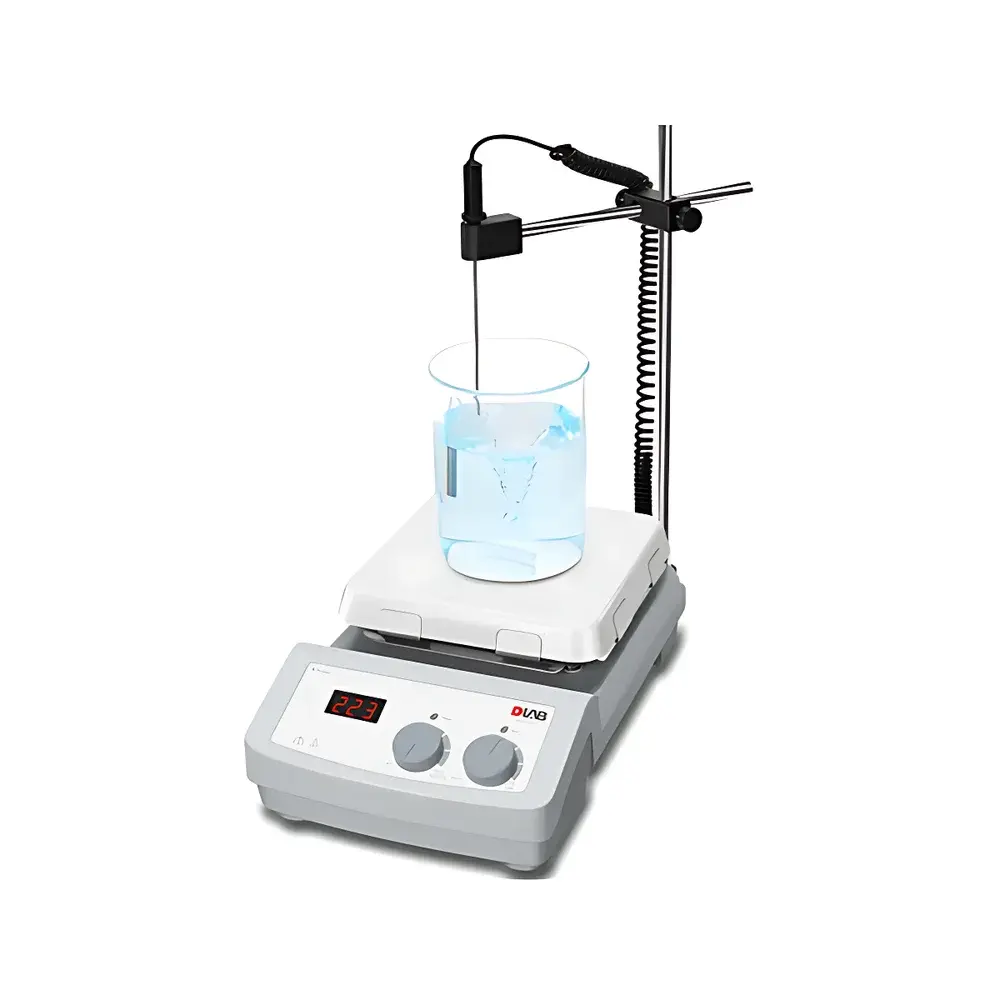
DLAB MS7-H550-S LED Digital Display Hotplate Magnetic Stirrer
| Brand | DLAB |
|---|---|
| Origin | Beijing, China |
| Manufacturer Type | Direct Manufacturer |
| Product Category | Domestic |
| Model | MS7-H550-S |
| Instrument Type | Magnetic Stirrer |
| Max Stirring Volume | 20 L (water) |
| Speed Range | 0–1500 rpm |
| Temperature Control Range | Ambient to 550 °C |
| Heating Power | 1000 W |
| Plate Dimensions | 184 × 184 mm |
| Plate Material | Ceramic-Glass |
| Motor Type | Brushless DC |
| Input Voltage | 100–120 / 200–240 V, 50/60 Hz |
| Interface | RS232 |
| IP Rating | IP21 |
| Weight | 4.5 kg |
| Safety Certifications | CE, cTUVus, FCC, DIN/EN 60529 |
Overview
The DLAB MS7-H550-S LED Digital Display Hotplate Magnetic Stirrer is an integrated thermal-mixing platform engineered for precision temperature-controlled stirring in research laboratories, quality control environments, and industrial R&D settings. It operates on the principle of magnetic coupling—rotating a PTFE- or glass-coated stir bar immersed in a sample via a rotating magnetic field generated beneath a thermally stable ceramic-glass plate. Simultaneous heating and stirring are independently controlled, enabling reproducible reaction kinetics studies, dissolution testing, buffer equilibration, and viscous media homogenization. Unlike basic hotplate stirrers, the MS7-H550-S incorporates dual-sensor thermal architecture: one embedded thermistor monitors surface temperature, while an optional external PT1000 probe enables immersion-based sample temperature feedback—critical for applications demanding traceable, sample-centric thermal validation per ISO/IEC 17025 or USP guidelines.
Key Features
- LED digital display showing real-time speed (rpm) and plate/sensor temperature with ±1 °C resolution
- Embedded PID temperature controller with overtemperature cutoff at 580 °C and automatic thermal shutdown if surface exceeds safe limits
- Ceramic-glass heating plate (184 × 184 mm) resistant to acids, alkalis, and thermal shock; non-porous surface ensures easy decontamination and compliance with GLP cleaning verification protocols
- Brushless DC motor delivering consistent torque up to 1500 rpm with low electromagnetic interference—suitable for sensitive electronic instrumentation nearby
- Dual independent control knobs: one for speed, one for temperature—enabling intuitive, glove-compatible operation without menu navigation
- Heating function operates independently from stirring; stirring continues during heater cooldown or fault events, preventing localized overheating or sample decomposition
- Residual heat warning: LED screen flashes when plate surface remains >50 °C after power-off—supporting lab safety SOPs aligned with ANSI Z535.4 hazard communication standards
- RS232 interface supports bidirectional communication with LIMS or custom LabVIEW/Python scripts for automated method execution, audit-trail logging, and data export in CSV/TXT format
Sample Compatibility & Compliance
The MS7-H550-S accommodates vessels from 10 mL vials to 20 L carboys (water-equivalent), compatible with borosilicate glass, stainless steel, and PTFE-lined containers. Its 80 mm maximum stir bar length supports high-viscosity samples (e.g., polymer melts, colloidal suspensions, agarose gels). The unit complies with IEC 61010-1:2010 for electrical safety in laboratory equipment and meets EMC requirements per EN 61326-1. TÜV-certified CE, cTUVus, and FCC marks confirm conformity with North American and EU regulatory frameworks. IP21 rating protects against vertically falling drips—suitable for standard dry-lab environments but not splash-prone wet chemistry areas unless housed under fume hood enclosures.
Software & Data Management
Via RS232, the MS7-H550-S integrates into regulated workflows requiring electronic records. It transmits timestamped speed/temperature logs and accepts ASCII command sets for remote start/stop, setpoint adjustment, and status polling. When paired with compliant software (e.g., DLAB’s optional PC Control Suite or third-party SCADA systems), it supports 21 CFR Part 11-compliant audit trails—including user ID, parameter changes, and system events—with digital signature capability. Data retention follows ALCOA+ principles: attributable, legible, contemporaneous, original, accurate, complete, consistent, enduring, and available.
Applications
- Kinetic studies requiring precise ramp-and-hold thermal profiles (e.g., enzyme denaturation, catalyst activation)
- Preparation of homogeneous standards for ICP-MS or HPLC calibration curves
- Dissolution testing per USP using jacketed vessels with PT1000 feedback
- Synthesis of metal-organic frameworks (MOFs) under reflux conditions with inert atmosphere compatibility
- Cell culture media pre-warming with contamination-minimized contact surfaces
- Calibration of temperature probes and thermocouples using NIST-traceable reference standards
FAQ
Can the MS7-H550-S maintain ±0.2 °C temperature accuracy without the external PT1000 sensor?
No—the ±0.2 °C precision is only achievable when the optional PT1000 probe is inserted directly into the sample and enabled in sensor mode. Default plate-surface control has ±10 °C tolerance.
Is the RS232 interface optically isolated?
No—RS232 is electrically coupled; for electrically noisy environments, use a USB-to-RS232 converter with galvanic isolation or install ferrite chokes on the cable.
What is the maximum recommended continuous operating time at 550 °C?
DLAB specifies ≤2 hours at ≥500 °C to preserve ceramic-glass integrity and thermal sensor longevity; extended high-temperature use requires periodic recalibration and visual inspection for microcracking.
Does the unit support multi-point temperature ramping?
No—it implements single-setpoint PID control only; programmable ramps require external PLC or PC-based sequencing software via RS232 commands.
How is overheat protection verified during IQ/OQ qualification?
Validation includes deliberate sensor failure simulation (e.g., open-circuit thermistor), measurement of cutoff response time (<3 s), and confirmation of audible/visual alarms per IEC 62304 Class B software safety requirements.



