
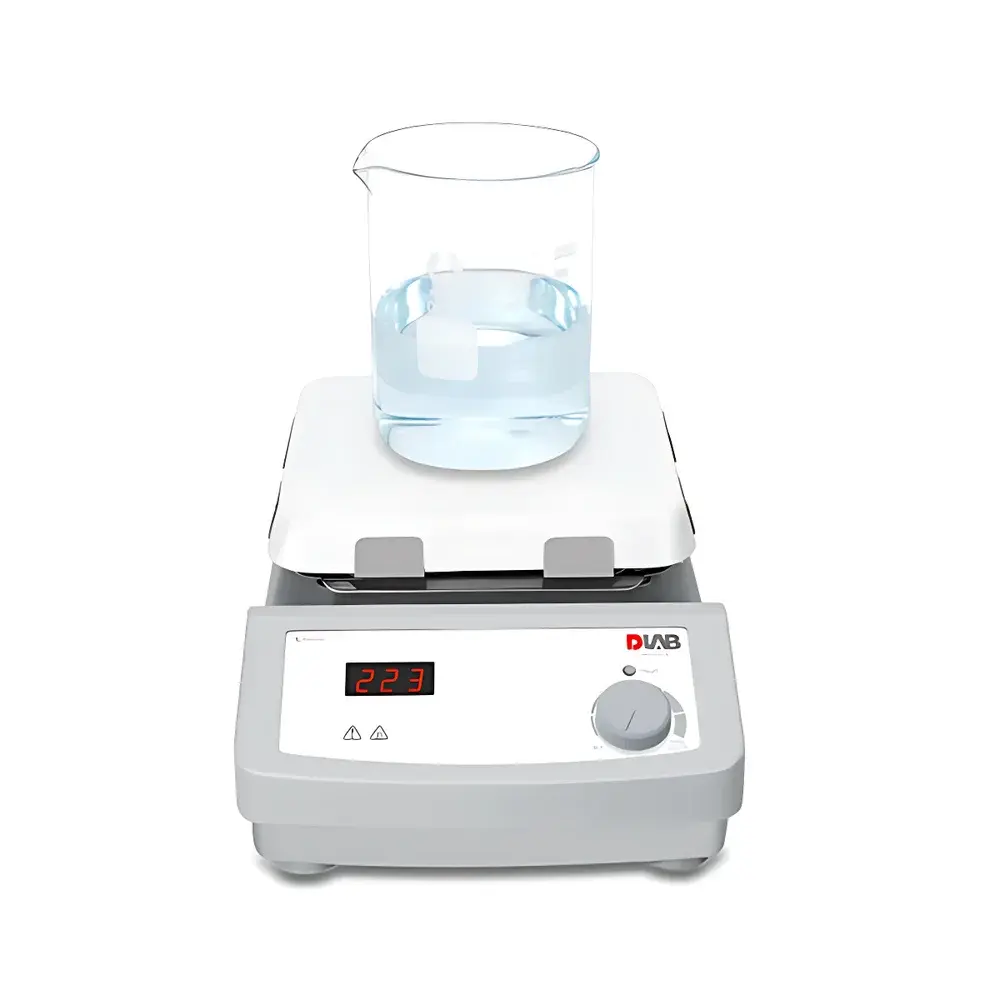
DLAB HP550-S LED Digital Electric Heating Plate
| Brand | DLAB |
|---|---|
| Origin | Beijing, China |
| Manufacturer Type | Direct Manufacturer |
| Regional Classification | Domestic (China) |
| Model | HP550-S |
| Heating Power | 1000 W |
| Max. Heating Temperature | 550 °C |
| Temperature Uniformity | ±10 °C |
| Plate Dimensions | 184 × 184 mm |
| Heating Zone Dimensions | 184 × 184 mm |
| Display Type | LED Digital Display |
| Safety Cut-off Temperature | 580 °C |
| External Sensor Support | PT1000 (±0.5 °C accuracy) |
| Residual Heat Warning Threshold | 50 °C |
| Housing IP Rating | IP21 |
| Dimensions (L×W×H) | 215 × 360 × 112 mm |
| Weight | 4.5 kg |
| Operating Environment | 5–40 °C, ≤80% RH |
| Voltage/Frequency | 100–120 V / 200–240 V, 50/60 Hz |
Overview
The DLAB HP550-S LED Digital Electric Heating Plate is a precision-engineered thermal platform designed for consistent, safe, and controllable heating in analytical laboratories, sample preparation workflows, and routine digestion applications. It operates on resistive heating principles, delivering uniform thermal energy across a chemically inert glass-ceramic surface. Unlike open-coil or aluminum-plate heaters, the HP550-S employs a solid-state ceramic heating element embedded beneath a seamless, non-porous glass-ceramic plate—ensuring rapid thermal response, long-term dimensional stability, and resistance to thermal shock. Its maximum operating temperature of 550 °C supports high-temperature evaporation, ashing, solvent removal, and acid digestion protocols commonly employed in environmental, pharmaceutical, and food testing labs. The unit is engineered for benchtop integration in ISO/IEC 17025-accredited facilities and complies with general electrical safety requirements per IEC 61010-1 for laboratory equipment.
Key Features
- LED digital display with real-time temperature readout (±1 °C resolution) and intuitive 5 °C incremental setpoint adjustment
- Dual-stage thermal protection: independent safety circuit interrupts power at 580 °C, preventing overheating beyond operational limits
- Glass-ceramic top plate (184 × 184 mm) offering exceptional chemical resistance to strong acids (e.g., HNO₃, HCl, HF), alkalis, and organic solvents—ideal for closed-vessel digestion and reflux setups
- Residual heat warning system: audible and visual alert activates when surface temperature exceeds 50 °C after shutdown—even with mains power connected—reducing burn risk during post-operation handling
- Optional external PT1000 probe input enables contact-based temperature feedback control, improving process repeatability to ±0.5 °C in critical applications requiring traceable thermal validation
- Robust housing rated IP21 for protection against vertically falling drips and solid objects >12.5 mm, suitable for standard laboratory environments with moderate humidity (≤80% RH)
Sample Compatibility & Compliance
The HP550-S accommodates standard laboratory vessels including borosilicate glass beakers (up to 1000 mL), PTFE digestion tubes, quartz crucibles, and ceramic evaporating dishes. Its flat, homogeneous heating zone ensures minimal thermal gradient across multi-vessel configurations. The device meets fundamental safety requirements outlined in IEC 61010-1:2010 (Edition 3.1) for electrical equipment used in measurement, control, and laboratory use. While not intrinsically certified for hazardous locations, its design supports GLP-compliant documentation when paired with external calibration records and sensor traceability. Routine verification using NIST-traceable thermocouples aligns with ASTM E220 and ISO/IEC 17025 clause 6.4.10 for equipment suitability assessment.
Software & Data Management
The HP550-S operates as a standalone analog-digital hybrid instrument without embedded firmware or network connectivity. Temperature logging and audit trails require integration with external data acquisition systems via the PT1000 interface. When used in regulated environments (e.g., FDA-regulated QC labs), users may implement manual logbooks or electronic lab notebooks (ELNs) to record setpoints, duration, vessel type, and observed behavior—supporting 21 CFR Part 11 compliance through procedural controls rather than built-in software features. Calibration certificates for external probes should be retained per GMP Annex 15 guidelines.
Applications
- Acid digestion of soil, sediment, and biological tissues prior to ICP-OES or ICP-MS analysis
- Controlled evaporation of solvent extracts in pesticide residue testing (AOAC 2007.01)
- Pre-concentration of aqueous samples in environmental water analysis (EPA Method 200.8)
- Heating reaction mixtures in synthesis and catalyst activation studies
- Drying and conditioning of filter papers, gravimetric crucibles, and desiccators
- Standardization of hotplate performance across multi-site laboratories under ISO/IEC 17043 proficiency testing schemes
FAQ
Does the HP550-S support programmable ramp-soak profiles?
No. It provides fixed-temperature setpoint control only; time-based thermal profiling requires external controllers.
Can the glass-ceramic plate be replaced if cracked?
Yes—DLAB supplies replacement plates (Part No. HP550-PLATE) as field-serviceable components with factory recalibration guidance.
Is the unit compatible with voltage standards outside China?
Yes. Dual-voltage input (100–120 V / 200–240 V, 50/60 Hz) enables global deployment without transformers.
What is the recommended calibration frequency?
Annual calibration is advised per ISO/IEC 17025; more frequent checks are required if used in validated processes or following mechanical impact.
Does the residual heat warning function require battery backup?
No. It draws standby power from the main supply and remains active until the plate cools below 50 °C or the unit is unplugged.



