
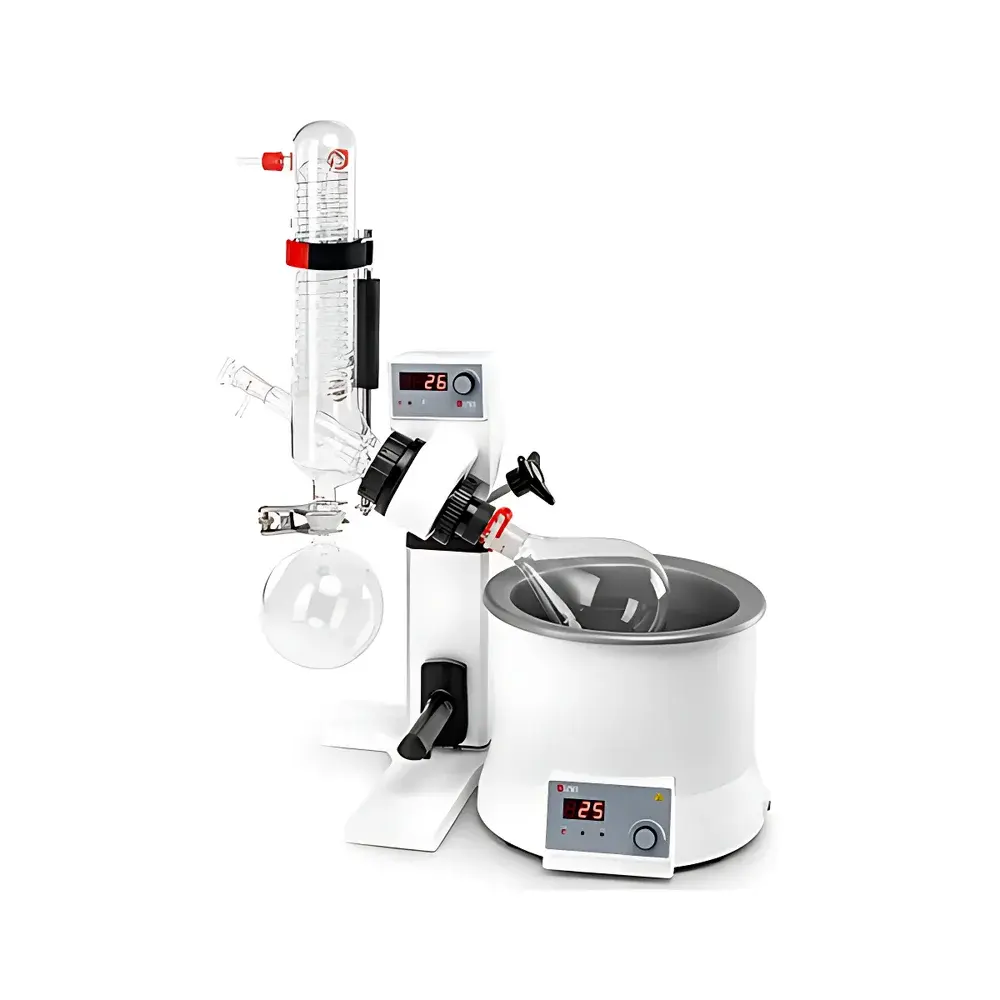
DLAB RE100-S Digital Rotary Evaporator
| Brand | DLAB |
|---|---|
| Origin | Beijing, China |
| Manufacturer Type | Original Equipment Manufacturer (OEM) |
| Country of Origin | China |
| Model | RE100-S |
| Capacity | 5 L |
| Ultimate Vacuum | 100 mbar |
| Rotational Speed Range | 20–200 rpm |
| Temperature Control Range | Ambient to 180 °C |
| Heating Accuracy | ±1.5 °C (water bath), ±3 °C (oil bath) |
| Condenser Cooling Surface Area | 1000 cm² |
| Power Supply | 100–240 VAC, 50/60 Hz |
| Motor | Brushless DC |
| Display | LED |
| Protection Rating | IP20 |
| Dimensions (W×D×H) | 440 × 320 × 450 mm |
| Net Weight | 7 kg |
| Operating Environment | 5–40 °C, ≤80% RH |
| USB Interface | Yes |
| Lift Mechanism | Manual + assisted lift |
| 升降行程 | 110 mm |
| Timer & Bidirectional Rotation | Yes |
Overview
The DLAB RE100-S Digital Rotary Evaporator is an engineered solution for efficient solvent removal, concentration, and gentle sample recovery in research laboratories, quality control environments, and pilot-scale synthesis workflows. Designed around the principle of reduced-pressure distillation, the system operates by rotating a sample flask under controlled vacuum while simultaneously heating the bath—thereby increasing the surface area of the liquid film and lowering its boiling point. This enables rapid, reproducible evaporation of heat-sensitive compounds without thermal degradation. The RE100-S integrates dual-mode heating (water or oil bath), precise PID temperature regulation, and a high-efficiency condensation architecture to deliver consistent performance across diverse organic, aqueous, and mixed-solvent systems. Its modular construction supports seamless integration into GLP-compliant workflows where traceability, repeatability, and operational safety are foundational requirements.
Key Features
- Dual-mode 5 L heating bath capable of reaching 180 °C—optimized for both water and oil media with independent thermal control logic and overtemperature cutoff protection.
- Brushless DC motor delivering stable rotational speeds from 20 to 200 rpm with low vibration and extended service life; includes programmable bidirectional rotation and adjustable dwell timing (1–999 s).
- PID-controlled temperature regulation with ±1.5 °C accuracy in water and ±3 °C in oil—calibrated against NIST-traceable reference standards during factory validation.
- Patented dual-helix condenser with central arc geometry enhances laminar flow dynamics and gravitational drainage, achieving >92% solvent recovery efficiency under standard test conditions (ethanol/water, 40 °C bath, 80 mbar).
- Double-layer modified PTFE sealing gasket combined with spring-loaded compression ensures leak-tight operation up to 180 °C and full compatibility with aggressive solvents including chlorinated hydrocarbons, esters, and strong acids.
- Manual lift mechanism with auxiliary assist lever enables smooth vertical adjustment over 110 mm travel range; integrated flask ejection aid simplifies rapid flask exchange without tooling.
- USB interface compliant with CDC ACM class protocol allows direct connection to Windows/Linux hosts for real-time logging of rotational speed, bath temperature, and runtime—supporting audit-ready data capture per FDA 21 CFR Part 11 requirements when paired with validated software.
Sample Compatibility & Compliance
The RE100-S accommodates standard 5 L round-bottom flasks (ISO 22610 compliant neck dimensions) and interfaces seamlessly with DLAB’s optional vapor-tight receiving flasks and cold traps. It is suitable for processing samples ranging from volatile solvents (e.g., diethyl ether, acetone, hexane) to higher-boiling-point media (e.g., ethylene glycol, silicone oils) under controlled vacuum conditions down to 100 mbar. The device conforms to IEC 61010-1:2010 for electrical safety in laboratory equipment and meets EN 60529 (IP20) ingress protection specifications. All wetted parts comply with USP Class VI biocompatibility testing criteria. No internal lubricants or elastomers contact process vapors, eliminating risk of extractables in pharmaceutical or analytical applications.
Software & Data Management
While the RE100-S operates autonomously via front-panel LED interface, its native USB port enables host-based monitoring using DLAB’s open-protocol ASCII command set. Third-party LabVIEW, Python (pySerial), or MATLAB scripts can poll live parameters at user-defined intervals and export timestamped CSV logs. When deployed in regulated environments, the system supports electronic signature-enabled recordkeeping when integrated with validated LIMS or ELN platforms. Audit trail generation—including parameter changes, start/stop events, and error codes—is preserved in non-volatile memory for minimum 12 months, satisfying core elements of ALCOA+ data integrity principles.
Applications
- Concentration of natural product extracts (e.g., plant alkaloids, essential oils) prior to HPLC or GC-MS analysis.
- Solvent exchange in nanoparticle synthesis protocols requiring anhydrous conditions.
- Removal of reaction solvents post-coupling in peptide and oligonucleotide manufacturing.
- Recovery and reuse of expensive reagents such as palladium catalysts or chiral ligands.
- Preparative purification of thermally labile APIs under cGMP-aligned operating procedures.
- Teaching laboratory demonstrations of phase equilibria, Raoult’s law, and vacuum distillation kinetics.
FAQ
Does the RE100-S support automatic vacuum control?
No—the unit requires external vacuum source integration (e.g., diaphragm pump or water aspirator); it does not include built-in vacuum regulation.
Is the heating bath calibrated at time of shipment?
Yes—each unit undergoes two-point calibration (at 25 °C and 100 °C) using PT100 reference probes traceable to national metrology institutes; calibration certificate is included.
Can the condenser be cooled with dry ice/acetone?
Yes—the condenser jacket accepts standard cryogenic coolants; maximum recommended coolant temperature is –40 °C to prevent thermal shock-induced microfractures.
What maintenance intervals are recommended?
Visual inspection of PTFE seals every 200 operating hours; motor brushless design eliminates scheduled commutator servicing; annual verification of temperature sensor drift advised.
Is firmware upgrade capability available?
Firmware updates are distributed via DLAB’s secure customer portal and applied through USB-hosted DFU mode; version history and release notes are publicly archived.



