
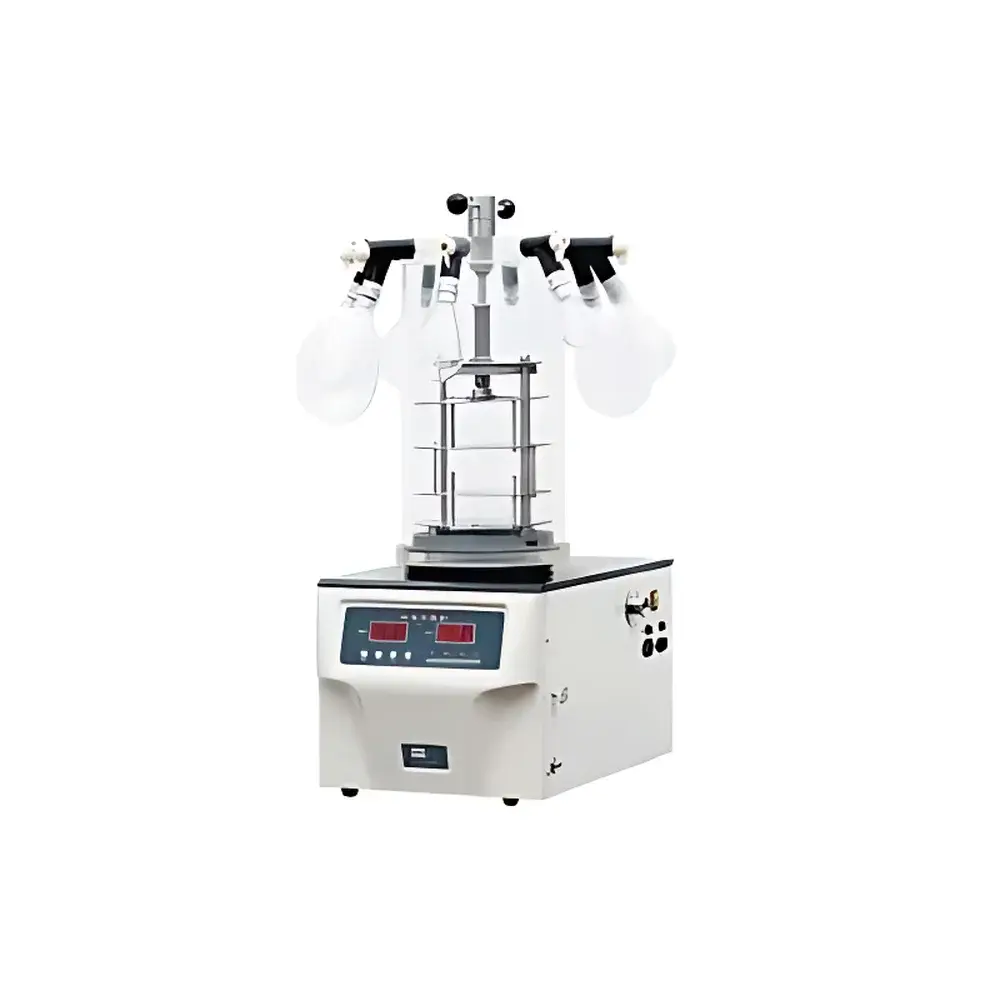
Hanuo FD-1D-50 Benchtop Freeze Dryer with Stoppering Function
| Brand | Hanuo |
|---|---|
| Origin | Shanghai, China |
| Model | FD-1D-50 |
| Instrument Type | Stoppering Freeze Dryer |
| Application | Laboratory-Scale Lyophilization |
| Shelf Area | 0.12 m² |
| Ultimate Vacuum | ≤20 Pa |
| Condenser Temperature | −50 °C |
| Water Capture Capacity | 3 kg/24 h |
| Dimensions (W×D×H) | 380 × 600 × 345 mm |
| Power Supply | 220 V, 50 Hz, 850 W |
| Standard Configuration | Benchtop Main Unit, 2 L Domestic Vacuum Pump, Stoppering Chamber Assembly, 8 Rubber Valves, 8 Glass Freeze-Drying Flasks (Φ180 mm, 3-Shelf Stack) |
Overview
The Hanuo FD-1D-50 is a compact, benchtop stoppering freeze dryer engineered for precise, reproducible lyophilization of heat-sensitive biological and pharmaceutical samples in research and quality control laboratories. It operates on the principle of sublimation—removing water from frozen samples under deep vacuum while maintaining product integrity through controlled thermal management. Unlike conventional air-drying or spray-drying methods, freeze drying preserves structural conformation, enzymatic activity, and immunogenicity of labile biomolecules such as monoclonal antibodies, plasmid DNA, recombinant proteins, and live attenuated vaccines. The system integrates a −50 °C condenser, a robust dual-stage rotary vane vacuum pump (2 L capacity), and a manually operated stoppering mechanism compatible with standard Φ180 mm glass flasks stacked across three shelves. Its 0.12 m² shelf area supports batch processing of up to 0.7 L of aqueous solution per cycle, making it suitable for early-stage formulation development, stability testing, and small-batch reference standard preparation.
Key Features
- Integrated −50 °C stainless-steel condenser with high-efficiency refrigeration circuit for reliable ice capture and stable vacuum maintenance
- Stoppering-compatible chamber design enabling aseptic sealing of vials post-drying without breaking vacuum
- Ultimate vacuum performance ≤20 Pa, verified per ISO 27893:2017 (vacuum measurement in freeze dryers)
- Benchtop footprint (380 × 600 × 345 mm) optimized for limited lab space without compromising condenser surface area or thermal mass
- 850 W power consumption at 220 V/50 Hz, compliant with IEC 61000-3-2 harmonic emission standards
- Standard inclusion of eight Φ180 mm borosilicate glass freeze-drying flasks and eight silicone rubber valves for manual pressure equalization and sample isolation
Sample Compatibility & Compliance
The FD-1D-50 accommodates a broad range of sample formats including liquid solutions, suspensions, and pre-frozen gels in open or stoppered vials and flasks. Its −50 °C condensing capability ensures efficient removal of both free and bound water from formulations containing buffers, cryoprotectants (e.g., sucrose, trehalose), and low-conductivity solvents. While not certified for GMP manufacturing, the unit meets essential engineering criteria referenced in USP (Packaging Integrity Evaluation) and supports GLP-aligned documentation workflows when paired with external temperature mapping and vacuum logging tools. All wetted surfaces are constructed from 304 stainless steel and borosilicate glass, minimizing leachables and supporting routine cleaning validation per ASTM E3106-18 (Standard Guide for Cleaning Validation in Laboratories).
Software & Data Management
The FD-1D-50 operates via an analog/manual control interface—intentionally designed for simplicity, reliability, and reduced electromagnetic interference in shared instrument environments. No embedded microprocessor or digital display is included; instead, vacuum level is monitored using an analog Pirani gauge, and condenser temperature is indicated via a calibrated bimetallic thermometer. This architecture eliminates firmware dependencies, simplifies IQ/OQ protocols, and facilitates audit-ready traceability when used with external data loggers compliant with FDA 21 CFR Part 11 requirements (e.g., calibrated thermocouple arrays and vacuum transducers connected to validated acquisition systems). Users may document critical process parameters—including shelf temperature (via external probe), chamber pressure, condenser load, and cycle duration—for inclusion in study reports aligned with ICH Q5C (Stability Testing of Biotechnological/Biological Products).
Applications
- Lyophilization of diagnostic reagents, enzyme conjugates, and ELISA kit components
- Stabilization of bacterial and yeast cultures for long-term cryoarchiving
- Preparation of reference standards for HPLC, LC-MS, and dissolution testing
- Drying of botanical extracts and nutraceuticals while retaining polyphenol and flavonoid bioactivity
- Processing of tissue homogenates and cell lysates prior to proteomic or metabolomic analysis
- Method development and cycle optimization for subsequent scale-up to pilot or production freeze dryers
FAQ
What is the maximum sample volume per batch?
The FD-1D-50 supports up to 0.7 liters of aqueous solution distributed across eight Φ180 mm flasks or equivalent vial configurations, assuming a fill depth of ≤10 mm per container to ensure uniform sublimation front progression.
Can this unit be used for sterile processing?
No—the FD-1D-50 lacks ISO Class 5 cleanroom certification, vapor-phase hydrogen peroxide (VPHP) compatibility, or integrated sterilization cycles. Sterile vial stoppering requires integration with a laminar flow hood or isolator environment prior to chamber loading.
Is the vacuum pump oil-free?
No—the included 2 L rotary vane pump uses mineral oil lubrication and requires periodic oil replacement and particulate filtration to maintain ≤20 Pa performance and prevent backstreaming contamination.
Does the system support programmable shelf temperature control?
No—temperature regulation is passive and ambient-dependent. Active shelf heating or cooling is not available; users must rely on pre-freezing samples to target eutectic temperatures before primary drying initiation.
What maintenance intervals are recommended?
Condenser defrosting after every 3–5 cycles; vacuum pump oil change every 200 operating hours or quarterly (whichever occurs first); rubber valve inspection for elasticity and seal integrity before each use.



