
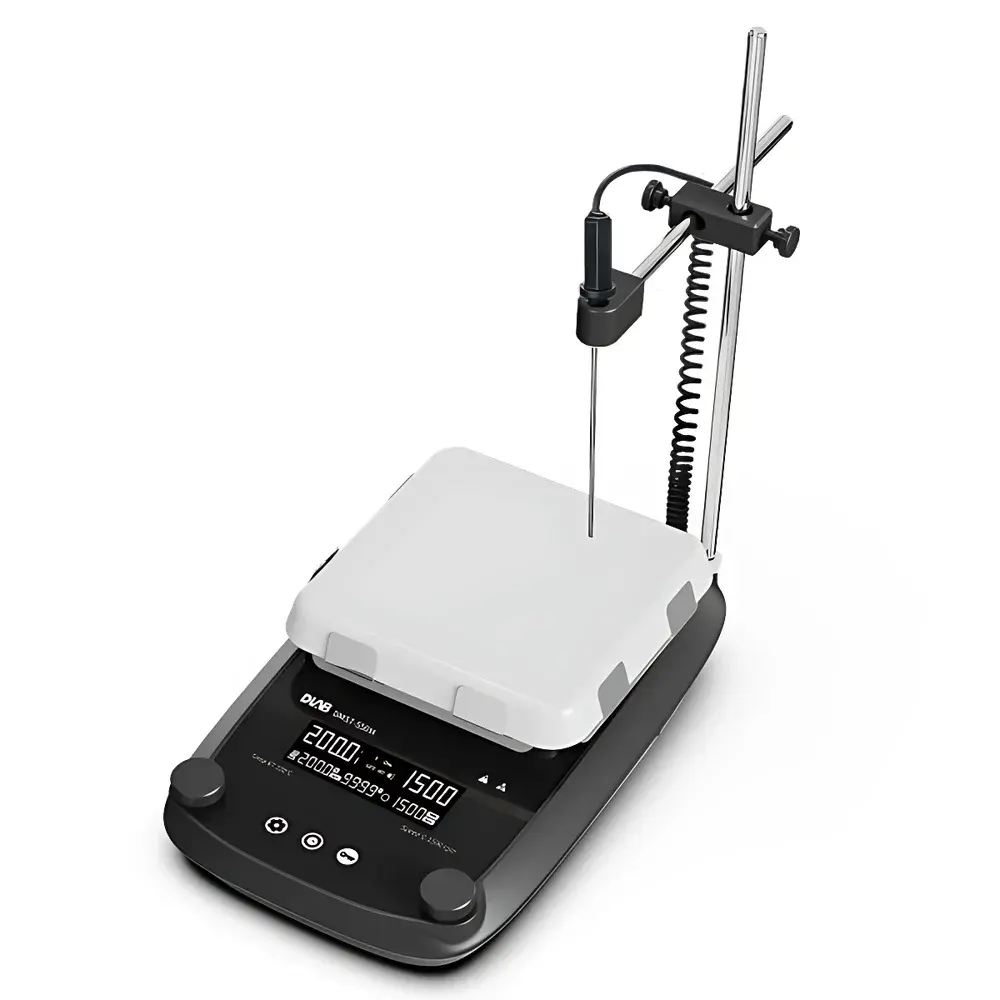
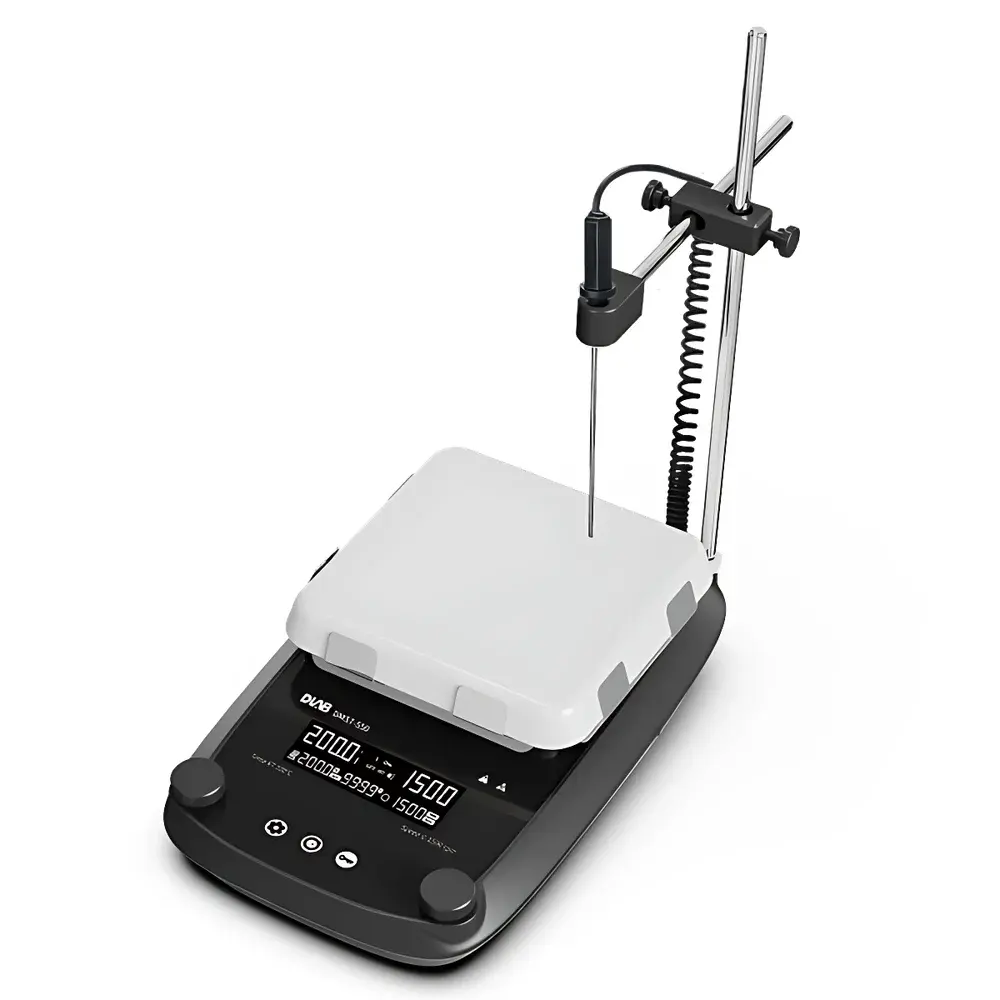
DLAB DMS7-550M 7-inch LCD Digital Magnetic Stirrer with Ceramic Heating Plate
| Brand | DLAB |
|---|---|
| Origin | Beijing, China |
| Manufacturer Type | Direct Manufacturer |
| Product Category | Domestic |
| Model | DMS7-550M |
| Instrument Type | Magnetic Stirrer |
| Maximum Stirring Volume | 20 L |
| Speed Range | 50–1500 rpm (1 rpm increments) |
| Temperature Control Range | Ambient to 550 °C (1 °C increments) |
| Protection Rating | IP42 |
| Motor Type | Brushless DC Motor |
| Timer Range | 1 min – 99 h 59 min |
| Remote Interface | RS232/USB for PC connectivity |
| Safety Features | Dual independent thermal cut-off circuits, overheat protection, residual heat warning (“HOT” display), safety lock, audible alarm |
Overview
The DLAB DMS7-550M is a high-performance, digitally controlled magnetic stirrer engineered for precision heating and mixing in demanding laboratory environments. Built around a robust Couette-flow principle—where rotational torque from a rotating magnetic field induces homogeneous motion in paramagnetic stir bars—the instrument delivers consistent shear transfer across viscous and thermally sensitive samples. Its integrated ceramic-coated aluminum heating plate enables rapid, uniform thermal distribution up to 550 °C, while the brushless DC motor ensures stable rotational output without electromagnetic interference or mechanical wear. Designed for continuous operation under GLP-compliant workflows, the DMS7-550M meets core functional requirements of synthetic chemistry, materials science, and pharmaceutical process development labs where reproducible thermal-mechanical conditioning is critical.
Key Features
- Ceramic-coated 7-inch aluminum heating plate offering exceptional chemical resistance, thermal stability, and ease of decontamination—ideal for acidic, alkaline, or solvent-based reaction media.
- Dual independent safety circuits continuously monitor plate temperature and internal electronics; automatic power cutoff occurs upon sensor failure, short circuit, or sustained overheating beyond user-defined thresholds.
- Three programmable heating profiles (A: Fast Ramp, B: Standard Ramp, C: Isothermal Hold) allow precise adaptation to reaction kinetics, crystallization protocols, or solvent reflux conditions.
- Residual heat warning system activates when surface temperature exceeds 50 °C: the LCD displays flashing “HOT” even after power-off, preventing accidental contact burns during post-run handling.
- Brushless DC motor provides silent, spark-free operation with >20,000-hour service life and zero maintenance—eliminating carbon dust contamination risks common in brushed motors.
- Full parameter feedback via high-contrast LCD: real-time display of speed (rpm), set/actual temperature (°C), elapsed/timer countdown (hh:mm), and operational status flags (e.g., “ALARM”, “LOCK”, “HOT”).
- Configurable safety lock prevents unintended parameter changes during active runs—particularly valuable in shared-core facilities or teaching laboratories.
Sample Compatibility & Compliance
The DMS7-550M accommodates standard laboratory glassware (Erlenmeyer flasks, round-bottom flasks, beakers) up to 20 L volume using appropriately sized PTFE- or glass-coated stir bars (recommended bar length: 40–80 mm). Its IP42 ingress protection rating safeguards against splashes and particulate ingress during routine benchtop use. The device complies with IEC 61010-1:2010 for electrical safety in laboratory equipment and supports traceable calibration per ISO/IEC 17025 requirements when paired with external PT100 probes. While not certified for hazardous area (ATEX/IECEx) use, its spark-free motor and grounded metal housing meet general-purpose safety expectations for non-explosive environments under USP and EU GMP Annex 15 guidelines.
Software & Data Management
Via RS232 or USB interface, the DMS7-550M supports bidirectional communication with Windows-based control software (included). Users can log time-stamped speed/temperature profiles, export CSV-formatted datasets for statistical analysis (e.g., ANOVA of heating ramp consistency), and synchronize multi-unit operations in parallel synthesis setups. Audit trail functionality records all parameter modifications—including operator ID (if network-authenticated), timestamp, and pre-/post-change values—satisfying FDA 21 CFR Part 11 requirements for electronic records when deployed with validated software configuration. Firmware updates are delivered via secure signed packages to maintain integrity across instrument fleets.
Applications
- Controlled-temperature synthesis of metal-organic frameworks (MOFs) and covalent organic frameworks (COFs) requiring prolonged heating at 180–400 °C under inert atmosphere.
- Homogenization of high-viscosity polymer solutions (e.g., PVDF in NMP) prior to membrane casting, where consistent shear history impacts pore morphology.
- Accelerated solvent extraction (ASE) method development in environmental QA/QC labs, using heated stirring to optimize analyte recovery from solid matrices.
- Preparation of nanoparticle dispersions (e.g., Fe3O4 in oleic acid) where precise thermal ramping minimizes Ostwald ripening during nucleation.
- Teaching labs conducting calorimetry experiments or Arrhenius kinetic studies—leveraging the timer’s independent heating/stirring stop logic to preserve sample integrity post-reaction.
FAQ
Does the DMS7-550M support external temperature probe input for closed-loop PID control?
No—the unit relies on built-in RTD sensing embedded beneath the ceramic plate. For probe-based feedback, users must employ third-party controllers interfaced via analog voltage output (0–10 V) or digital protocols.
Can the timer function pause both heating and stirring simultaneously?
No—by design, the timer terminates heating at expiry but maintains stirring to prevent thermal shock or sedimentation; this behavior is fixed and non-configurable.
What is the maximum recommended ambient operating temperature?
The unit is rated for continuous operation at ambient temperatures ≤35 °C and relative humidity ≤80% non-condensing, as specified in IEC 61010-1 Clause 6.3.2.
Is the ceramic coating resistant to hydrofluoric acid (HF)?
No—while highly resistant to HCl, HNO3, and NaOH, the alumina-based ceramic layer is not HF-compatible; alternative PTFE-sheathed hotplates are recommended for HF applications.
How often does the internal temperature sensor require recalibration?
DLAB recommends annual verification against a NIST-traceable reference thermometer; deviation exceeding ±2 °C at 100 °C or ±5 °C at 500 °C warrants factory recalibration.



