
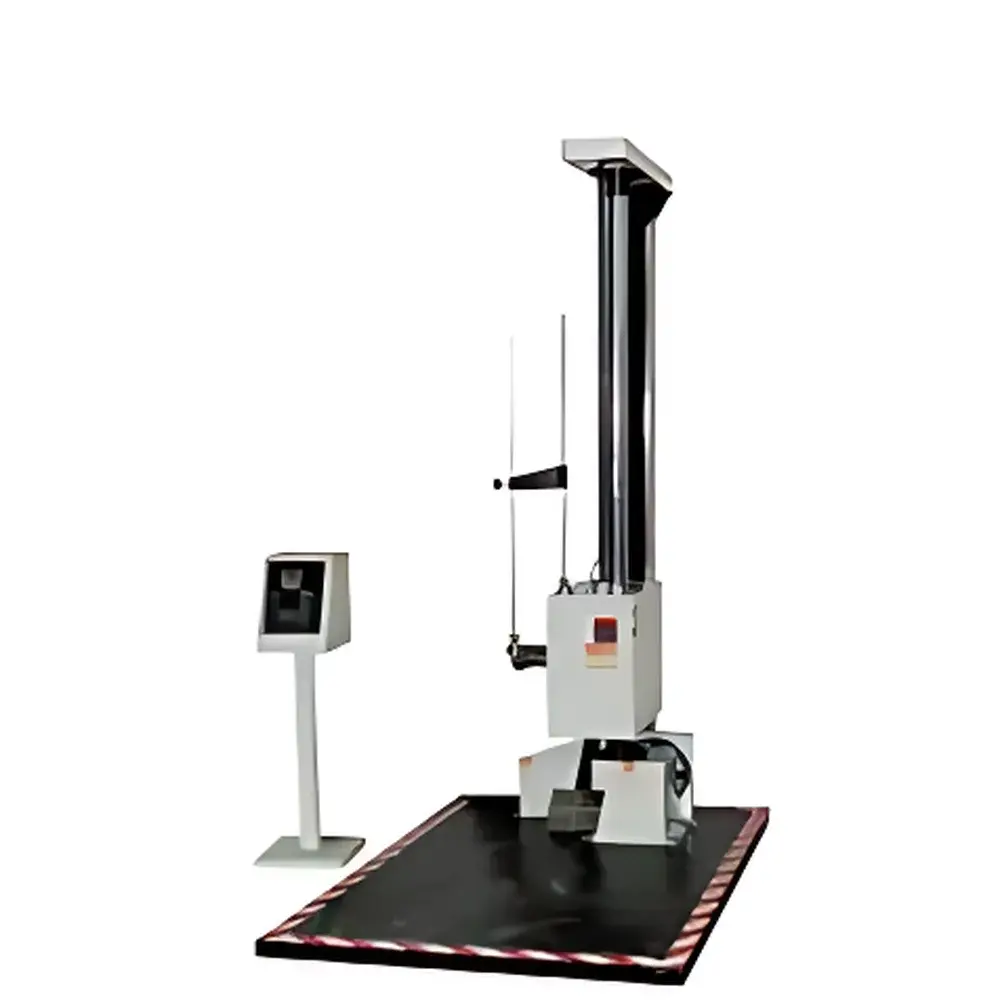
Jianhu JH-6017 Dual-Arm Free-Fall Impact Tester
| Brand | Jianhu |
|---|---|
| Origin | Shanghai, China |
| Model | JH-6017 |
| Max. Test Load | 65 kgf |
| Drop Height Range | 45–200 cm |
| Drive System | Motorized Vertical Lift |
| Drop Release | Electromagnetic Holding & Instant Free-Fall |
| Impact Surfaces | Flat Face, Edge (Line), and Corner |
| Height Display | Digital LED Indicator |
| Base Construction | Solid Steel Base with Four Adjustable Leveling Feet |
| Safety Protection | Upper/Lower Limit Microswitches |
| Accessories | 250 cm Calibration Tape with Scale Pointer |
| Compliance | Designed for ISO 2233, ASTM D5276, ISTA 1A/2A/3A, GB/T 4857.5 |
Overview
The Jianhu JH-6017 Dual-Arm Free-Fall Impact Tester is an engineered solution for standardized drop testing of packaged goods in quality control, packaging development, and logistics validation laboratories. It operates on the principle of controlled gravitational free-fall impact—where a test specimen, secured on a motor-driven lift platform, is held at a preset height by electromagnetic retention and released instantaneously to simulate real-world handling shocks during transportation and warehousing. Unlike single-arm configurations, the dual-arm, dual-column structural design provides enhanced lateral rigidity and load distribution, enabling stable testing of larger or asymmetrically balanced packages up to 65 kgf without torsional deflection. The system complies with core international drop-test standards including ISO 2233 (Packaging—Complete, filled transport packages—Vertical impact test), ASTM D5276 (Standard Test Method for Drop Testing of Loaded Containers by Free Fall), and GB/T 4857.5 (Chinese national standard equivalent to ISO 2233). Its mechanical architecture prioritizes repeatability, operator safety, and long-term dimensional stability under repeated impact loading.
Key Features
- Dual-arm, dual-column steel frame construction ensures minimal flexure during high-mass drop events, supporting consistent impact alignment across face, edge, and corner orientations.
- Motorized vertical lift system with digital height display (LED) enables precise, repeatable positioning from 45 cm to 200 cm in 1 cm increments; height setting is independent of load mass within rated capacity.
- Electromagnetic release mechanism guarantees zero-delay, zero-friction detachment—eliminating mechanical hysteresis and ensuring true free-fall kinematics per ISO/IEC 17025 traceability requirements.
- Integrated microswitch-based upper and lower limit protection prevents over-travel damage to drive components and maintains calibration integrity during routine operation.
- Heavy-duty solid steel base with four independently adjustable leveling feet ensures vibration damping and horizontal stability—even on non-ideal laboratory flooring—critical for maintaining impact vector orthogonality.
- Standardized fixture set includes corner clamps, edge guides, and flat-face support plates conforming to ISO 2233 Annex A geometries for unambiguous orientation registration.
Sample Compatibility & Compliance
The JH-6017 accommodates rigid and semi-rigid packaged units—including corrugated boxes, plastic totes, composite drums, and consumer electronics cartons—within dimensions constrained only by the 65 kgf mass limit and the open column envelope (typical max. footprint: 800 mm × 800 mm). Test specimens are secured using non-deforming mechanical fixtures that preserve original package geometry without introducing pre-stress. All operational protocols align with Good Laboratory Practice (GLP) documentation frameworks: height settings, drop sequence order (face → edge → corner), and pass/fail criteria are manually logged or integrated into external LIMS via RS-232 output (optional). While the instrument itself does not include automated data logging, its mechanical consistency supports audit-ready manual records compliant with ISO/IEC 17025 clause 7.7 (Results reporting) and FDA 21 CFR Part 11 when paired with validated procedural controls.
Software & Data Management
The JH-6017 operates as a stand-alone electromechanical tester with no embedded firmware or proprietary software. Height adjustment, release initiation, and safety interlock status are managed via front-panel push-button controls and LED indicators. For laboratories requiring electronic recordkeeping, the unit features an RS-232 serial interface (optional accessory) to transmit height setpoint, drop count, and emergency stop triggers to external SCADA systems or custom LabVIEW/Python-based acquisition platforms. All test parameters—including drop height, orientation mode, specimen ID, and visual inspection notes—are documented manually per internal SOPs. This architecture avoids software validation overhead while preserving full traceability when integrated into GxP-aligned workflows.
Applications
- Validation of primary and tertiary packaging designs against ISTA 1A (non-simulation), 2A (partial simulation), and 3A (full simulation) protocols.
- Comparative assessment of cushioning material performance (e.g., foam density gradients, honeycomb board compression recovery) under standardized impact energy inputs.
- Root-cause analysis of field failure reports involving transit damage—correlating lab-induced impact vectors with observed failure modes (e.g., corner crush vs. seam separation).
- Supplier qualification audits where objective, repeatable drop-test evidence is required prior to production ramp-up.
- Educational use in packaging engineering curricula for demonstrating energy transfer, deformation mechanics, and standardization principles in physical testing.
FAQ
What standards does the JH-6017 directly support?
It is mechanically configured to execute tests per ISO 2233, ASTM D5276, ISTA 1A/2A/3A, and GB/T 4857.5. No software or calibration certificate is included by default; third-party verification is recommended for accredited labs.
Can the tester accommodate irregularly shaped packages?
Yes—provided mass remains ≤65 kgf and the center of gravity stays within the column footprint. Custom fixture adapters may be fabricated per user specifications.
Is height calibration traceable to national standards?
The integrated 250 cm tape scale and LED indicator require periodic verification against NIST-traceable rulers or laser distance meters; calibration intervals should follow internal QA policy (typically every 6 months or after 500 drops).
Does the unit meet CE or UL safety certification?
As supplied, it carries no CE or UL mark; compliance with IEC 61000-6-2 (immunity) and IEC 61000-6-4 (emissions) requires third-party assessment per regional regulatory requirements.
What maintenance is required for long-term accuracy?
Monthly inspection of electromagnetic release timing, quarterly lubrication of lead screws, and annual verification of microswitch actuation thresholds using calibrated force gauges.



