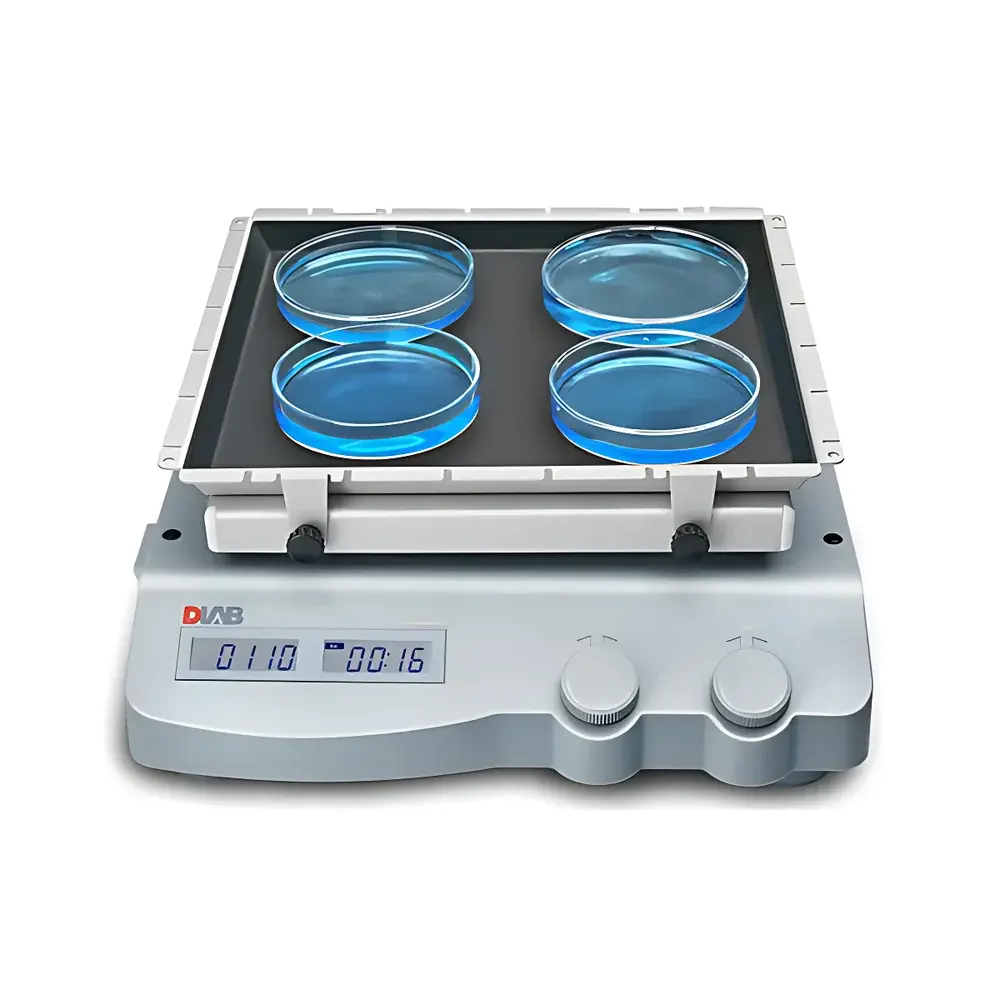
DLAB SK-L180-Pro Linear Shaker
| Brand | DLAB |
|---|---|
| Origin | Beijing, China |
| Manufacturer Type | Direct Manufacturer |
| Product Category | Domestic |
| Model | SK-L180-Pro |
| Instrument Type | Linear Shaker |
| Timer Range | 1 min – 19 h 59 min |
| Oscillation Frequency | 100–350 rpm |
| Stroke Amplitude | 4 mm |
| Temperature Range | 5–40 °C, ≤80% RH |
| Number of Platforms | 1 |
| Max Load Capacity | 2.5 kg (including clamps) |
| Motor Type | Brushless DC Motor |
| Input Power | 28 W |
| Output Power | 15 W |
| Power Supply | 100–240 V, 50/60 Hz |
| Power Consumption | 30 W |
| Dimensions (L×W×H) | 300 × 340 × 100 mm |
| Net Weight | 8.1 kg |
| Ambient Operating Conditions | 5–40 °C, ≤80% RH |
| Enclosure Rating | IP21 |
| Data Interface | RS232 |
Overview
The DLAB SK-L180-Pro Linear Shaker is an engineered platform for precise, low-shear linear reciprocating motion in life science laboratories. Unlike orbital or rotary shakers, the SK-L180-Pro generates controlled horizontal back-and-forth oscillation—ideal for applications requiring uniform suspension without vortexing or excessive shear stress, such as cell culture maintenance, immunoassay plate washing, blotting membrane agitation, and gentle reagent mixing. Its brushless DC motor delivers consistent torque across the full speed range (100–350 rpm), ensuring high reproducibility between runs and long-term operational stability with zero brush wear or commutator maintenance. Designed for benchtop integration in ISO-certified cleanrooms, QC labs, and academic research facilities, the unit complies with IEC 61010-1 safety standards for laboratory electrical equipment and meets EMC requirements per EN 61326-1.
Key Features
- Linear reciprocating motion with fixed 4 mm stroke amplitude—optimized for even sample distribution and minimal splashing in shallow vessels.
- Dual independent LCD displays: one dedicated to real-time speed (rpm), the other to remaining timer duration—enabling simultaneous monitoring without menu navigation.
- Intelligent speed protection circuitry automatically halts operation if rotational inertia exceeds safe thresholds during load imbalance or mechanical obstruction.
- RS232 serial interface enables bidirectional communication with host PCs; supports ASCII-based command protocols for remote parameter configuration and status polling.
- Free Shaker PC Software (Windows-compatible) provides graphical real-time plotting of speed vs. time profiles, exportable CSV logs, and programmable multi-step protocols with up to 10 segments.
- Modular clamp system compatible with universal microplate holders (96-/384-well), universal flask clamps (50–500 mL), Petri dish racks, and custom adapter plates—no tools required for installation.
- IP21-rated enclosure ensures protection against vertically falling drips and solid objects >12.5 mm—suitable for standard lab environments but not wet or high-humidity enclosures.
Sample Compatibility & Compliance
The SK-L180-Pro accommodates a broad spectrum of standard labware: flat-bottom microplates, PCR plates, glass or plastic Petri dishes (up to 150 mm diameter), Erlenmeyer flasks (50–250 mL), and test tubes (in rack format). Its 2.5 kg maximum payload includes mass of clamps and fixtures—ensuring stable operation under full load at 350 rpm. The device operates within ambient conditions compliant with ISO 14644-1 Class 8 cleanroom specifications (when used without internal heating/cooling). While not a regulated medical device, its firmware architecture supports audit-ready operation: all parameter changes via PC software are timestamped and logged locally, aligning with GLP documentation practices. It does not incorporate temperature control hardware; therefore, it is not classified as a “heated shaker” under USP or FDA 21 CFR Part 11 definitions.
Software & Data Management
The included Shaker PC Software implements a lightweight client-server architecture over RS232, requiring no additional drivers on Windows 10/11 systems. Each session records metadata—including operator ID (manually entered), start/stop timestamps, target speed, actual speed trace, and elapsed runtime—stored in encrypted local SQLite databases. Export functions support .csv and .xlsx formats with ISO 8601-compliant datetime fields. Audit trail integrity is maintained through write-once logging: historical entries cannot be edited or deleted post-execution. For integration into LIMS or ELN platforms, raw ASCII command/response sequences (e.g., “SPEED=220rn”, “STATUS?rn”) are documented in the user manual, enabling custom API wrappers.
Applications
- Western blot membrane agitation during antibody incubation and wash steps—minimizing background noise from uneven reagent contact.
- Cell detachment using enzyme-free dissociation buffers, where orbital motion may damage adherent monolayers.
- ELISA plate washing prior to substrate addition—reducing edge effects and improving inter-well CVs.
- Pre-analytical sample homogenization of viscous biological fluids (e.g., synovial fluid, mucus) prior to centrifugation or filtration.
- Quality control testing of lateral flow assay strip sensitivity under standardized agitation protocols (per CLSI EP21-A).
- Environmental microbiology: gentle resuspension of biofilm fragments from stainless-steel coupons prior to CFU enumeration.
FAQ
Is the SK-L180-Pro suitable for use inside a CO₂ incubator?
No—the unit lacks environmental sealing beyond IP21 and contains no temperature-compensated electronics; operation above 40 °C or in elevated CO₂/humidity will void warranty and compromise motor longevity.
Can multiple SK-L180-Pro units be daisy-chained via RS232?
No—each unit requires a dedicated serial port or USB-to-RS232 adapter; shared bus topology is not supported due to lack of addressable addressing in the firmware protocol.
Does the shaker retain settings after power loss?
Yes—last-used speed and timer values are stored in non-volatile memory and restored upon reboot; however, active run states are not preserved.
What is the tolerance on amplitude accuracy across the speed range?
The 4 mm stroke is mechanically fixed via cam-follower linkage; deviation is ±0.15 mm across 100–350 rpm, verified per ISO 5347-12 vibration calibration guidelines.
Are CE or UKCA markings present on the device?
Yes—the unit carries CE marking under the Low Voltage Directive (2014/35/EU) and EMC Directive (2014/30/EU); UKCA marking is not applied, as the manufacturer does not currently hold UK-recognized conformity assessment certification.