
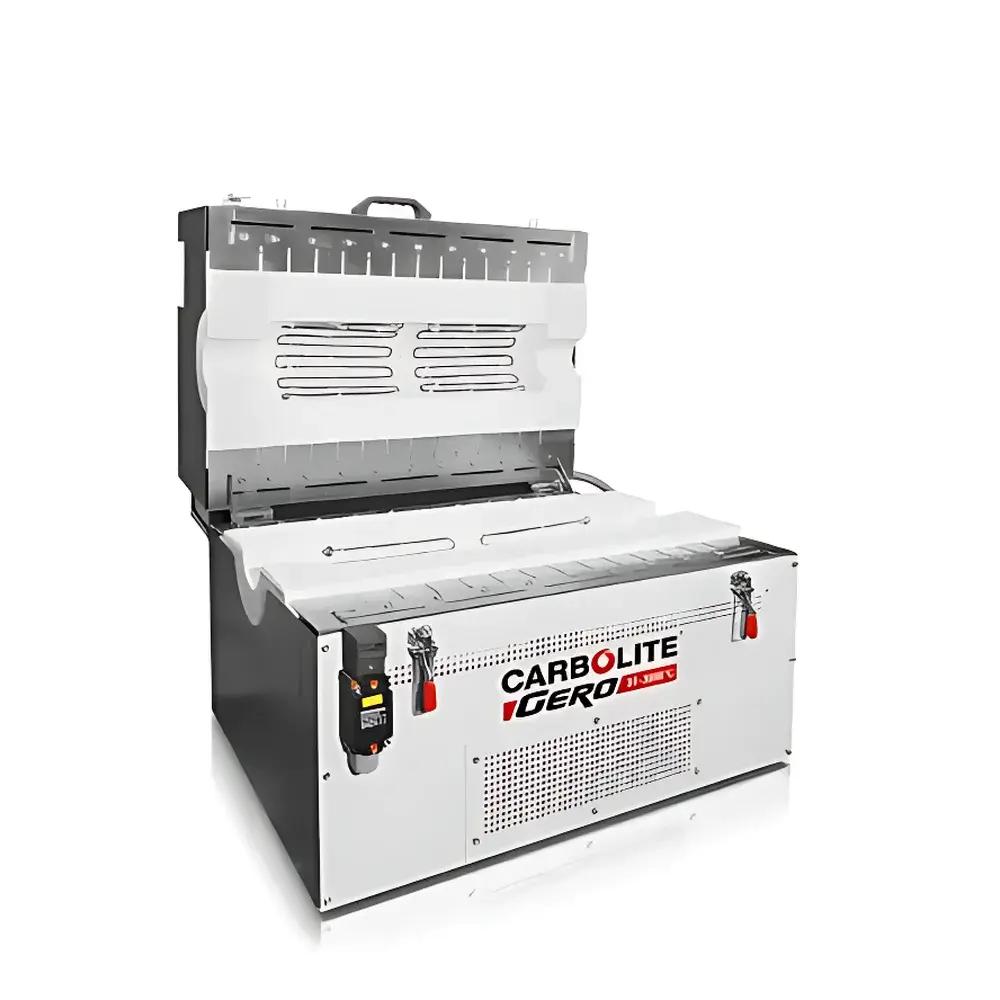
Carbolite Gero FST/FZS Split-Shell Tube Furnace (1300°C)
| Brand | Carbolite Gero |
|---|---|
| Origin | Germany |
| Model | FST/FZS |
| Maximum Temperature | 1300°C |
| Heating Zones | Single-zone (FST) or Triple-zone (FZS) |
| Heating Element | High-purity FeCrAl alloy wire (5 mm diameter) |
| Insulation | Low-heat-capacity ceramic fiber modules |
| Safety Interlock | Automatic power cutoff upon door opening |
| Temperature Uniformity | ±5°C in hot zone (with radiation shields and end plugs) |
| Programmable Controller | 24-segment ramp-soak profile |
| Overtemperature Protection | EPC3016P1 (FST) or CC-T1 (FZS) |
| Power Supply Options | 1-phase 220–240 V or 3-phase 200–480 V |
| Max. Tube OD | 150 mm (standard) |
| Cooling Method | Natural convection via engineered venting |
| Mounting Flexibility | Horizontal or vertical orientation |
| Compliance | Designed for GLP/GMP environments |
Overview
The Carbolite Gero FST/FZS Split-Shell Tube Furnace is an industrial-grade, high-temperature thermal processing system engineered for precision-controlled atmosphere and vacuum applications in research laboratories and pilot-scale production. Operating up to 1300°C in air or inert/reducing atmospheres, the furnace employs resistive heating via robust 5 mm diameter FeCrAl alloy elements embedded within low-thermal-mass ceramic fiber insulation—enabling rapid thermal response, exceptional energy efficiency, and long-term stability. Its defining split-shell architecture allows full lateral access to the working tube without disassembly, facilitating rapid sample loading/unloading, integration of pre-flanged reactors, and accelerated cooling cycles. The system supports both horizontal and vertical configurations using L-shaped mounting brackets, and is routinely deployed in materials synthesis, catalyst activation, fuel cell component testing, thermocouple calibration per ASTM E230, and controlled-atmosphere sintering protocols.
Key Features
- Split-shell design with dual quick-release latches and ergonomic top-handle enables tool-free access to the hot zone in under 10 seconds.
- Ceramic fiber insulation with integrated heating elements minimizes thermal inertia and improves temperature reproducibility across repeated cycles.
- Integrated safety interlock cuts power to all heating zones immediately upon shell opening—compliant with IEC 61000-6-2 and EN 60519-2 requirements for laboratory furnace safety.
- High-precision S-type thermocouples (IEC 60584-2 Class 1) provide stable feedback for ±0.5°C controller accuracy within the operating range.
- Modular control cabinet (separated by up to 6 m cable) houses either the EPC3016P1 (FST) or CC-T1 (FZS) programmable controller with 24-segment ramp-soak programming and real-time data logging.
- Optional Ethernet interface (IEEE 802.3) supports remote monitoring, SCADA integration, and audit-trail generation per FDA 21 CFR Part 11 when paired with validated software.
- Standard radiation shielding plugs and ceramic end caps enhance axial temperature uniformity (±5°C over specified hot zone length).
Sample Compatibility & Compliance
The FST/FZS accommodates quartz, alumina, silicon carbide, and molybdenum disilicide (MoSi₂) tubes with outer diameters up to 200 mm and lengths exceeding 4.5 m in custom configurations. When used with ceramic tubes, maximum recommended heating rates are limited to 5°C/min to prevent thermal shock. The furnace meets structural and electrical safety standards per EN 61000-6-4 (EMC), EN 60519-2 (industrial heating equipment), and conforms to ambient operating conditions defined in ISO 14644-1 Class 8 cleanroom environments. For regulated applications—including catalyst aging per ISO 10075 or thermal barrier coating development—the system supports traceable calibration documentation and GLP-compliant operation when configured with optional data-logging controllers and electronic signature modules.
Software & Data Management
Carbolite Gero’s digital controllers offer native CSV export, time-stamped event logging (door open/close, alarm triggers, setpoint changes), and configurable alarm thresholds (e.g., deviation >±3°C for >60 s). With optional Ethernet connectivity, users can integrate the furnace into centralized lab management systems using Modbus TCP or OPC UA protocols. All controller firmware complies with IEC 62443-3-3 for industrial cybersecurity baseline protection. Audit trails include user ID, timestamp, parameter change, and reason code—fully supporting 21 CFR Part 11 requirements for electronic records and signatures when deployed with validated third-party LIMS platforms.
Applications
- Chemical vapor deposition (CVD) precursor decomposition and thin-film growth
- Fuel cell membrane electrode assembly (MEA) thermal conditioning and degradation studies
- Thermocouple calibration against fixed-point reference cells (e.g., Cu, Ag, Au freezing points)
- Catalyst calcination, reduction, and sulfidation under controlled gas flows (H₂, N₂, Ar, NH₃)
- Metal injection molding (MIM) and ceramic injection molding (CIM) debinding and sintering
- Heat treatment of advanced ceramics, superalloys, and battery electrode materials
- Thermal aging of polymers and composites per ASTM D3045 and ISO 2578
- Low-pressure pyrolysis and carbonization of biomass precursors
FAQ
What is the maximum allowable heating rate for ceramic tubes?
For quartz or alumina tubes, the recommended maximum heating rate is 5°C/min to avoid thermal stress-induced fracture.
Can the furnace operate under vacuum or reactive gas atmospheres?
Yes—when equipped with optional vacuum flanges (KF or CF), inert gas purge kits, or hydrogen-compatible safety systems rated for >750°C operation.
Is the controller compliant with FDA 21 CFR Part 11?
The base controller is not Part 11–validated out-of-the-box, but becomes compliant when integrated with Carbolite Gero’s optional audit-trail-enabled software suite and electronic signature module.
What is the standard warranty coverage?
Carbolite Gero provides a 24-month parts-and-labor warranty on furnace structure, heating elements, and insulation; 12 months on electronics and controllers.
How is temperature uniformity verified and documented?
Uniformity is measured per ASTM E220 using three calibrated S-type thermocouples positioned at center, +¼, and –¼ of the hot zone length—with shielding plugs installed; test reports are supplied upon request.



