
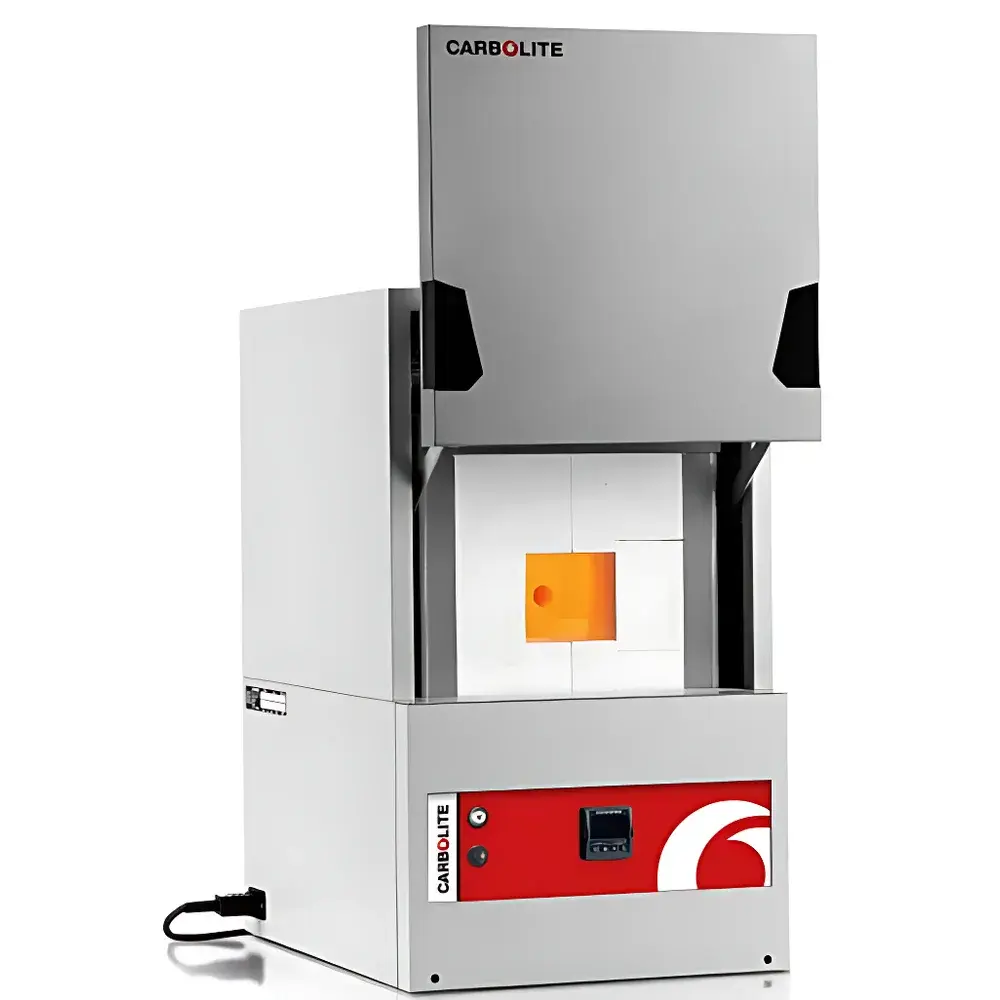
Carbolite Gero CDF Dental Sintering Furnace
| Brand | Carbolite Gero |
|---|---|
| Origin | United Kingdom |
| Model | CDF |
| Instrument Type | Benchtop Box Furnace |
| Maximum Temperature | 1530 °C |
| Temperature Uniformity | ±1 °C |
| Heating Element | Silicon Carbide (SiC) Rods |
| Internal Chamber Dimensions | 80 × 90 × 150 mm (W × D × H) |
| Rated Power | 2000 W |
| Time to Max Temperature | 126 min |
| Control System | PID 3216P1 Programmable Controller (8-Stage Ramp/Soak) |
| Cooling | Natural Convection |
| Compliance | CE, UKCA, IEC 61000-6-3, IEC 61000-6-4 |
Overview
The Carbolite Gero CDF Dental Sintering Furnace is a precision-engineered benchtop box furnace specifically designed for controlled thermal processing of dental prosthetic materials—including zirconia, lithium disilicate, and metal-ceramic frameworks. Operating on the principle of resistive heating via high-purity silicon carbide (SiC) rods, the CDF delivers exceptional temperature stability and spatial uniformity across its compact 80 × 90 × 150 mm chamber. Its maximum operating temperature of 1530 °C enables full densification of high-performance yttria-stabilized zirconia (YSZ) and advanced glass-ceramics in accordance with ISO 6872 and EN ISO 13356 standards. The furnace is engineered for repeatable, traceable sintering cycles under laboratory or clinical production environments—supporting both routine quality control and R&D workflows in dental laboratories and academic biomaterials research facilities.
Key Features
- High-reliability silicon carbide heating elements ensuring contamination-free thermal processing—critical for maintaining surface integrity and phase purity of dental oxides.
- PID 3216P1 programmable controller with 8-stage ramp/soak capability, enabling precise replication of multi-step sintering profiles (e.g., debinding, intermediate hold, final densification).
- Temperature accuracy of ±1 °C at setpoint, verified per ASTM E220 calibration methodology using NIST-traceable thermocouples.
- Built-in 24-hour timer for unattended overnight operation—validated for continuous duty cycle compliance under IEC 60335-1 safety requirements.
- Robust ceramic fiber insulation and double-walled steel construction minimize external surface temperature rise (<45 °C at ambient), enhancing lab safety and energy efficiency.
- Standard inclusion of alumina-based ceramic sintering trays and 200 g of 2 mm zirconia support beads—optimized for uniform heat transfer and mechanical stability of crowns, bridges, and implant abutments during heating/cooling phases.
Sample Compatibility & Compliance
The CDF accommodates a wide range of dental restorative substrates, including monolithic and layered zirconia blanks (e.g., 3Y-TZP, 4Y/5Y-PSZ), lithium disilicate ingots (IPS e.max), and cobalt-chrome frameworks prior to porcelain firing. Chamber geometry supports standard CAD/CAM milled units up to Ø30 mm × 25 mm height. All internal surfaces are inert and non-reactive, eliminating risk of elemental migration into sensitive bioceramic matrices. The system complies with EU Medical Device Regulation (MDR 2017/745) Annex I essential requirements for thermal processing equipment used in Class IIa dental device manufacturing. Optional overtemperature protection (OTC) module meets IEC 61508 SIL 2 functional safety criteria for unmanned operation.
Software & Data Management
While the base CDF operates via front-panel PID interface, optional RS232 serial communication enables integration with third-party data acquisition systems or LIMS platforms. When configured with extended firmware, the controller supports audit-trail logging (timestamped setpoints, actual temperatures, dwell times) compliant with FDA 21 CFR Part 11 requirements for electronic records in regulated dental labs. Data export is supported in CSV format for post-process analysis in MATLAB, Python, or statistical process control (SPC) software. Optional atmosphere protection kits allow argon or nitrogen purging—enabling oxygen-sensitive sintering protocols aligned with ISO 13356 Annex B recommendations for low-oxygen zirconia densification.
Applications
- Sintering of CAD/CAM-milled zirconia restorations (crowns, veneers, multi-unit bridges) under controlled ramp-hold-cool profiles.
- Thermal treatment of lithium disilicate glass-ceramics requiring precise nucleation and crystallization kinetics.
- Pre-sintering and final densification of porous titanium scaffolds for dental implantology research.
- Heat treatment validation studies for ISO 13356-compliant Y-TZP materials under GLP-aligned experimental conditions.
- Method development for rapid thermal cycling protocols in dental material fatigue testing.
FAQ
What is the recommended maintenance interval for the SiC heating elements?
Silicon carbide rods typically exhibit service life exceeding 2,000 hours at ≤1400 °C; annual visual inspection and resistance measurement are advised per Carbolite Gero Technical Bulletin TB-CD-07.
Can the CDF be used for sintering non-dental ceramics such as alumina or hydroxyapatite?
Yes—the furnace’s temperature range and uniformity performance meet ASTM C1161 requirements for structural ceramic sintering; however, application-specific profile validation is required.
Is the CDF compatible with automated sample loading systems?
Not natively; the CDF is manually loaded. Integration with robotic handlers requires custom mounting brackets and safety interlock retrofitting, subject to site-specific risk assessment.
Does the standard configuration include temperature mapping certification?
No—optional IQ/OQ documentation packages (including 9-point chamber mapping per ASTM E220) are available upon request for GMP-regulated environments.



