
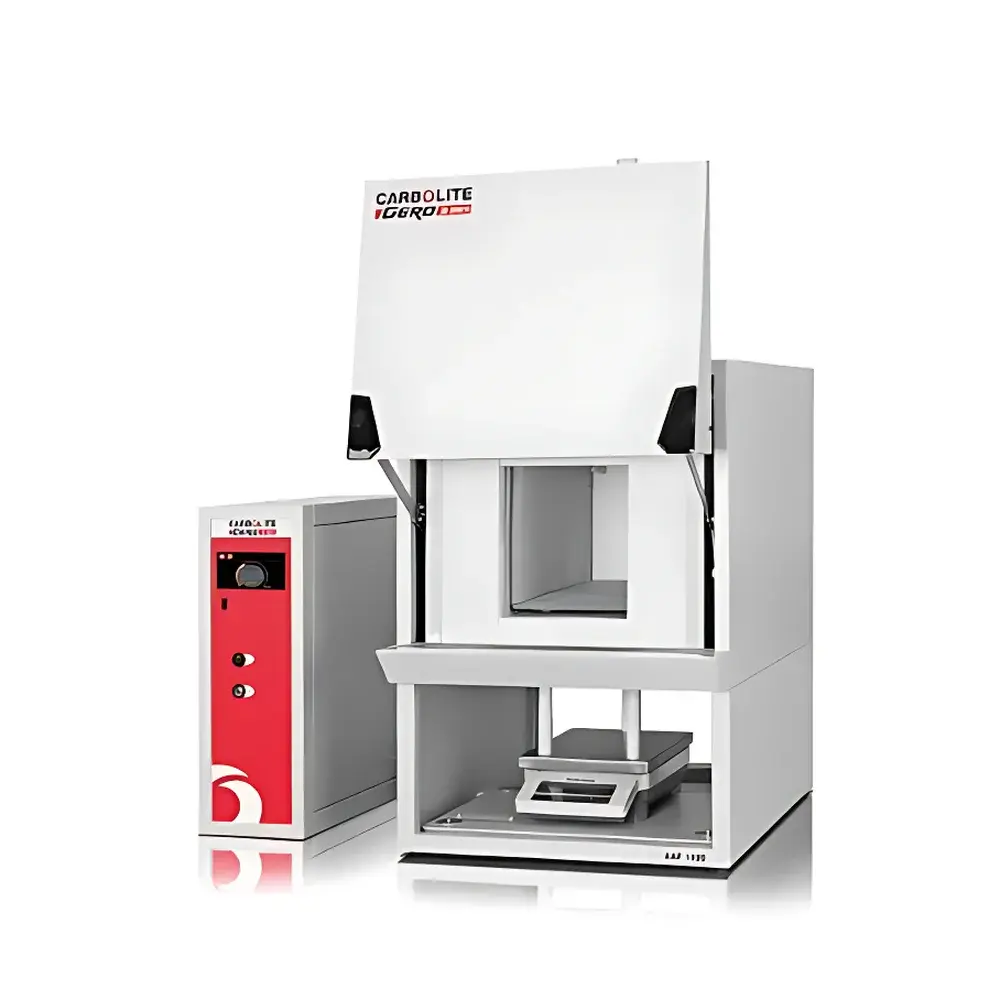
Carbolite Gero AAF-BAL Thermogravimetric Ashing Furnace with Integrated Precision Balance
| Brand | Carbolite Gero |
|---|---|
| Origin | Germany |
| Model | AAF-BAL |
| Instrument Type | Box-Type Muffle Furnace |
| Max Temperature | 1100 °C |
| Max Power | 7080 W |
| Internal Dimensions | 215 × 196 × 400 mm |
| Heating Element Protection | Silicon Carbide Felt |
| Thermocouple Type | K |
| Balance Capacity | 3 kg (optional), Resolution: 0.01 g |
| Controller Options | EPC3008P10 (Ethernet-enabled) or NanoDac™ |
| Compliance | ASTM D2974, ISO 1171, USP <281>, EN 15403 |
Overview
The Carbolite Gero AAF-BAL is a purpose-engineered thermogravimetric ashing furnace designed for precise, real-time loss-on-ignition (LOI) analysis in regulated laboratory environments. Unlike conventional muffle furnaces, the AAF-BAL integrates a high-stability analytical balance directly into the furnace chamber—enabling continuous, in-situ mass measurement throughout thermal treatment. Its operation is grounded in gravimetric principle: sample mass is monitored dynamically as temperature ramps and holds, allowing quantitative determination of volatile content, organic fraction, moisture, carbonate decomposition, and residual ash yield. The furnace operates up to 1100 °C with a sustained working temperature of 1000 °C, making it suitable for standardized ashing protocols across environmental, geological, cementitious, and waste characterization applications—including ASTM D2974 (moisture, ash, and organic matter in peat and organic soils), ISO 1171 (determination of ash in solid mineral fuels), and USP (residue on ignition for pharmaceutical excipients).
Key Features
- Integrated precision balance (3 kg capacity, 0.01 g resolution) housed within the hot zone, thermally isolated from control electronics for long-term stability
- Dual-zone heating architecture with side-mounted silicon carbide (SiC) heating elements protected by corrosion-resistant silicon carbide felt—ensuring uniform temperature distribution and extended element life in aggressive atmospheres (e.g., SO₂, CO, chloride-rich volatiles)
- Independent thermal and weighing control loops: furnace temperature regulation and mass acquisition operate synchronously but autonomously, eliminating cross-interference
- Configurable ramp-and-hold thermal profiles via programmable controllers (standard EPC3008P10 or optional NanoDac™), supporting multi-step sequences with up to 16 segments
- Overtemperature protection circuitry compliant with IEC 61000-6-2/6-4, safeguarding samples during unattended operation and meeting GLP/GMP requirements for audit-ready workflows
- Robust mechanical design: 70 kg unit weight, reinforced insulation, and front-opening door with counterbalanced hinge enabling ergonomic access without compromising thermal integrity
Sample Compatibility & Compliance
The AAF-BAL accommodates heterogeneous solid matrices including sludge, sediment, soil, fly ash, cement clinker, lime, calcined bauxite, refractory aggregates, and municipal solid waste. Its 17 L internal volume (215 × 196 × 400 mm) supports standard crucibles (e.g., Pt, Al₂O₃, SiC) up to Ø90 mm × 50 mm height. All thermal and gravimetric procedures align with internationally recognized standards: EN 15403 (determination of organic carbon in sewage sludge), ISO 11358 (thermogravimetry of polymers), and EPA Method 1684 (total suspended solids and LOI in wastewater). The system’s hardware architecture and data handling pathways support compliance with FDA 21 CFR Part 11 when deployed with validated iTools software (purchased separately) and appropriate electronic signature configurations.
Software & Data Management
Data acquisition is performed via either the EPC3008P10 controller (with embedded Ethernet port) or the NanoDac™ recorder. Both platforms log synchronized time-stamped records of furnace temperature and sample mass at user-defined intervals (1–60 s). Raw datasets export in CSV format for post-processing in LIMS or statistical packages. The iTools software suite (sold separately) provides real-time graphical visualization, derivative (dm/dt) calculation, automatic endpoint detection, and report generation compliant with ISO/IEC 17025 documentation requirements. NanoDac™ users leverage Review Lite™ (included) for local review and USB archiving; networked deployment allows secure transfer to centralized SQL databases or cloud-based QA repositories via TLS-secured Ethernet.
Applications
- Quantification of organic carbon in environmental sediments and wastewater biosolids per EPA and ISO protocols
- Residue-on-ignition testing of pharmaceutical raw materials and excipients (USP )
- Calcination loss assessment in Portland cement, hydrated lime, and metallurgical fluxes
- Thermal stability profiling of catalyst supports, battery cathode precursors, and ceramic green bodies
- Moisture and volatile content verification in coal, biomass pellets, and alternative fuels (ASTM D3173, D3175)
- Quality control of refractory linings and fireclay compositions under cyclic thermal loading
FAQ
Does the AAF-BAL meet GLP or GMP validation requirements?
Yes—when configured with EPC3008P10 or NanoDac™ controllers, calibrated balance, and iTools software (with 21 CFR Part 11 add-on), the system supports IQ/OQ/PQ documentation and audit trails.
Can the furnace operate continuously at 1000 °C?
Yes—the AAF-BAL is rated for continuous operation at ≤1000 °C; 1100 °C is a short-term maximum limit (≤30 min) for specific calibration or method development tasks.
Is external ventilation or fume extraction required?
Yes—due to potential release of CO, NOₓ, SO₂, or halogenated compounds during organic combustion, connection to a certified chemical fume hood or dedicated ducted exhaust system is mandatory.
What balance options are available beyond the standard 3 kg/0.01 g unit?
Optional balances include 5 kg/0.02 g and 10 kg/0.05 g capacities; all maintain thermal drift compensation and electromagnetic interference shielding compatible with furnace EM fields.
How is temperature uniformity verified across the chamber?
Carbolite Gero provides factory calibration certificates showing ±5 °C uniformity (per ISO 9001:2015 Annex B) at 500 °C and 900 °C; users may perform periodic verification using traceable multi-point thermocouple mapping.



