
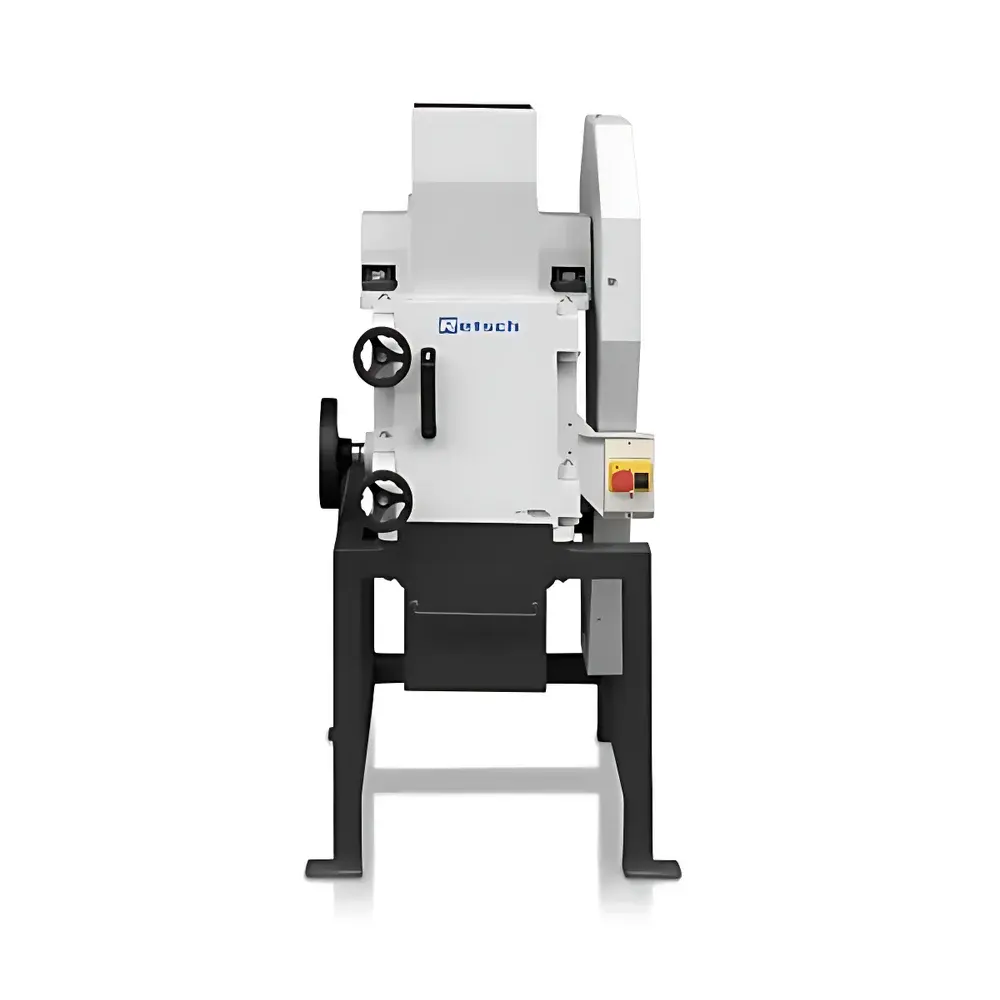
RETSCH BB400 Front-Loading Jaw Crusher
| Brand | RETSCH |
|---|---|
| Origin | Germany |
| Model | BB400 |
| Instrument Type | Jaw Crusher |
| Sample Suitability | Hard, Brittle, Medium-Hard Materials |
| Max. Feed Size | < 220 × 90 mm |
| Adjustable Jaw Gap | 0–30 mm (graduated scale, zero-point calibrated) |
| Final Particle Size | < 2 mm |
| Throughput | up to 400 kg/h |
| Batch Capacity | 10 L |
| Grinding Chamber Material Options | Manganese Steel, Tungsten Carbide, Heavy-Metal-Free Stainless Steel, NiHard 4 |
| Feed Hopper | Spring-damped, front-access, no-rebound design |
| Dust Extraction Port | Yes (compatible with optional vacuum system) |
| Drive | Three-phase motor, 5.5 kW |
| Power Supply | Variable voltage, three-phase |
| Protection Class | IP 55 |
| Dimensions (W × H × D) | 695 × 1399 × 719 mm |
| Net Weight | ~400 kg |
| Compliance | CE-marked, designed and manufactured in accordance with EN 61000-6-2/6-4, EN ISO 12100, and EN 60204-1 |
Overview
The RETSCH BB400 Front-Loading Jaw Crusher is an industrial-grade primary size reduction instrument engineered for reliable, high-throughput coarse comminution of hard, brittle, and medium-hard materials. Based on the well-established principle of compressive crushing—where material is subjected to mechanical pressure between two opposing jaw plates—the BB400 employs a robust eccentric drive mechanism that imparts elliptical motion to the movable jaw. This motion generates controlled compressive force within the wedge-shaped crushing chamber, fracturing samples progressively as they descend under gravity. The fixed and movable jaws (220 × 90 mm active surface) are precisely aligned to ensure uniform stress distribution and minimal particle attrition during initial breakage. Designed for laboratory-to-pilot-scale preprocessing, the BB400 serves as a critical first-stage grinder prior to downstream analytical or processing steps—including XRF sample preparation, geochemical assay, metallurgical liberation analysis, or recycling feedstock conditioning.
Key Features
- Front-access, spring-damped feed hopper enabling safe, ergonomic loading of oversized feed material up to 220 × 90 mm
- Continuously adjustable jaw gap (0–30 mm), calibrated via engraved scale with traceable zero-point reference and wear compensation (up to −10 mm)
- High-capacity throughput of up to 400 kg/h, validated under continuous operation with representative mineral and synthetic feedstocks
- Modular jaw plate system supporting interchangeable liners: manganese steel (standard), tungsten carbide (for extreme abrasion resistance), NiHard 4 (for high-impact applications), and heavy-metal-free stainless steel (for contamination-sensitive workflows)
- Integrated dust extraction port compliant with ISO 14644-1 Class 8 cleanroom-compatible vacuum interfaces
- IP 55-rated electrical enclosure and CE-conformant construction meeting EN 60204-1 (safety of machinery) and EN ISO 12100 (risk assessment)
- Optional central lubrication system for extended maintenance intervals and consistent bearing performance
Sample Compatibility & Compliance
The BB400 accommodates heterogeneous, irregularly shaped samples common in geology (e.g., ore lumps, slag, rock cores), construction materials (concrete aggregates, refractory bricks), electronic waste (PCBs, ceramic substrates), and recycled glass/ceramics. It is unsuitable for fibrous, elastic, or highly ductile materials. Jaw plate material selection aligns with application-specific contamination control requirements: tungsten carbide liners eliminate Fe/Ni leaching in trace-element geochemistry; heavy-metal-free stainless steel meets USP / elemental impurity limits for pharmaceutical excipient preprocessing. All configurations comply with GLP documentation standards for instrument qualification (IQ/OQ/PQ), including calibration traceability for gap setting and documented wear-rate monitoring protocols.
Software & Data Management
While the BB400 operates as a stand-alone mechanical unit without embedded digital controls, its operational parameters are fully integratable into laboratory-wide data governance frameworks. Jaw gap settings, batch timestamps, operator IDs, and maintenance logs can be recorded manually or via LIMS-integrated electronic notebooks (e.g., LabWare, STARLIMS). Optional analog signal outputs (4–20 mA) enable real-time throughput monitoring when paired with external flow meters or load cells. For FDA-regulated environments, audit trails for gap calibration events and liner replacement records satisfy 21 CFR Part 11 requirements when maintained in validated electronic systems.
Applications
- Geochemical sample preparation for X-ray fluorescence (XRF) and ICP-MS analysis requiring homogenized sub-2 mm fractions
- Metallurgical process development: liberation testing of sulfide ores and evaluation of comminution energy efficiency
- Recycling industry: pre-shredding of end-of-life electronics, photovoltaic modules, and automotive catalyst substrates
- Construction materials R&D: particle size distribution analysis of recycled concrete aggregate (RCA) and alkali-activated binders
- Environmental remediation: size reduction of contaminated soils and fly ash prior to leaching tests (TCLP, SPLP)
FAQ
What is the maximum feed size the BB400 can accept?
The BB400 accepts feed particles up to 220 × 90 mm in dimension—among the largest in its class for front-loading jaw crushers.
Can the final particle size be consistently maintained below 2 mm?
Yes, provided the jaw gap is set ≤2 mm and feed material is appropriately pre-sorted to exclude oversize contaminants; reproducibility is enhanced by zero-point calibration and wear compensation.
Is the BB400 suitable for use in regulated pharmaceutical or clinical laboratories?
It may be deployed in such environments when equipped with heavy-metal-free stainless steel jaws and operated under documented SOPs satisfying USP and ISO 17025 requirements for equipment qualification.
Does the BB400 require routine recalibration of the jaw gap scale?
The graduated scale is factory-calibrated and retains accuracy over time; however, periodic verification against certified gauge blocks (e.g., ISO 3650) is recommended per internal quality procedures.
What safety certifications does the BB400 hold?
It carries full CE marking and conforms to EN 61000-6-2 (immunity), EN 61000-6-4 (emissions), EN ISO 12100 (risk assessment), and EN 60204-1 (electrical safety).



