
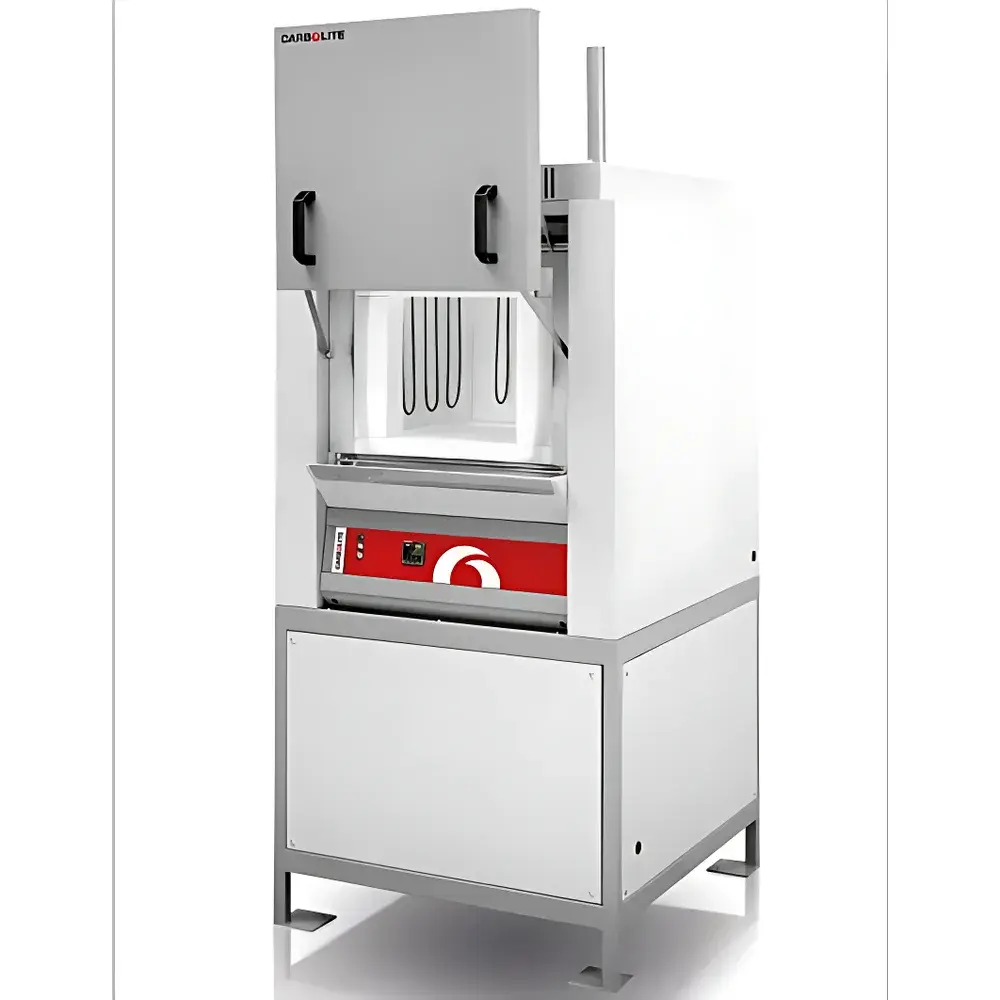
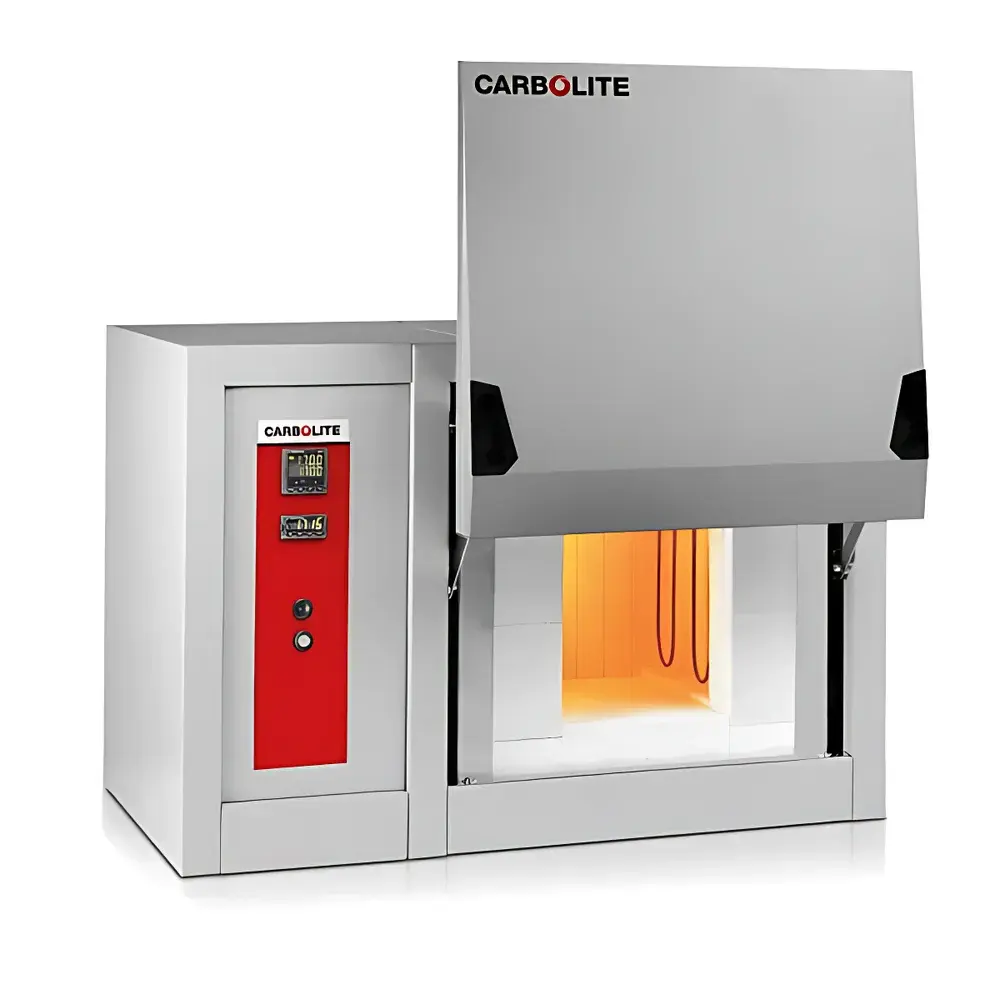
Carbolite Gero HTF 18/27/3216P1 High-Temperature Box Muffle Furnace
| Brand | Carbolite Gero |
|---|---|
| Origin | United Kingdom |
| Model | HTF 18/27/3216P1 |
| Type | Box-Type Muffle Furnace |
| Max Operating Temperature | 1800 °C |
| Temperature Uniformity | ±5 °C |
| Max Power Consumption | 4050 W |
| Ramp Time to Max Temperature | 50 min |
| Heating Element | Silicon Molybdenum (MoSi₂) Rods |
| Internal Chamber Dimensions | 158 × 150 × 225 mm (L×W×H) |
| Control System | 8-Stage PID Programmable Controller with Over-Temperature Protection |
| Communication Interface | RS232 (standard on selected variants) |
| Insulation | Low-Thermal-Mass Refractory Brick + Lightweight Ceramic Fiber |
Overview
The Carbolite Gero HTF 18/27/3216P1 is a high-precision, vertically opening box-type muffle furnace engineered for demanding thermal processing applications in materials science, metallurgy, ceramics, and advanced research laboratories. Designed around a robust MoSi₂ heating element architecture, it delivers stable, repeatable operation up to 1800 °C — a critical capability for sintering refractory oxides, ashing high-purity samples, heat-treating specialty alloys, and conducting controlled thermal decomposition studies. Its muffle configuration isolates the sample chamber from combustion by-products and heating element volatilization, ensuring contaminant-free thermal environments essential for ASTM E119, ISO 5659-2, and USP compliant testing. The furnace employs dual-layer insulation — dense refractory brick lining combined with low-conductivity ceramic fiber — to minimize thermal lag, improve energy efficiency, and maintain external surface temperatures below 60 °C during continuous operation at maximum setpoint.
Key Features
- Vertical lift door mechanism engineered to position the hot face away from operator access zone, reducing radiant exposure and enhancing ergonomic safety during loading/unloading.
- MoSi₂ heating elements mounted in protective ceramic sheaths provide exceptional oxidation resistance and long service life at ultra-high temperatures, with minimal resistance drift over time.
- 8-segment programmable PID controller with independent ramp/soak profiles, enabling precise thermal cycling protocols required for TGA-correlative studies, phase transformation analysis, and annealing optimization.
- Integrated over-temperature cut-off (OTC) circuitry with redundant thermocouple monitoring (Type S or B optional), compliant with IEC 61000-6-2 and EN 60519-2 safety standards for industrial heating equipment.
- Forced-air cooling system embedded within the outer casing maintains safe exterior skin temperature and extends electronic component longevity under prolonged duty cycles.
- RS232 serial interface as standard on designated variants supports bidirectional communication with LabVIEW, MATLAB, or custom SCADA systems for automated data logging and remote parameter adjustment.
Sample Compatibility & Compliance
The HTF 18/27/3216P1 accommodates crucibles and sample holders up to 158 mm (L) × 150 mm (W) × 225 mm (H), supporting standard alumina, zirconia, and graphite ware. Its sealed muffle design prevents cross-contamination between successive runs — a prerequisite for GLP-compliant residue analysis and ISO/IEC 17025 accredited calibration labs. The furnace meets CE marking requirements under the Machinery Directive 2006/42/EC and Electromagnetic Compatibility Directive 2014/30/EU. Optional upgrades include Type B thermocouples for traceable calibration to NIST standards and audit-trail-enabled controllers aligned with FDA 21 CFR Part 11 data integrity guidelines.
Software & Data Management
While the base unit operates via front-panel interface, the RS232 port enables integration with Carbolite Gero’s optional Thermocouple Logger Software (v4.2+) for real-time temperature profiling, CSV export, and alarm-triggered event capture. When paired with third-party DAQ hardware, the furnace supports synchronized multi-channel acquisition — e.g., coupling thermocouple readings with mass loss data from an adjacent microbalance. All program logs, setpoint changes, and fault events are timestamped and stored locally for post-run forensic review — critical for ISO 9001 internal audits and regulatory submissions.
Applications
- Sintering of silicon carbide (SiC), tungsten carbide (WC), and yttria-stabilized zirconia (YSZ) compacts under inert or air atmospheres.
- Ash content determination per AOAC 942.05 and EPA Method 1631E for environmental solid waste matrices.
- Thermal gravimetric analysis (TGA) pre-conditioning of catalyst supports and battery electrode materials.
- Heat treatment of dental porcelain, investment casting molds, and aerospace-grade superalloys requiring tight thermal uniformity (±3 °C across load zone).
- Calibration of high-temperature reference standards used in national metrology institutes.
FAQ
What atmosphere options are supported inside the HTF chamber?
The furnace is configured for ambient air operation; however, it can be adapted for inert gas purging (N₂, Ar) using optional flanged inlet/outlet ports and flowmeter integration.
Is the temperature uniformity specification validated across the full working volume?
Yes — uniformity of ±5 °C is verified at three axial points (center, top corner, bottom corner) per ASTM E220-21 Annex A2 using calibrated Type S thermocouples.
Can the 8-stage program be expanded to more steps?
Via optional firmware upgrade and 20-segment controller retrofit (part no. HTF-PROG20), supporting complex multi-ramp sequences with dwell times ranging from 1 minute to 99 hours.
Does the unit comply with laboratory electrical safety standards?
It conforms to IEC 61010-1:2010 for electrical safety in laboratory equipment, including dielectric strength testing, grounding continuity verification, and creepage/clearance validation.
What maintenance intervals are recommended for MoSi₂ elements?
Under typical intermittent use (≤4 hrs/day at 1700–1800 °C), elements retain nominal resistance for ≥2000 operating hours; annual visual inspection and resistance baseline measurement are advised.



