
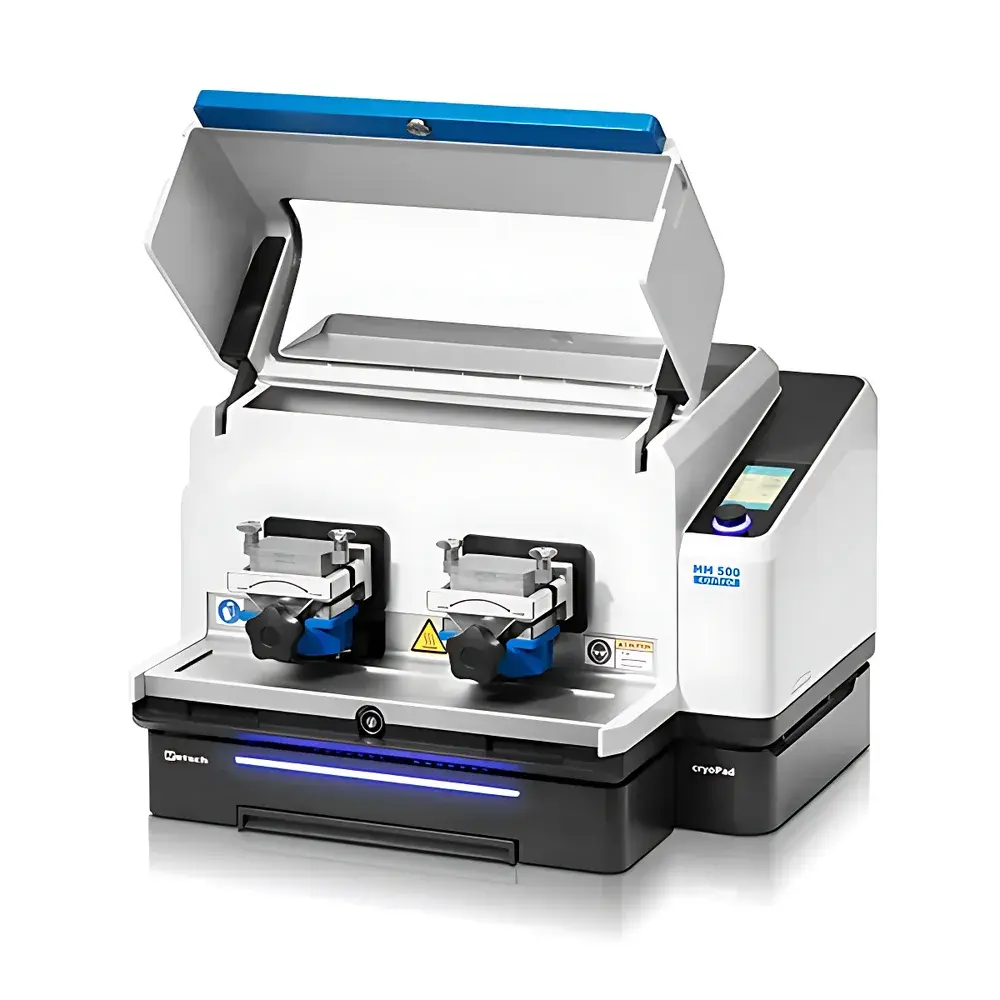
Retsch MM500 control High-Energy Temperature-Controlled Planetary Ball Mill
| Brand | Retsch |
|---|---|
| Origin | Germany |
| Model | MM500 control |
| Instrument Type | Planetary Ball Mill |
| Sample Compatibility | Cryogenic, Dry & Wet Grinding |
| Maximum Feed Size | ≤ 10 mm |
| Final Particle Size | down to ~0.1 µm |
| Batch Volume Options | 50 / 80 / 125 mL |
| Temperature Control Range | –100 °C to +100 °C |
| Operating Frequency | up to 30 Hz |
| Cooling/Heating Interface | Integrated Heat-Exchange Platform with External Chiller or Liquid Nitrogen (cryoPad optional) |
Overview
The Retsch MM500 control is a high-energy planetary ball mill engineered for precise, real-time temperature control during mechanical comminution. Unlike conventional ball mills, the MM500 control integrates a patented heat-exchange platform between the grinding jar and drive unit—enabling active thermal management across an unprecedented range of –100 °C to +100 °C. This architecture supports cryogenic grinding of thermolabile biomolecules, polymers, and pharmaceuticals; controlled exothermic reactions during mechanochemical synthesis; and reproducible wet or dry milling under stabilized thermal conditions. Its planetary motion generates high-frequency impact and shear forces (up to 30 Hz), ensuring efficient particle size reduction through combined collision and friction mechanisms—critical for achieving sub-micron final particle sizes (~0.1 µm) in batch volumes up to 125 mL.
Key Features
- Real-time temperature monitoring and regulation via integrated heat-exchange platform—displaying actual platform temperature synchronized with grinding dynamics
- Dual thermal interface options: (a) liquid nitrogen cooling with cryoPad base for stable sub-zero operation (–100 °C to 0 °C); (b) external chiller or tap-water circulation for broad-range heating/cooling (–100 °C to +100 °C) without cryoPad
- Intuitive 7-inch capacitive touchscreen interface supporting SOP storage, multi-step program sequencing, and audit-ready parameter logging
- Ergonomic jar clamping system with screw-tightened platform—designed for secure handling of 50, 80, and 125 mL grinding jars under high-frequency operation
- Acoustically optimized housing delivering low-noise performance (<65 dB(A)) suitable for shared laboratory environments
- Cryogenic workflow continuity: rapid jar cooldown pre-grinding and pressure-relief design minimizing post-grinding condensation and thermal recovery time
Sample Compatibility & Compliance
The MM500 control accommodates diverse sample classes—including biological tissues, pharmaceutical actives, metal alloys, ceramics, and reactive organometallic precursors—under strictly controlled thermal regimes. Its ability to maintain cryogenic integrity during extended milling supports ISO 13320-compliant laser diffraction particle sizing preparation and ASTM E2904-22 protocols for nanomaterial dispersion analysis. When operated with validated SOPs and timestamped temperature logs, the system aligns with GLP and GMP documentation requirements. Optional integration with external chillers certified to DIN EN 61000-6-3 (EMC) and IEC 61010-1 (safety) ensures regulatory compatibility in QC laboratories subject to FDA 21 CFR Part 11 data integrity standards.
Software & Data Management
The embedded control software records all operational parameters—including setpoint vs. actual temperature profiles, frequency ramping sequences, runtime, and jar identification—in CSV-compatible format. Each grinding cycle generates a timestamped metadata file containing operator ID, program name, thermal deviation alerts, and hardware status flags. Data export supports traceability in LIMS-integrated workflows and satisfies ALCOA+ principles (Attributable, Legible, Contemporaneous, Original, Accurate). No cloud dependency: all data reside locally on the device’s industrial-grade SSD with optional USB backup. Firmware updates are delivered via encrypted firmware packages verified against Retsch’s digital signature—ensuring integrity and version control in regulated environments.
Applications
- Cryogenic milling of RNA/DNA extraction buffers and protease-sensitive proteins without denaturation
- Mechanochemical synthesis of MOFs and co-crystals under controlled exothermic conditions
- Production of nanostructured battery cathode materials (e.g., LiCoO₂, NMC) with minimized phase segregation
- Homogenization of heterogeneous polymer blends prior to DSC or TGA analysis
- Preparation of ultra-fine reference standards for SEM-EDS calibration and XRD crystallite size analysis
- Grinding of heat-sensitive APIs (e.g., peptides, monoclonal antibody aggregates) for dissolution testing per USP
FAQ
What temperature accuracy is achieved during cryogenic grinding with cryoPad?
The cryoPad system maintains ±1.5 °C stability at –80 °C over 30-minute continuous operation, verified via calibrated Pt100 sensors embedded in the heat-exchange platform.
Can the MM500 control be integrated into automated lab systems?
Yes—RS232 and Ethernet interfaces support Modbus TCP and ASCII command protocols for scheduling via third-party LIMS or robotic sample handlers.
Is validation documentation available for GMP environments?
Retsch provides IQ/OQ templates compliant with Annex 15 and ASTM E2500-21, including temperature mapping reports for all jar volumes and thermal ramp verification protocols.
How does the heat-exchange platform avoid condensation inside sealed grinding jars?
By decoupling jar wall temperature from ambient dew point through dynamic thermal buffering, and by enabling controlled pressure equalization post-grinding via integrated venting valves.
What jar materials are compatible with the full –100 °C to +100 °C range?
Stainless steel (316L), hardened steel, tungsten carbide, and PTFE-lined jars—all qualified per EN 10088-1 and tested for thermal shock resistance at ≥50 cycles.



